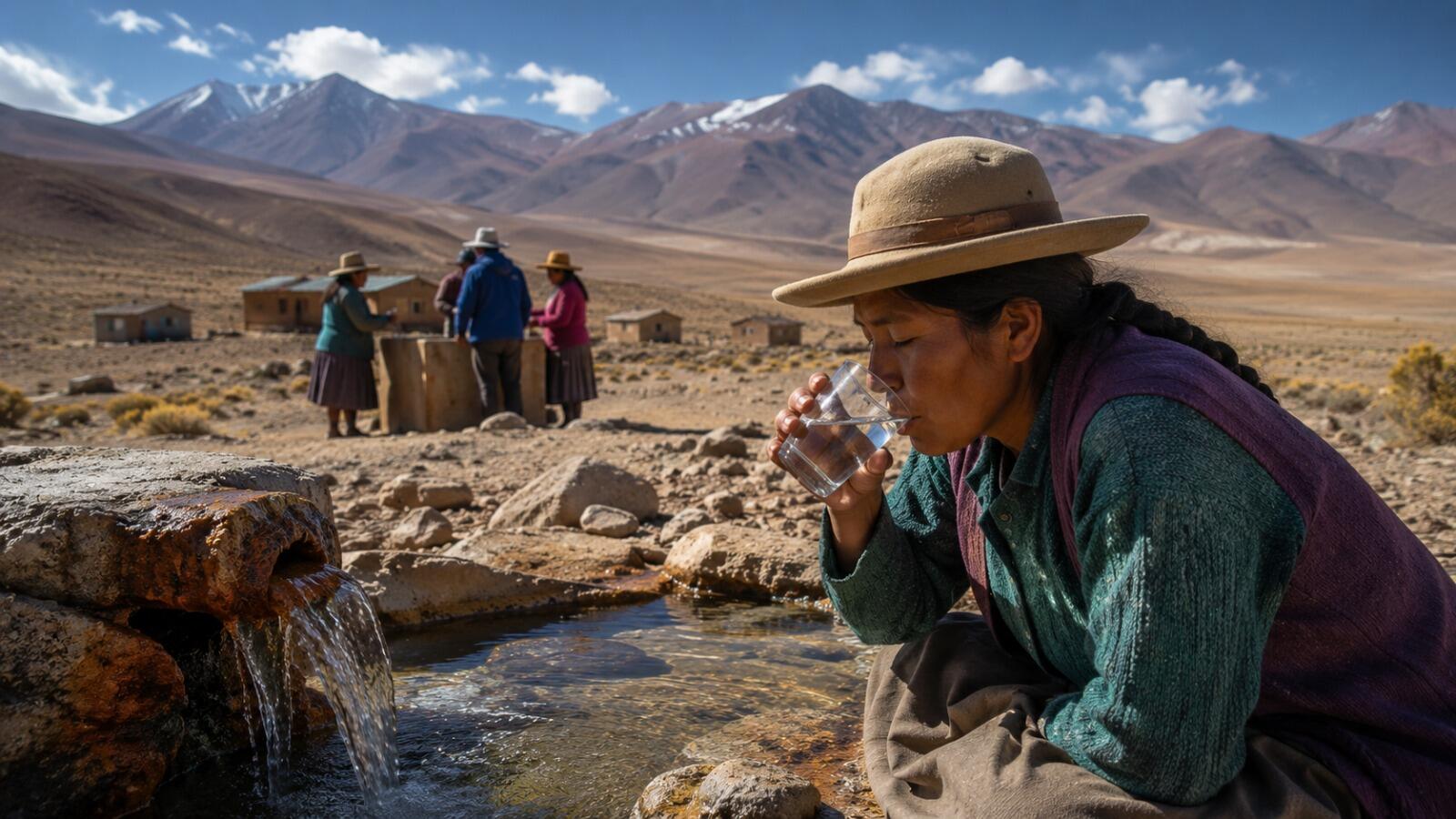
For thousands of years, indigenous populations in Chile's Atacama Desert survived by drinking groundwater laced with natural arsenic concentrations exceeding 1,000 micrograms per liter, a hundred times higher than modern safety thresholds established by the World Health Organization. This prolonged environmental pressure triggered a rare instance of human genetic adaptation. Natural selection favored individuals carrying specific variants of the AS3MT gene, which codes for an enzyme that accelerates the methylation and excretion of inorganic arsenic before it can accumulate to lethal or carcinogenic levels.
The Atacama is an environment defined by stark extremes. Sandwiched between the Pacific Ocean and the towering Andes Mountains, portions of this hyperarid plateau have never recorded rainfall. Yet human groups settled these river valleys roughly 7,000 years ago. They built societies around the only water sources available. Unbeknownst to them, millennia of volcanic activity in the Andes had leached massive quantities of toxic metalloids directly into the subterranean aquifers and surface streams.
The Toxic Legacy of Andean Geology
Geological weathering is relentless. Rain and snowmelt filter through volcanic rock formations, dissolving arsenic and carrying it down into desert basins like Quebrada Camarones and the Loa River valley.
For outsiders, acute or chronic consumption of this water brings disaster. Clinical toxicology points to a grim inventory of outcomes: skin lesions, severe hyperpigmentation, peripheral neuropathy, vascular disease, and cancers of the bladder, kidney, and lung. Industrial quantities of arsenic disrupt cellular respiration by substituting for phosphate in key biochemical reactions, halting adenosine triphosphate production and damaging DNA repair pathways.
Yet generations of local inhabitants maintained stable communities without the catastrophic epidemiological collapses that modern toxicological models predict. This anomaly baffled anthropologists and geneticists for decades. The paradox demanded an explanation beyond mere cultural workarounds or low-volume water consumption.
Decoding the AS3MT Mutation
The answer lies deep within the human genome. Researchers examining populations across the Andean highlands and northern Chile discovered that long-term exposure acted as an evolutionary sieve.
When inorganic arsenic enters the human body, Phase II metabolic enzymes transform the poison through methylation, converting it into mono- and dimethylated metabolites that are subsequently cleared through urine. The efficiency of this process depends heavily on the AS3MT gene, located on chromosome 10.
Genetic sequencing revealed a striking divergence. In populations residing in Quebrada Camarones for millennia, a specific protective genetic signature known as the CTTA haplotype appeared in roughly 68 percent of individuals. By contrast, populations in southern Chile with no history of high arsenic exposure displayed this protective variant at rates under 10 percent.
Natural selection systematically purged vulnerable genotypes. Individuals carrying less efficient metabolic variants suffered higher rates of early mortality, reproductive failure, and disease, reducing their chances of passing on their traits. Those born with efficient AS3MT configurations rapidly methylated and excreted the poison, neutralizing the threat before cellular damage accumulated.
The Modern Public Health Paradox
Evolutionary adaptation does not mean immunity. While genetic variants offer a shield against historical exposure levels, modern industrial activities and municipal water systems introduce complex variables that complicate this narrative.
When modern infrastructure brought unchecked water supplies with elevated arsenic concentrations to urban centers like Antofagasta during the mid-twentieth century, even populations with indigenous ancestry experienced spikes in cancer rates before treatment plants were finally installed. Genetics mitigate risk; they do not erase it. Chronic ingestion still places a heavy metabolic tax on cellular systems.
Furthermore, medical science must grapple with the downstream health consequences hidden in aging populations. Chronic exposure, even when buffered by efficient methylation, interacts dynamically with lifestyle factors, nutritional status, and genetic predispositions to cardiovascular disease.
The story of the Atacama Desert is a testament to the resilience of human biology under siege from the earth itself. Adaptation is written not just in stone and artifacts, but in the microscopic architecture of human DNA. Survival required reshaping the machinery of life to process the very elements threatening to destroy it.