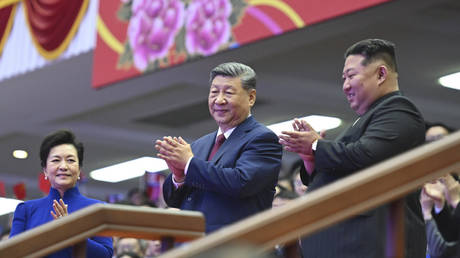
The assumption dominating Western defense circles for the last decade has collapsed. For years, the official line on North Korea was that its nuclear arsenal existed primarily as a survival mechanism, a desperate shield for a hermit kingdom terrified of regime change. Beijing, the narrative went, tolerated this rogue behavior only because it feared a unified, pro-Western Korea on its border.
That theory is dead. What is actually happening along the Yalu River is the construction of a permanent, offensive military alliance designed to split Pacific command structures. China is no longer treating Kim Jong Un’s nuclear program as an embarrassing liability, but as a sub-contracted forward battery.
The Sub-Contracted Arsenal
Pyongyang has transitioned from an isolated pariah into a critical node of a larger geopolitical machine. This is not a marriage of ideological affection. It is a cold, transactional arrangement. China supplies the economic floor that keeps the Kim regime from collapsing, providing oil, grain, and sanctions evasion pipelines. In return, North Korea provides chronic, calibrated instability that forces the United States and its allies to split their attention, resources, and naval assets.
Consider the geography. Every time a US carrier strike group positions itself in the Sea of Japan to deter a North Korean missile test, it is a carrier group that cannot easily patrol the Taiwan Strait. This distraction is deliberate. Beijing acts as the diplomatic shield in the United Nations Security Council, consistently blocking new sanctions, while North Korea acts as the provocateur.
This dynamic changed fundamentally over the last twenty-four months. The war in Ukraine created a secondary pipeline where North Korean artillery ammunition and ballistic missiles flow to Moscow in exchange for Russian telemetry data, satellite tech, and submarine designs. China watches this happen with quiet approval. The triangulation works perfectly for Beijing. Russia gets the raw materials to sustain its war of attrition, North Korea gets advanced military blueprints it could never develop on its own, and China keeps its hands clean while watching Western ammunition stockpiles deplete.
The Infrastructure of Integration
To see where this is going, look at the physical border. Satellite imagery shows a massive expansion of rail yards, automated cargo transfer stations, and bridge infrastructure linking Dandong with Sinuiju. This is not the architecture of a country trying to distance itself from a volatile neighbor. It is the footprint of a deep, structural economic integration meant to survive long-term Western trade restrictions.
The financial plumbing undergirding this relationship has also migrated out of reach. Western intelligence agencies spent years tracking North Korean illicit finance through traditional banking networks, freezing assets where they could. Today, the trade happens via state-sanctioned cryptocurrency laundering networks operating through Chinese exchanges, and direct, over-the-counter commodity swaps.
A standard transaction no longer requires dollars or euros. A shipment of North Korean refined zinc or coal unloads at a port in Liaoning province. In exchange, a convoy of trucks crosses the border carrying dual-use CNC machines, specialized chemicals for rocket propellant, and semiconductor components. The paper trail does not exist.
The Fallacy of the Containment Model
The current Western response relies heavily on a policy of enhanced deterrence, specifically pushing Washington, Seoul, and Tokyo into a tighter security triad. Joint naval drills have increased, and intelligence-sharing protocols are faster than they have ever been.
But this strategy misjudges the adversary's calculus. Enhanced deterrence assumes the other side wants to avoid a conflict at all costs. For Kim Jong Un, backed by Chinese industrial muscle and Russian technical data, the equation looks different. He sees a West burdened by domestic political division, a fractured defense industrial base, and multiple theater commitments across Europe and the Middle East.
The strategy also hits a wall when it encounters South Korean domestic politics. The consensus in Seoul is fraying. A growing percentage of the South Korean foreign policy establishment openly questions whether the US nuclear umbrella remains credible. If Pyongyang possesses multiple, survivable intercontinental ballistic missiles capable of hitting American cities, would a US president truly sacrifice Los Angeles to save Seoul?
This doubt drives a quiet but persistent movement within South Korea to develop its own independent nuclear deterrent. If Seoul takes that path, the regional security architecture fractures completely, which is exactly the kind of long-term chaos Beijing wants to trigger.
The Dual-Front Dilemma
The military reality is that the Pentagon can no longer plan for an isolated conflict on the Korean Peninsula. Any scenario involving a North Korean move against the South must now be calculated as a coordinated action with China.
If Beijing decides to move on Taiwan, the most efficient way to secure its northern flank is to instruct Pyongyang to create a maximum military crisis on the DMZ. This forces the US to freeze its forces in South Korea and Japan to prevent a total collapse of the peninsula, effectively taking those assets off the board for the defense of Taiwan.
+-------------------------------------------------------------------+
|                     THE PACIFIC SQUEEZE                           |
+-------------------------------------------------------------------+
|                                                                   |
|   [ CHINESE STRATEGIC FOCUS ]         [ NORTH KOREAN ACTION ]     |
|   Primary Target: Taiwan              Primary Role: Distraction   |
|   Action: Naval blockade / Invasion   Action: Missile tests / DMZ |
|                                               mobilization        |
|                                                                   |
|                                 |                                 |
|                                 v                                 |
|                                                                   |
|                     [ UNITED STATES DILEMMA ]                     |
|            Split Assets: Must defend both fronts simultaneously   |
|            Result: Diluted force projection in Taiwan Strait      |
|                                                                   |
+-------------------------------------------------------------------+
The industrial capacity mismatch makes this dilemma worse. The United States maintains qualitative military superiority, but its manufacturing base is slow and fragile. China possesses the industrial capacity to build ships, missiles, and drones at a speed the West cannot match in peacetime. Adding North Korea's massive, low-tech military factories into that supply chain creates a persistent numbers problem for allied planners.
Shifting the Leverage Point
Stopping this dynamic requires abandoning the fiction that Beijing can be persuaded to help denuclearize North Korea. Western diplomats spent two decades begging Chinese officials to enforce sanctions, treating them as partners in regional stability. It was a diplomatic wild goose chase.
The only way to alter Beijing’s behavior is to make its defense of Pyongyang incredibly expensive to its own economic ambitions. This means moving past targeted sanctions against individual North Korean front companies and moving toward systemic secondary sanctions against the major Chinese state-owned banks and shipping entities that process the trade.
If a major Chinese bank faces a choice between maintaining access to the global US dollar clearing system or helping North Korea buy rocket components, it will choose the dollar every time. Up until now, Washington has hesitated to pull this trigger, fearing the collateral economic damage to global markets. That hesitation is read as weakness in Beijing.
The Western policy apparatus remains stuck in a loop of issuing strongly worded statements and conducting symbolic military exercises while its adversaries build a permanent, integrated fortress across East Asia. The time for treating North Korea as an isolated problem run by an eccentric dictator has passed. Kim Jong Un is a critical cog in an aggressive, revisionist alliance, and he is playing his part exactly as scripted.