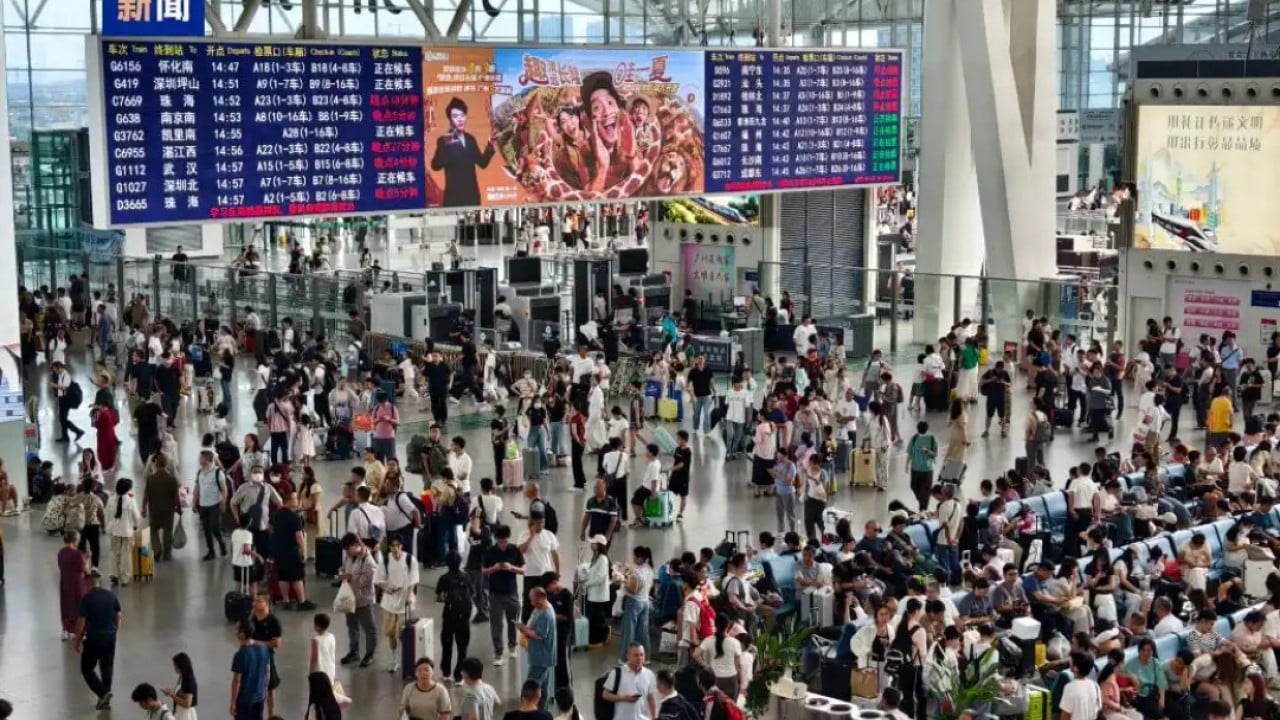
When Typhoon Noul bears down on the Pearl River Delta, the economic engine of southern China does not merely slow down; it halts completely. As of late July 2026, authorities have ordered the total suspension of passenger rail services across Guangdong province, while dozens of airports brace for operational gridlock. For a region that treats hyper-efficiency as a baseline, halting high-speed rail networks and grounding flights out of hubs like Shenzhen Bao'an and Guangzhou Baiyun represents a staggering logistical fracture.
Standard meteorological reports frame these closures as simple safety precautions against a severe tropical storm packing sustained winds near 130 kilometers per hour. Yet, looking past the surface-level orange alerts and emergency declarations reveals a complex cascade of supply chain vulnerabilities, infrastructural stress tests, and financial exposure that extends far beyond a single weekend of bad weather.
The Anatomy of a Total Regional Shutdown
When China Railway Guangzhou Group implements a blanket suspension across both high-speed and conventional lines, the decision reflects a fundamental shift in risk management philosophy. Modern high-speed rail operating at 300 kilometers per hour or greater requires absolute track integrity and precise electrical stability. Crosswinds exceeding critical thresholds can destabilize rolling stock, making proactive shutdowns standard operating procedure rather than reactive panic.
However, the ripple effects are immediate and severe. Shenzhen acts as the hardware capital of the world and a primary logistics artery for global electronics manufacturing. When cargo movement freezes alongside passenger lines, component delivery schedules face instant compression.
[Typhoon Noul Approach]
       │
       ▼
[Guangdong Rail & Air Suspension]
       │
       ├─► Manufacturing Component Delays
       ├─► Port and Maritime Vessel Evacuations
       └─► Stranded Commuters & Commercial Backlogs
Aviation data providers tracking the storm indicate that upwards of 36 airports face varying degrees of disruption as Noul tracks toward the eastern Guangdong coast. Major facilities including Hong Kong International, Shenzhen Bao'an, and Zhuhai Jinwan activated severe weather protocols simultaneously. Ground stops do not just inconvenience travelers; they throw global airline crew scheduling into disarray, forcing repositioning flights to wait out the squalls in distant hangars.
The Cost of Hyper-Density Infrastructure
Southern China's urbanization model relies on seamless integration between rapid transit and dense populations. Millions of commuters cross municipal boundaries daily for work within the Greater Bay Area. By cutting off rail links and grounding flights, Typhoon Noul exposes the inherent fragility of hyper-connected economic zones.
Consider the maritime sector running parallel to these rail networks. Thousands of offshore workers, including crews on oil platforms in the South China Sea, completed mandatory evacuations alongside the suspension of regional ferry routes. Emergency rescue vessels, tugboats, and pollution cleanup ships were staged ahead of time, illustrating an elaborate, highly rehearsed disaster response mechanism.
Yet, rehearsal does not equal immunity. Every hour that Shenzhen and Guangzhou remain cut off from neighboring provinces translates to millions of dollars in lost productivity. Small-to-medium enterprises relying on just-in-time delivery models absorb the brunt of the shock. Warehouses fill to capacity with outbound goods that cannot leave loading docks, while assembly lines face potential starvation for raw materials if the transport freeze extends past the initial 48-hour window.
Navigating the Post-Landfall Uncertainty
As Noul prepares to make its final approach near coastal hubs like Huizhou and Shanwei, forecasters note that the storm's exact inland trajectory remains difficult to map with absolute precision. This uncertainty forces transport authorities to err heavily on the side of caution. Reopening a rail network or clearing an airspace requires rigorous track inspection for debris, mudslides, and structural washouts before normal speeds can resume.
Passengers stranded across Shenzhen stations are advised to monitor official channels like the China Railway 12306 application, but digital updates offer little immediate comfort to those caught in the middle of a massive logistical standstill. The real test for southern China's transport administrators will not be the shutdown itself—which has evolved into a well-oiled routine of emergency response—but the speed and safety of the recovery phase once the storm system degrades over land.
The next forty-eight hours will determine whether this multi-modal transport freeze remains a temporary inconvenience or hardens into a prolonged bottleneck for regional commerce.