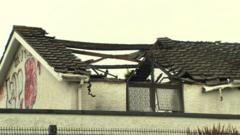
Arson attacks driven by racial animus are destroying minority-owned small businesses across urban centers, forcing owners to face a double crisis of financial ruin and physical terror. While local authorities frequently treat these incidents as isolated property crimes, data shows a systemic pattern of targeted destruction that exploits gaps in municipal surveillance and insurance coverage. For independent entrepreneurs, a single fire does not just burn down a storefront. It permanently wipes out generational wealth and upends community stability.
Understanding the mechanisms behind these attacks requires looking past the immediate wreckage to examine the intersection of hate crime trends, commercial real estate vulnerabilities, and insurance failures.
The Anatomy of a Targeted Attack
Most commercial arsons occur under the cover of darkness, but hate-motivated blazes carry specific operational markers. Perpetrators usually target highly visible neighborhood fixtures—such as grocery stores, restaurants, or clothing boutiques—that serve as cultural hubs for specific immigrant or racial communities.
Federal hate crime statistics underscore the scale of the issue. According to FBI data tracking bias-motivated incidents, property damage and arson directed at minority-owned establishments have seen sustained peaks over the last five years. Anti-Asian, anti-Black, and anti-Hispanic bias accounts for the vast majority of these business-targeted offenses.
The physical execution of these crimes relies heavily on accelerants like gasoline or kerosene, thrown through broken storefront windows. This method ensures maximum structural damage within minutes, often triggering total roof collapses before local fire departments can arrive on the scene. For the owner, the devastation is immediate.
The False Safety Net of Commercial Insurance
Many observers assume that insurance payouts quickly make business owners whole after a fire. This is a myth. The reality of commercial property insurance leaves many minority entrepreneurs holding the bag after a bias-motivated attack.
Standard commercial policies cover fire damage, but they contain strict clauses regarding total valuation and business interruption.
- Underinsurance Traps: Inflation and rising construction costs mean that policies written even two years ago rarely cover the actual cost of rebuilding a structure to modern building codes.
- The Investigation Delay: Insurance adjusters scrutinize arson cases with extreme suspicion. Companies routinely delay payouts for six to twelve months while conducting independent fraud investigations to ensure the owner did not set the fire for insurance money.
- Premium Spikes: If a business is targeted in a hate crime, the surrounding area is immediately flagged as a high-risk zone. Surviving businesses in the neighborhood face premium increases of 40% to 100%, pricing out thin-margin operations.
A hypothetical example illustrates the math. Consider a independent bodega generating $400,000 in annual revenue with a 10% profit margin. A total-loss fire inflicts $300,000 in property damage and $150,000 in lost inventory. Even with insurance covering 80% of the loss after a six-month delay, the owner must find $90,000 in immediate cash to cover clean-up fees, structural stabilization, and continuous vendor debts. Most independent operations carry less than 30 days of cash reserves. They simply go under.
Why Municipal Response Systems Fail
Local police departments face structural hurdles when investigating racially motivated arson. Proving intent is notoriously difficult in property crimes where the physical evidence is literally reduced to ash.
Without explicit graffiti left at the scene or digital footprints like social media threats, detectives struggle to classify a fire as a hate crime. Consequently, prosecutors often opt for simpler, lesser charges like third-degree arson or criminal mischief to secure a quick conviction. This misclassification dilutes public data, hiding the true scope of racial targeting from federal tracking systems and preventing neighborhoods from receiving targeted federal security grants.
Municipal surveillance infrastructure also lags behind in independent commercial corridors. While downtown financial districts enjoy dense networks of high-definition security cameras, working-class commercial strips often rely on broken streetlights and outdated, low-resolution cameras owned by individual shopkeepers. Perpetrators exploit these blind spots with ease.
The Rippling Economic Shadow
When a cornerstone business burns down, the damage radiates outward through the entire local economy. Independent shops do not exist in a vacuum; they form tight supply chains with local wholesalers, delivery drivers, and specialized contractors.
The Food Desert Effect
Many targeted businesses are independent grocery stores operating in neighborhoods abandoned by major national chains. A single arson attack can instantly turn a stable neighborhood into a food desert, forcing elderly residents and families without vehicles to travel miles for basic nutritional needs.
Property Devaluation
A charred, boarded-up building acts as a visual anchor of decay. Nearby foot traffic drops by an average of 20% to 30% in the months following a major commercial fire, depressing the sales of adjacent shops and inviting secondary crimes like vandalism and illegal dumping.
Capital Flight
Banks and traditional lenders monitor neighborhood crime data closely. A string of unresolved arsons or hate incidents causes financial institutions to restrict commercial lending or demand higher interest rates for new businesses looking to open in the area, freezing economic mobility.
Real Security Demands Structural Changes
Chamber of commerce meetings often produce empty platitudes about community resilience, but sentimentality cannot rebuild a scorched concrete foundation. Protecting vulnerable business owners requires concrete policy shifts at the state and local levels.
Cities must establish immediate emergency relief funds specifically earmarked for victims of hate-motivated property crimes to bypass the months-long insurance gridlock. These funds should cover immediate environmental cleanup and structural hoarding within 48 hours of an incident, preventing the rapid onset of neighborhood blight.
Security infrastructure needs a decentralized overhaul. Instead of relying on passive police patrols, municipal grants should fund the installation of high-output LED lighting and cloud-connected, commercial-grade security networks across vulnerable business corridors. Business owners need the tools to harden their properties before the match is struck, turning soft targets into high-risk environments for bad actors.
Relying on the resilience of heartbroken owners is an unsustainable strategy that guarantees the slow death of diverse commercial districts.