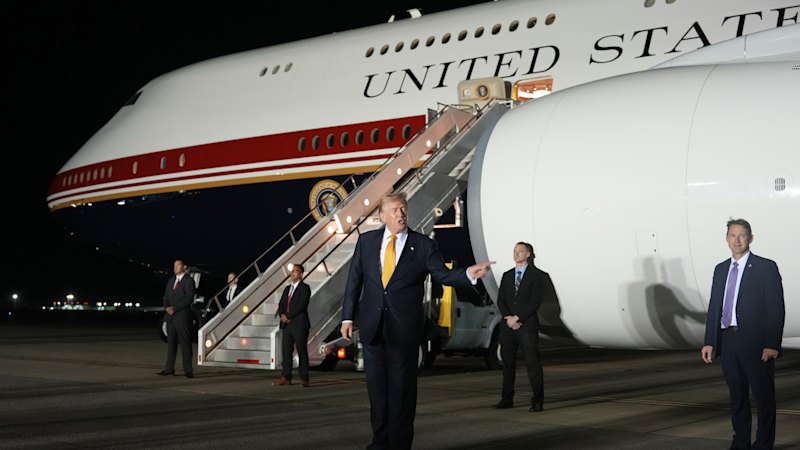
When President Donald Trump departed the NATO summit in Ankara, Turkey, an urgent security directive forced a sudden pivot. Intelligence reports of a credible threat orchestrated by Iranian proxy forces targeting the commander-in-chief triggered an emergency aircraft swap. Instead of flying home on the newly acquired Boeing 747-8 gifted by Qatar, the president was rushed onto a decades-old legacy VC-25A aircraft equipped with classified defensive countermeasures.
This high-level logistical scramble exposed vulnerabilities in executive transport. It also brought intense scrutiny to a multi-million-dollar aviation transition that bypassed standard military procurement checks.
The Anatomy of an Emergency Swap
Intelligence agencies detected a specific plot involving a potential missile attack targeting the presidential flight. While the threat itself targeted the president rather than the airframe, the physical realities of the aircraft dictated the tactical response.
Trump had flown into Ankara aboard the newly inducted Boeing 747-8, a luxurious airframe accepted from the Qatari government. The aircraft was intended to serve as a transitional bridge before permanent replacements arrive. Yet, the rapid integration timeline meant the jet lacked the comprehensive defensive architecture built into older presidential flagships.
The Secret Service intervened upon receiving the intelligence. The older Air Force One models feature sophisticated countermeasures, including directional infrared countermeasures, missile-blinding laser systems, and advanced electronic misdirection technology designed to confuse incoming munitions. The Qatari-donated 747-8 lacked equivalent defensive deployments at the time of the flight.
The Procurement Paradox
Operating a presidential transport requires more than comfortable cabins and long-range fuel capacity. The federal government maintains strict military specifications for executive aircraft to ensure survival in hostile airspace.
The transition to the Qatari-gifted airframe bypassed normal, grueling defense testing cycles. Securing an aircraft donated by a foreign government introduced administrative pressures to field the asset quickly.
That haste created a dangerous capability gap. Military aviation experts note that retrofitting a commercial widebody jet into a secure airborne command post requires years of structural modifications. Shielding fly-by-wire systems against electromagnetic pulses, installing secure military communication suites, and integrating counter-missile systems cannot be rushed without creating vulnerabilities.
When confronted by reporters about the abrupt change, the administration attempted to downplay the security urgency. Explanations ranged from flying the legacy aircraft "for old time's sake" to leaving the newer jet behind to honor military personnel. Behind closed doors, however, the reality was stark. The risk profile of operating an under-defended aircraft through a volatile regional airspace corridor proved unacceptable.
Geopolitical Fallout and Regional Tensions
The incident unfolded against a backdrop of escalating hostilities between Washington and Tehran. Direct threats against American leadership have elevated security postures across the board. Intelligence sharing between allied nations, including critical alerts flagged by foreign intelligence services, continues to shape executive travel safety.
Operating in proximity to Middle Eastern airspace during a period of open kinetic friction magnifies every threat vector. Proxy networks aligned with Iran maintain access to sophisticated tactical weaponry capable of reaching high-altitude flight paths if a window of vulnerability opens during takeoff or landing phases.
The decision to swap planes in Turkey, fly to the United Kingdom on the legacy jet, and subsequently manage the public relations fallout demonstrates the friction between political optics and hard security demands. The White House has since returned the Qatari-donated aircraft to maintenance facilities for additional defensive installations.
Executive aviation exists at the intersection of extreme luxury and absolute paranoia. When the margins vanish, the glamour of a newly gifted flagship yields to the cold engineering of a 35-year-old military transport. The episode in Ankara underscores that against targeted state-level threats, cosmetic upgrades offer no substitute for proven survival systems.