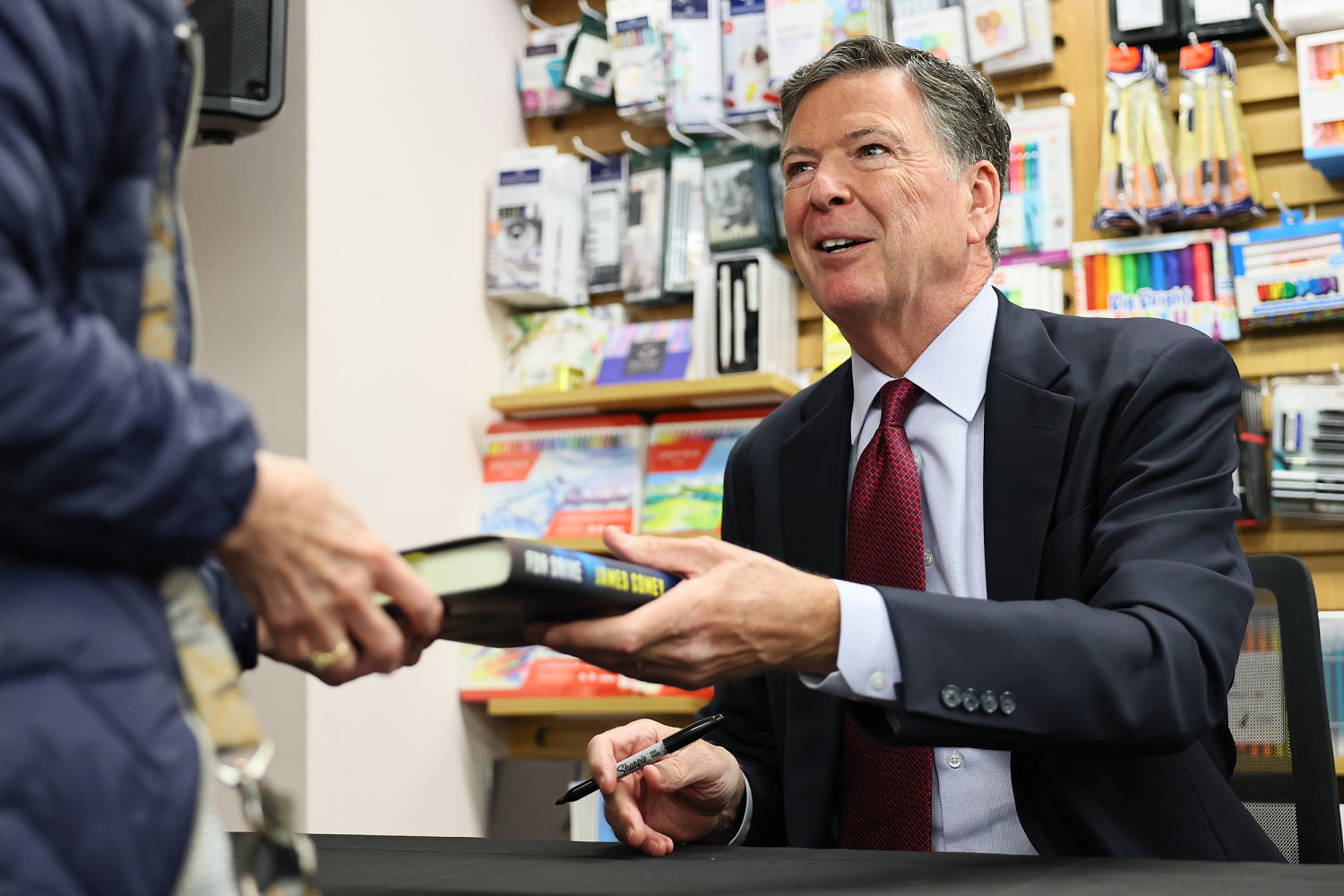
Federal prosecutors are now using former FBI Director James Comey's own crime thriller novel against him, arguing that an Instagram photo of seashells spelling out the numbers "86 47" was an intentional threat and a promotional stunt designed to simulate the plot of his fiction. In court filings defending their indictment, the Justice Department pointed to Comey's book, FDR Drive, claiming its themes of public messaging and stochastic violence provide the underlying motive for his May 2025 social media post.
The unorthodox prosecution has turned a beachside photo into a constitutional battleground. It forces observers to ask how far a government can go when mining a writer's imagination to prove criminal intent in a real-world court.
The Anatomy of a Beachside Indictment
The core of the government's case rests on a simple image posted to Instagram. Comey shared a photo of seashells arranged on a North Carolina beach to display the digits "86 47". To federal prosecutors in the Eastern District of North Carolina, those numbers carried a dark double meaning. They argued that "86" functions as organized crime slang for killing or throwing someone out, while "47" designates Donald Trump as the forty-seventh president.
Comey's defense team has fought back with hundreds of pages of dismissal motions. They maintain that the former bureau chief merely stumbled upon the natural formation during a coastal walk, recognized no malicious intent, and promptly deleted the post once critics raised alarms. Defense lawyers argue the phrase "86" is common restaurant lingo or a generic term for removal, frequently used in political protests without triggering federal indictments.
Yet the Justice Department refuses to yield. In their latest filings, prosecutors asserted that "there is no serious dispute" an objective viewer could interpret the seashell layout as an incitement to eliminate the president. They anchored this argument directly to the literary timing of Comey's career as a novelist.
Mining Fiction for Mens Rea
Prosecutors took the unusual step of pulling excerpts from FDR Drive, which hit shelves just days after the Instagram post. The novel features a narrative arc involving public figures whose messaging inspires followers to target political enemies. Government attorneys claimed the book serves as a structural blueprint for Comey's real-world actions, drawing parallels between his fictional characters and his digital footprint.
This strategy introduces profound evidentiary challenges. Courts have traditionally treated creative writing as protected expression, keeping an author's imagination distinct from their personal conduct. By treating a thriller novel as an admission of intent, the prosecution crosses into largely uncharted territory. Legal scholars watching the docket point out that proving a writer's plot mirrors a defendant's state of mind establishes a dangerous precedent for future criminal trials involving creative professionals.
The government also leaned heavily on media appearances to establish a commercial motive. Prosecutors highlighted an exchange on The Late Show with Stephen Colbert, where the host joked about the viral nature of the seashell controversy boosting book sales. They also cited an interview with The Wall Street Journal where Comey batted away queries about whether the post was a promotional stunt. To the Justice Department, these moments prove a willingness to court controversy for profit. To Comey's defenders, they represent standard media circus noise injected retroactively into a weak case.
The Burden of Proof in a Polarized Climate
Charging a former high-ranking federal official under threat statutes demands an extraordinarily high legal threshold. Free speech protections safeguard hyperbole, political expression, and ambiguous statements unless they constitute a direct, clear threat. To bridge this gap, prosecutors emphasized the broader threat environment. They reminded the court that the post occurred against a backdrop of heightened security concerns and attempts on the president's life.
Context matters in threat analysis. A message delivered during a period of heightened volatility can carry different legal weight than the same message uttered in peaceful times. Even so, defense attorneys argue that stretching this principle to cover an ambiguous photo of beach debris stretches federal criminal statutes past their breaking point.
The defense has also pressed claims of selective and vindictive prosecution, pointing to public statements by the president demanding Comey's arrest. The government countered that the prosecutors who signed the indictment acted independently without improper direct orders from executive leadership. Proving vindictive prosecution requires clearing an exceptionally high bar, leaving the core battleground squarely focused on the seashells themselves and the strange intersection of a thriller novel and a federal courtroom.
As the case moves closer to trial, the central tension remains unresolved. The prosecution is asking a jury to look at a handful of beach shells, a text-message definition, and a work of fiction, and find proof beyond a reasonable doubt that a former federal prosecutor crossed the line from provocative speech into criminal conspiracy.


