Football dynasties do not shatter with a single catastrophic explosion. They fracture quietly in the sterile concrete corridors of stadiums, under the glare of tactical analysis boards, and behind the closed doors of dressing rooms where the men who built an empire finally run out of patience with one another.
The inner workings of elite sporting institutions are rarely as harmonious as the trophy lifts suggest. When the cameras roll for sanitised streaming projects, they prefer to capture the ecstasy of May rather than the bitter, exhausting grind of a winter collapse. But behind the forthcoming Amazon Prime documentary release, A Beautiful Obsession, lies a much harsher reality of the Manchester City machine.
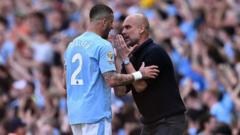
At the center of that tension was a very public, very raw collision between Pep Guardiola and his captain, Kyle Walker, during the darkest stretch of the Catalan manager’s career. To understand that falling out is to understand how the ultimate footballing obsessive finally pushed his most trusted physical anomaly past the breaking point.
The Autumn of Discontent and Tactical Exhaustion
Every tactical system has a breaking point. For Manchester City, the autumn of 2024 exposed fractures that years of domestic dominance had successfully glossed over. A brutal sequence of nine defeats across twelve matches brought an unfamiliar panic to the Etihad Stadium. For a manager accustomed to relentless, metronomic control, the sudden loss of defensive stability felt like a personal betrayal of his principles.
Guardiola demands an almost inhuman cognitive load from his players. Every phase of play requires spatial awareness, positional discipline, and perpetual mental calculation. When a team begins to lose matches, the margin for error shrinks, and the manager's internal pressure valve begins to blow.
Kyle Walker had spent years serving as the ultimate tactical cheat code for this system. Gifted with recovery pace that defied conventional laws of aging for a wide defender, Walker could erase entire opposition counter-attacks single-handedly. He was the insurance policy that allowed Guardiola to commit eight or nine blue shirts into the attacking third.
Yet athleticism has an expiration date, and cognitive fatigue sets in long before the legs entirely give out. During that grim winter stretch, the defensive transitions that once looked effortless began to fail. Balls over the top caught City unawares. Tactical structures collapsed under the weight of sheer physical and mental exhaustion.
The Dressing Room Flashpoint
True authority in football is tested when the victories stop. When Manchester City slumped to a 2-0 defeat against Liverpool in December 2024, the tension boiled over into open conflict.
In the immediate aftermath, Guardiola turned his frustrations directly toward his right-back and club captain. The Catalan coach's critique was blunt and uncompromising, telling Walker that he simply did not understand and demanding that he shoulder more responsibility as the leader of the squad.
For a veteran player who had put his body on the line for the club across multiple title races, the public and private finger-pointing rankled. Walker pushed back, voicing a frustration familiar to many elite athletes who feel micro-managed to the point of suffocation. In audio captured by the documentary crew, the defender challenged his manager directly, noting that every single tactical meeting seemed to single him out by name.
Guardiola’s response was cold and administrative. The captaincy, in the manager's eyes, came with the burden of bearing the brunt of the tactical blame when things went sideways.
This was not a simple personality clash. It was a structural incompatibility between an autocratic manager demanding absolute intellectual compliance and a veteran player whose game was built on instinct, raw physical dominance, and emotional expression.
The Anatomy of a Managed Exit
Elite football clubs do not tolerate prolonged civil wars in the dressing room. Once the friction between manager and captain crosses a certain threshold, the resolution is swift and clinical.
Walker featured in only a handful of matches following the December confrontation. The relationship had reached an irreversible impasse. By January, the wheels were in motion for an exit, culminating in a loan move to AC Milan before a permanent departure to Burnley.
The transition of power was handled with typical ruthless efficiency by the club hierarchy. When the summer of 2025 arrived, Guardiola did not leave the captaincy vacant for a player vote or natural succession; he appointed Bernardo Silva to lead the side. It was a clear signal that the era of emotional, physical enforcers like Walker was giving way to a different brand of technical stewardship.
Documentaries of this scale are curated products, shaped by editors and approved by club PR teams to project a narrative of dignified transition. Yet the raw footage capturing the Guardiola-Walker fallout slips past the corporate filter. It reminds us that the pursuit of perfection leaves collateral damage in its wake.
The trophies remain locked in the cabinets, and the statue will eventually be cast, but the machinery of dominance requires human fuel. When that fuel burns out, the friction leaves scars that even millions of pounds and a shelf full of gold medals cannot entirely erase.