The Anatomy of a Multi-Million Dollar Interception
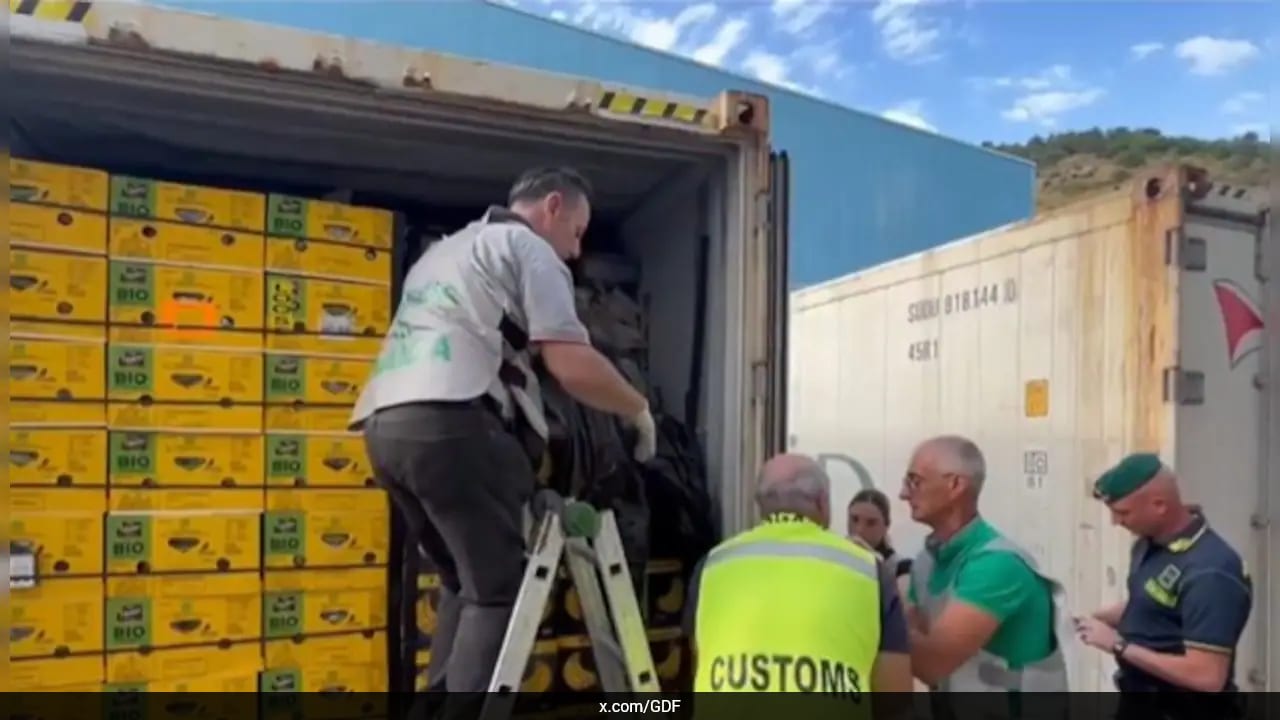
Italian law enforcement authorities struck a severe blow against transatlantic drug cartels when officers intercepted nearly three tons of high-purity cocaine hidden inside a commercial banana shipment. The illicit cargo, valued at approximately $290 million on the street, was discovered at the port of Gioia Tauro in Calabria. Sniffer dogs and specialized scanning technology flagged container units originating from South America, uncovering hundreds of wrapped bricks tucked behind crates of fresh fruit.
This seizure highlights the scale of modern maritime trafficking. It also exposes how organized crime syndicates hijack global agricultural supply chains to flood European markets.
To understand how $290 million worth of narcotics ends up stacked behind perishable produce, one must look past the immediate bust and examine the logistics of international shipping. Gioia Tauro sits at the heart of the Mediterranean transshipment network. Millions of TEUs (twenty-foot equivalent units) move through its docks annually. Out of those millions, customs agencies can physically inspect only a tiny fraction without causing catastrophic delays to global trade.
Cartels exploit this operational bottleneck with calculated precision.
+-----------------------------------------------------------------------+
|                       TYPICAL MARITIME SUPPLY CHAIN                   |
|                                                                       |
|  [Origin Farm] ---> [Packing Facility] ---> [Port of Departure]       |
|                             |                      |                  |
|                   (Infiltration Point A)  (Infiltration Point B)     |
|                                                    |                  |
|                                            [Transatlantic Transit]    |
|                                                    |                  |
|                                           [Port of Entry]             |
|                                                    |                  |
|                                           (Extraction/Bust)           |
+-----------------------------------------------------------------------+
How Cartels Weaponize Perishable Freight
Refrigerated containers, known in the maritime industry as reefers, are the gold standard for cocaine smugglers. Fresh produce like bananas, pineapples, and avocados must move quickly through ports to prevent spoilage. Fast clearance times mean less time for thorough customs inspections.
Smugglers rely on several distinct methods to introduce contraband into these cold supply chains.
Rip-On Rip-Off Operations
This technique involves corrupting workers at the port of origin or intermediate transshipment hubs. Smugglers break the official security seal of a legitimate commercial container, pack the drug duffel bags right near the door, and seal it with a cloned counterfeit tag.
Upon arrival at the destination port, insiders extract the cargo before the container moves to the final buyer, who often has no idea their shipment was compromised.
Structural Modification
Cartels buy or rent containers to build hidden compartments directly into the floors, ceilings, or refrigeration units. These modifications require technical skill and advance notice, but they offer greater concealment against routine visual checks.
Only advanced X-ray scanners or density meters reveal the discrepancy.
Front Companies and Compromised Exporters
Sometimes the commercial entity exporting the fruit is directly controlled by the syndicate. Cartels establish legitimate agricultural businesses, build a years-long history of clean exports, and then begin slipping massive illicit payloads alongside agricultural yield.
+--------------------------+---------------------------------------------------+
| Smuggling Method         | Operational Mechanism                             |
+--------------------------+---------------------------------------------------+
| Rip-On / Rip-Off         | Breach container, load near doors, re-seal tag    |
| Structural Modification  | Build false walls/floors in refrigerated units    |
| Compromised Exporter     | Use legitimate farm/front company as cover        |
+--------------------------+---------------------------------------------------+
The Calabria Factor and European Distribution
The location of this specific seizure carries massive geopolitical weight. Calabria is the home territory of the 'Ndrangheta, an Italian criminal enterprise that has quietly built a near-monopoly on the European cocaine trade over the last thirty years.
While public attention historically focused on the Sicilian Mafia, the 'Ndrangheta quietly built direct broker relationships with South American producers in Colombia, Peru, and Bolivia.
European cocaine consumption has surged, driven by high purity levels and falling wholesale prices. Ports across Northern and Southern Europe—including Antwerp, Rotterdam, Hamburg, and Gioia Tauro—face an overwhelming tide of illicit cargo.
Customs officials find themselves outgunned by the sheer volume of maritime traffic.
When a single shipment carrying $290 million is intercepted, it represents a real loss for the financiers behind the load. Yet, in the cold accounting of international drug trafficking, these losses are factored into the cost of doing business. If nine containers get through and the tenth gets seized, the operation remains exceptionally profitable.
The Technological Arms Race at the Docks
Port authorities are fighting back with modern detection tools. They no longer rely solely on physical searches and narcotics detection dogs.
- High-Throughput Container Scanners: Giant mobile X-ray and gamma-ray portals image entire semi-trucks and containers in seconds.
- Artificial Intelligence and Predictive Analytics: Algorithms scan shipping manifests, flag unusual routing anomalies, analyze exporter histories, and mark high-risk containers for physical search.
- Trace Detection and Chemical Sensors: Sniffer devices detect minute chemical vapors offgassing from packaging materials inside sealed units.
These tools help level the playing field, but technology alone cannot solve the problem.
Port corruption remains the weakest link in maritime security. A single bribed crane operator, dockworker, or customs clerk can bypass the most sophisticated scanning hardware by alerting smugglers which containers are marked for inspection, or by altering manifest data in tracking software.
Supply Chain Integrity Needs Structural Reform
Stopping the flow of illicit narcotics through global maritime networks requires changing how international shipping operates.
Focusing entirely on seizures at destination ports acts as a band-aid on a systemic leak. Once a container arrives at a crowded port like Gioia Tauro, the logistics advantage belongs to the smuggler.
To build real security, maritime logistics must adopt strict end-to-end verification.
Smart Container Seals
Standard plastic and bolt seals are far too easy to tamper with or clone. Replacing them with digital, GPS-enabled smart seals that trigger real-time alerts the moment a container door opens off-route closes the window for rip-on, rip-off operations.
Upstream Verification at Origin
Inspections must shift to the ports of departure in South America. Interdicting contraband before it boards a container ship cuts off access to international maritime corridors entirely.
Stringent Vetting of Logistics Personnel
Addressing internal corruption requires continuous background checks, restricted access zones within port facilities, and dual-authorization protocols for moving high-risk containers.
The $290 million cocaine seizure in Italy shows that law enforcement can hit cartels where it hurts. But until global logistics networks fix the structural vulnerabilities in perishable shipping, cartels will treat a seized shipment as nothing more than an acceptable tax on doing business.