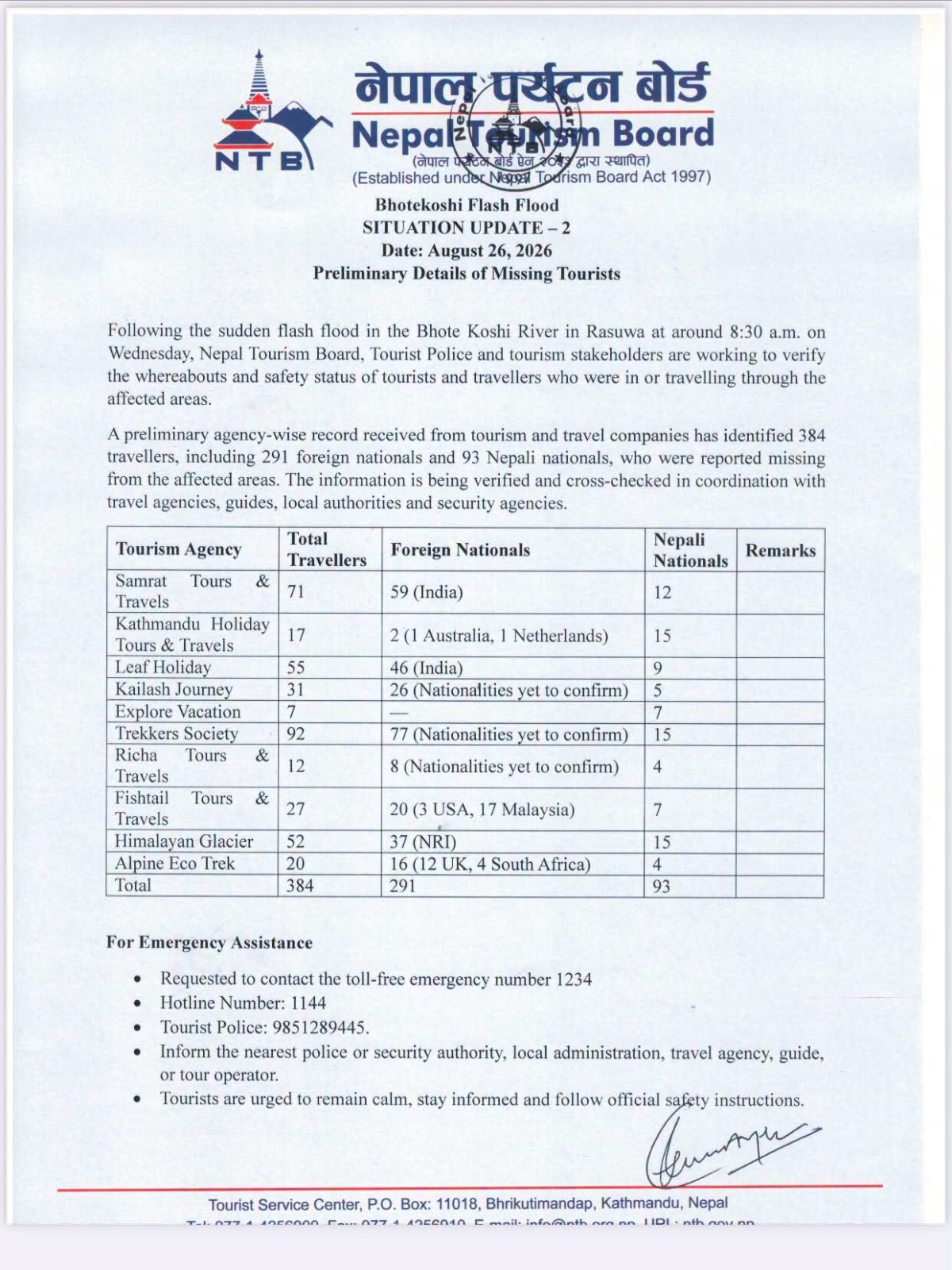
A sudden and catastrophic wall of water surged down the Bhote Koshi River into Nepal's northern Rasuwa district, leaving at least 95 people dead and hundreds unaccounted for. Among the 384 travellers initially listed as missing by the Nepal Tourism Board, 105 are Indian nationals, alongside dozens of non-resident Indians and citizens from several other countries. The disaster struck near the border with Tibet, wiping out settlements, trade routes, and critical hydropower infrastructure within minutes.
Emergency response teams, including the Nepal Army, Armed Police Force, and local police units, have mobilized heavily across Rasuwa, Nuwakot, and Dhading districts. Helicopters, drones, and specialized canine squads are currently scanning the debris-choked riverbanks. Yet, the sheer scale of the devastation has severely hampered access to the worst-hit zones like Timure Bazaar and Syafrubesi.
Anatomy of a Cross-Border Torrent
The catastrophe began around mid-morning when an immense wall of muddy water, rocks, and debris tore through the upper reaches of the river. Initial speculation pointed toward heavy seasonal downpours, but local meteorological data revealed a different story. Rasuwa did not experience heavy rainfall that morning. Instead, satellite data and seismic monitoring revealed that a 4.4-magnitude earthquake struck the region minutes before security footage captured the wall of water breaching the border from the Tibetan side.
This seismic shock likely triggered a massive rockslide or avalanche upstream, temporarily damming the river before the natural barrier collapsed under intense hydraulic pressure. When the blockage gave way, it sent an unstoppable surge rushing down a narrow 60-kilometer mountain corridor. Villages situated along the historic trade route with Tibet had virtually no warning time. Infrastructure built to withstand typical monsoon swells was obliterated instantly by the kinetic force of the rolling boulders and glacial debris.
The Human Toll and Verification Hurdles
Compiling an accurate casualty and missing persons list remains an agonizingly slow process. The preliminary numbers released by the Nepal Tourism Board originated from agency-wise records provided by ten major tour and trekking operators. Hundreds of pilgrims and adventure tourists were scheduled to cross the border or trek through the region on that fateful morning.
Many individuals marked as missing may simply be cut off from cellular communication rather than swept away by the torrent. Power lines are down, fiber-optic links are severed, and bridges connecting isolated mountain hamlets have vanished. Families across India and other nations are left waiting in profound uncertainty. Officials in Kathmandu have stressed that inclusion on the preliminary list does not confirm fatalities, but rather underscores the immense difficulty of tracking transients in remote Himalayan terrain.
The Indian Embassy in Kathmandu quickly established dedicated emergency helplines to assist families seeking information about affected citizens. Meanwhile, regional authorities in northern India, particularly across Bihar and Uttar Pradesh, remain on high alert as the swollen river systems flow downstream into the Gangetic plains. Chief ministers and disaster management cells have coordinated preemptive monitoring along the Gandak and Kosi rivers to mitigate secondary flooding risks.
Infrastructure Collapse and Economic Aftershocks
Beyond the heartbreaking loss of life, the disaster has dealt a severe blow to regional connectivity and energy security. The newly constructed Friendship Bridge at Rasuwagadhi, a vital commercial artery connecting Nepal and China, was completely washed away. Trade trucks, customs installations, and local markets were swallowed by the rising waters.
The energy sector faced immediate paralysis. At least a dozen hydropower projects along the river corridor suffered catastrophic damage. Energy ministry officials reported that hundreds of megawatts of electricity generation capacity went offline, representing a significant percentage of the country's total installed power output. Repairing these facilities will take months, if not years, given the heavy siltation and destroyed access roads.
Fragile Frontiers in a Warming Era
This disaster exposes the inherent vulnerability of Himalayan infrastructure to compounding geological and climatic hazards. As seismic activity interacts with fragile mountain slopes and shifting weather patterns, traditional risk models fall short. Early warning systems across high-altitude trans-boundary river basins require immediate modernization, real-time sensor integration, and cross-border data sharing between neighboring nations. Without synchronized monitoring upstream, communities downstream remain perpetually exposed to sudden, invisible threats descending from the roof of the world.