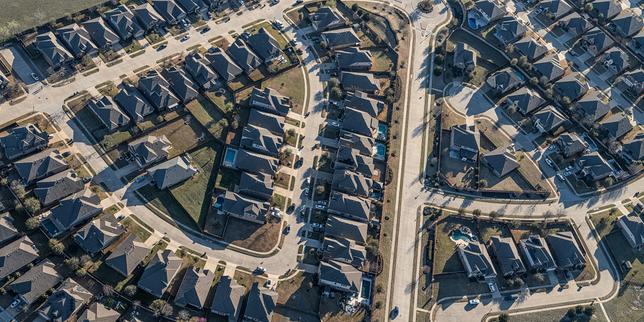
Ten years ago, towns north of Dallas like Celina, Prosper, and Anna were quiet agricultural outposts where cattle outnumbered commuters. Today, they represent the fastest-growing suburban corridor in the United States, driven by corporate relocations, aggressive state tax incentives, and an insatiable demand for single-family homes. While local officials celebrate the economic windfall, this hyper-growth has triggered an acute infrastructure crisis, strained regional water supplies, and created a municipal debt model that relies entirely on endless outward expansion.
Drive north up the Dallas North Tollway past Frisco, and the geography changes by the mile. Flat blackland prairie gives way to an unbroken horizon of concrete mixers, graded dirt, and master-planned communities. Towns that operated with volunteer fire departments and two-lane farm-to-market roads a decade ago now manage municipal budgets in the hundreds of millions. Also making news lately: Why Sour Spicy and Retro Sweets Are Taking Over the Halloween Candy Bowl.
The numbers tell a blunt story. Celina, Texas, hovered around 6,000 to 8,000 residents in the early 2010s. By the mid-2020s, its population surged past 50,000, with city planners actively preparing for a build-out population exceeding 350,000. Neighboring Prosper and Princeton have followed nearly identical trajectories. This is not organic urban evolution. It is industrial-scale suburban manufacturing.
The Corporate Engine Fueling the Sprawl
To understand why tens of thousands of families are packing into Collin and Denton counties, you have to follow the corporate headquarters. Over the last fifteen years, North Texas became the premier destination for Fortune 500 relocations. Toyota Motor North America moved its headquarters to Plano. PGA of America planted its flag in Frisco. Charles Schwab, Caterpillar, and dozens of major financial and tech firms shifted massive operational hubs into the region. Further insights into this topic are explored by Harvard Business Review.
Texas offers a simple value proposition to executives: zero state personal income tax, light-touch regulatory frameworks, and an abundant supply of cheap, flat land. Unlike coastal metros hemmed in by oceans, mountains, or strict urban growth boundaries, the Dallas-Fort Worth metroplex can expand outward indefinitely.
Once the corporate campuses landed in Plano and Frisco, land prices in those inner-ring suburbs skyrocketed. Frisco largely ran out of vacant tracts for standard single-family subdivisions. Developers did what they always do in Texas—they moved ten miles further north along Highway 380 and the tollway extension, buying up generational family farms and converting them into sprawling residential developments.
Remote and hybrid work schedules accelerated the trend. When a software engineer or corporate manager only needs to commute to a Plano office two days a week, a 45-minute drive from Celina or Melissa becomes entirely palatable, especially when it buys a 3,500-square-foot home with a three-car garage and access to a brand-new, state-of-the-art public school district.
How Texas Finances Hyper-Growth
Standard municipal finance cannot keep pace with a population that multiplies tenfold in a single decade. A small town cannot simply raise property taxes high enough to pay for $200 million in new water treatment plants, sewer trunks, and four-lane boulevards before the new residents actually move in.
Instead, North Texas relies heavily on specialized financial instruments that shift the upfront cost of infrastructure onto future homeowners. The primary vehicle is the Municipal Utility District (MUD), alongside Public Improvement Districts (PIDs) and Tax Increment Reinvestment Zones (TIRZs).
Here is how the mechanism works in practice. A developer buys 1,000 acres of raw farmland outside city limits. Because the city lacks the cash to extend water and sewer lines to the site, the state authorizes the creation of a MUD. The MUD issues tax-exempt municipal bonds to pay for the roads, pipes, and drainage systems. Once the homes are built and sold, the homeowners pay an extra layer of property taxes directly to the MUD to pay off those bonds over the next 25 to 30 years.
The Hidden Cost to Homeowners
On paper, this looks like a clean market solution. Growth pays for growth. In reality, it creates a heavy tax burden that catches many out-of-state buyers off guard.
Texas has no state income tax, so local governments rely almost entirely on property taxes to fund schools, counties, and cities. In a hyper-growth suburb, a homeowner pays taxes to:
- The county
- The city
- The local Independent School District (ISD)
- The community college district
- The MUD or PID
Combined property tax rates in these newly minted neighborhoods routinely hit 2.5% to 3.0% of a home's assessed value every single year. On a $600,000 home—now the baseline price in towns like Prosper—that translates to $15,000 to $18,000 annually in property taxes alone, before paying a dime toward principal, interest, or homeowners insurance.
The Infrastructure Deficit and the Highway 380 Nightmare
Concrete cannot be poured fast enough to match the pace of residential permitting. Across the northern corridor, infrastructure lags behind housing by five to seven years. The clearest symbol of this bottleneck is U.S. Highway 380, the main east-west artery connecting Denton, Prosper, and McKinney.
Originally built as a rural highway to move agricultural goods between county seats, Highway 380 now carries the daily commuter load of a major metropolitan interstate. Traffic frequently backs up for miles at intersections surrounded by newly built strip malls and apartment complexes. The Texas Department of Transportation (TxDOT) is currently executing massive, multi-billion-dollar bypass and expansion projects, but acquiring right-of-way through rapidly appreciating commercial land has turned into a legal and financial slog.
Water poses an even thornier problem. North Texas sits in a region prone to severe, multi-year droughts, yet suburban growth depends on heavily irrigated St. Augustine lawns and massive residential consumption. The North Texas Municipal Water District (NTMWD) supplies water to over two million people across the region. To meet the demands of the northern boom, the district had to construct Bois d'Arc Lake—the first major reservoir built in Texas in nearly 30 years—at a cost exceeding $1.6 billion. Even with the new reservoir online, regional water planners warn that conservation mandates and steeper tiered water rates will become permanent fixtures of suburban life.
The School District Arms Race
In North Texas, real estate values are tethered directly to public school districts. Families do not just move to Prosper or Celina for the houses; they move for the schools. This dynamic has forced local school districts into a relentless, capital-intensive construction race.
Prosper Independent School District has routinely opened multiple new elementary, middle, and high schools every single academic year just to keep classrooms from overflowing. To fund this expansion, school boards ask voters to approve massive bond packages—often exceeding $1 billion or $2 billion at a time.
Because Texas school finance laws cap the tax rate districts can charge for daily operations (teacher salaries, utilities, maintenance) while allowing separate tax levies for debt service (buildings and stadiums), districts have abundant cash for bricks and mortar, yet often struggle to pay competitive wages to the teachers staffing those buildings. You end up with $100 million high school campuses featuring college-grade athletic facilities and broadcast studios, alongside chronic staffing shortages in core subjects like math and special education.
The Illusion of the Suburban Growth Ponzi Scheme
Urban planners and municipal analysts have long warned about the long-term fiscal math of low-density suburban sprawl. The critique is straightforward. New subdivisions generate immediate windfalls for city coffers through permit fees, impact fees, and fresh property tax revenue. During the first ten to fifteen years, the infrastructure is brand new. Roads do not need repaving. Water mains do not burst. Drainage culverts remain clear.
The bill comes due in year twenty-five.
Single-family subdivisions have a notoriously low tax yield per acre compared to dense commercial or mixed-use urban cores, yet they require vast linear miles of asphalt, water pipes, and electrical lines per household. When the first wave of infrastructure reaches the end of its lifecycle, the property tax revenue generated by those homes is rarely enough to cover the full cost of replacement.
To pay for maintenance in older neighborhoods, cities must continue annexing new land and approving new developments to keep the upfront fee revenue flowing. If regional population growth ever stalls, or if high interest rates freeze residential construction for an extended period, cities heavily reliant on growth-driven revenue face an immediate budget cliff. They are left with three bad options: slash municipal services, defer maintenance until roads crumble, or hike property taxes on an already strained resident base.
What Happens When the Land Runs Out
The northern expansion of Dallas is not infinite. Geography and county lines eventually impose hard limits. As developments push past Celina toward the Red River and Oklahoma border, commute times to central job hubs stretch past an hour each way. At a certain distance, the suburban value proposition breaks down.
At the same time, the character of these towns is undergoing an irreversible shift. Longtime residents who moved to the area twenty years ago for acreage, quiet nights, and small-town governance frequently clash with newcomers demanding urban amenities, denser retail corridors, and expanded city services. Local city council meetings, once sleepy procedural affairs, have become battlegrounds over high-density apartment zoning, warehouse developments, and traffic mitigation.
The cities north of Dallas have proven they know how to build housing at a speed unmatched anywhere else in the Western world. Turning empty prairie into functioning suburbs for hundreds of thousands of people in a single generation is a massive logistical feat. Whether those cities can afford to maintain what they have built once the construction cranes finally pack up and move on remains an unanswered question.