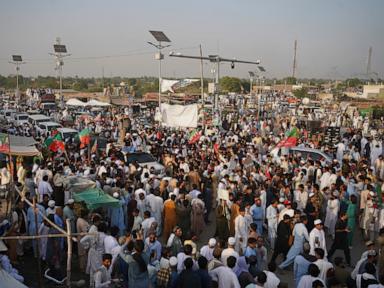
The shipping containers lining the Islamabad highways are not merely barricades of steel and concrete; they are physical monuments to institutional panic. When high-stakes negotiations between the federal coalition and the opposition collapsed, thousands of loyalists belonging to the Pakistan Tehreek-e-Insaf (PTI) party poured out of the rugged terrain of Khyber Pakhtunkhwa toward the capital. Their demand is stark and unyielding: the immediate release of imprisoned former Prime Minister Imran Khan. Yet, looking past the immediate spectacle of tear gas, blocked roads, and mass detentions reveals a much deeper structural decay within the state apparatus.
To understand why this confrontation feels entirely different from past political crises, one must examine the absolute sclerosis of Pakistan's political economy. Khan was ousted via a parliamentary no-confidence vote in 2022, but his removal failed to achieve what the ruling establishment quietly hoped for: the evaporation of his political base. Instead, imprisonment transformed a polarizing populist into an unyielding symbol of systemic defiance. Every shipping container hauled into place to block traffic is an admission that the current administration cannot win the argument in the public square.
The breakdown of talks exposed an irreconcilable chasm. The state demands capitulation and the quiet dismantling of the opposition's populist machinery. The PTI demands a total reset, pointing to the disputed general election as proof that civilian democracy has been hollowed out. Compromise requires a shared reality, and right now, the two sides inhabit completely different universes. One side operates from the bulletproof comfort of the institutional status quo, while the other draws energy from an aggrieved public facing severe economic pressures, runaway inflation, and institutional overreach.
State responses to these recurring marches have followed a predictable, heavy-handed script. Authorities seal off urban centers, suspend regional governance structures when pressure mounts, and sweep up mid-level party organizers in nocturnal raids. But treating a massive populist movement as a law enforcement problem rather than a political reality is a profound miscalculation. Each detained organizer and every blocked motorway only hardens the conviction of the base.
The confrontation also lays bare the fragility of civilian governance under the shadow of the military establishment. When political parties cannot negotiate a basic framework for public assembly without mediation collapsing over demands to access a single political prisoner, civilian institutions abdicate their authority. The longer this cycle of containment and defiance spins, the more the state's legitimacy erodes. The capital may hold out behind its walls of steel containers today, but a government that relies permanently on barricades has already lost the mandate to govern.
Imran Khan supporters march on Islamabad to demand his release after talks failed
This video provides an on-the-ground look at the demonstrations and the security response as protesters pressed toward Islamabad following the breakdown of political negotiations.