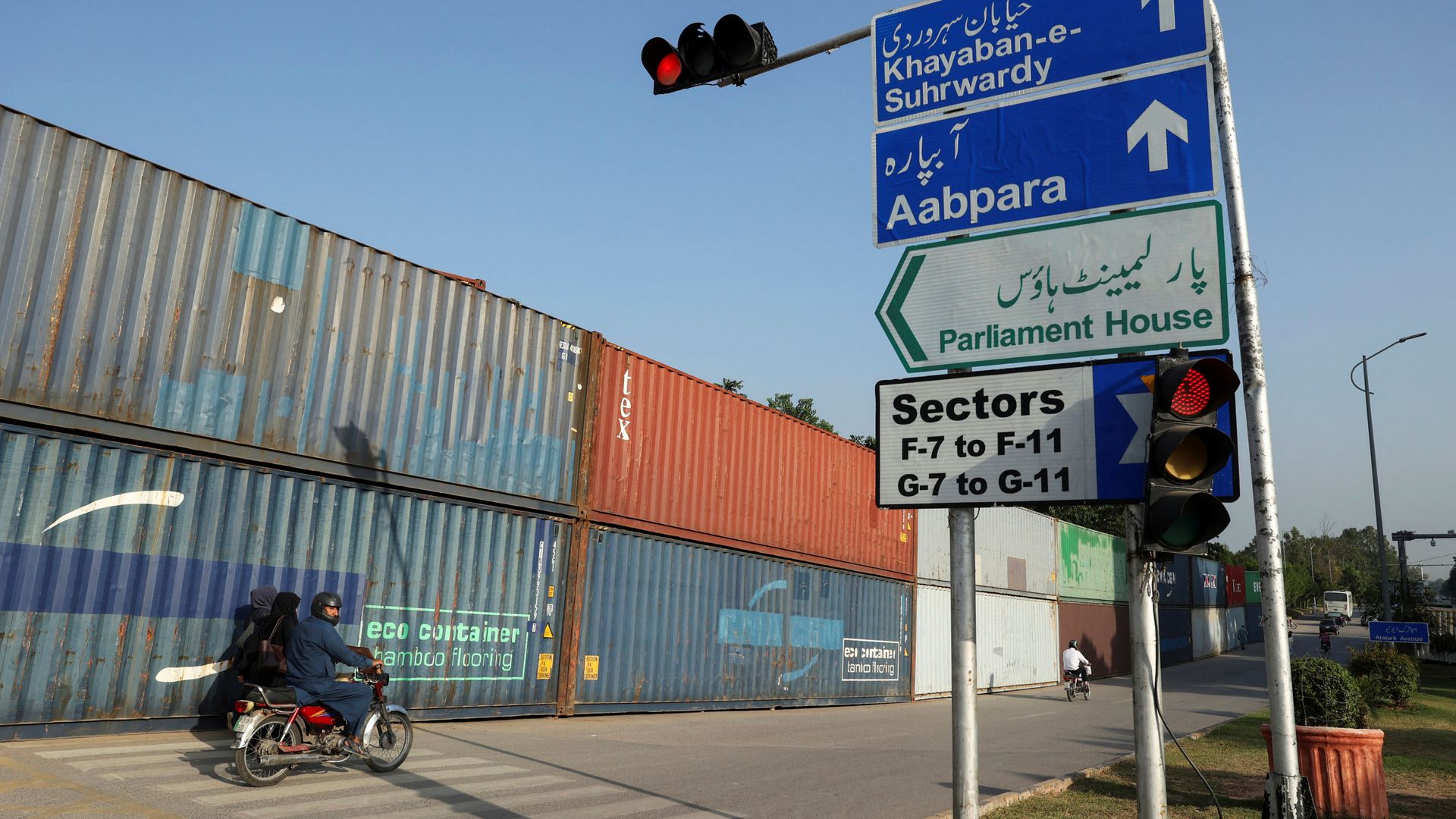
When authorities in Pakistan want to shut down a political movement, they do not call in riot police first. They call crane operators. Ahead of major demonstrations by supporters of jailed former Prime Minister Imran Khan, law enforcement agencies routinely commandeer hundreds of 40-foot steel shipping containers from private trucking firms, stacking them two stories high to seal off every major artery leading into Islamabad and Rawalpindi. This heavy-metal blockade is designed to physically prevent protesters from reaching the capital's administrative core, effectively turning a modern metropolis into a medieval walled city overnight.
It is an astonishingly blunt instrument of statecraft. While other governments rely on tear gas, water cannons, or digital blackouts to disperse crowds, the Pakistani state has perfected the art of architectural containment. By transforming global trade infrastructure into tactical barricades, officials achieve two goals simultaneously. They paralyze mass mobilization before it can gather critical mass in the capital's Red Zone, and they shift the burden of disruption onto the protesters themselves, framing the opposition as the true architects of economic chaos. For a more detailed analysis into this area, we suggest: this related article.
The Anatomy of a Modern Siege
To understand how Islamabad disappears behind a wall of corrugated steel, you have to look at the geography of the twin cities. Islamabad sits nestled against the Margalla Hills, connected to the rest of the country by a handful of high-capacity highways, interchanges, and bridges. Unlike sprawling megacities such as Karachi or Lahore, where winding alleyways make total containment nearly impossible, Islamabad was designed in the 1960s with wide, linear sectors and distinct chokepoints.
State planners and security officials know these pressure points intimately. During high-stakes standoffs between Imran Khan's Pakistan Tehreek-e-Insaf (PTI) party and the ruling coalition, police deploy containers at key junctions like Faizabad Interchange, Zero Point, and the Srinagar Highway. To get more background on this issue, extensive reporting can also be found on TIME.
The logistics are staggering. Local police stations are given quotas. Officers fan out across industrial zones and freight terminals, invoking emergency powers under colonial-era laws like Section 144 of the Code of Criminal Procedure to seize flatbeds and containers without immediate compensation. Heavy cranes hoist the empty boxes—each weighing roughly four metric tons—into double-stacked walls. Once the base layer is set, welding teams sometimes fuse the corners together, ensuring that even heavy machinery brought in by protesters cannot easily push them aside.
Who Actually Pays for the Wall
The containers do not belong to the government. They belong to private freight forwarders, small-scale logistics operators, and importers whose livelihoods depend on moving goods from the port city of Karachi up the Grand Trunk Road to the northern provinces.
When a container is seized, the economic clock stops for its owner. A single truck and container sitting idle at a highway barricade represents thousands of dollars in lost revenue, spoiled cargo, and missed contractual deadlines. If the containers are empty, the owners lose daily rental fees. If they happen to be loaded—and police have occasionally commandeered containers still packed with perishable food, textiles, or electronics—the financial ruin is immediate.
The state rarely reimburses these private businesses fairly, if at all. Truckers frequently report getting their vehicles back weeks later with punctured tires, smashed windshields, and scorched paint from tear gas canisters and bonfires. Yet resistance from the transport sector is muted. Challenging a police requisition order in court takes years, and transport unions know that opposing the security apparatus invites regulatory harassment, revoked permits, and tax audits. The private sector quietly absorbs the cost of political instability, passing those losses down to consumers through inflated prices on basic commodities.
The Evolution of Container Politics
This tactic did not originate with Imran Khan. Container blockades have become a standard fixture of Pakistani political theater over the last two decades, refined through successive administrations regardless of which party held power.
In 2014, when Imran Khan himself led a 126-day sit-in at Islamabad's D-Chowk against the government of then-Prime Minister Nawaz Sharif, the state erected massive container walls to protect parliament and diplomatic enclaves. Years later, when Khan was in power, his own administration used the exact same playbook to block marches led by religious parties and opposition coalitions.
What has changed in recent years is the sheer scale and preemptive nature of the deployments. Following Khan's ouster via a parliamentary no-confidence vote in April 2022, and his subsequent imprisonment on a slew of corruption and state-secrets charges, the confrontation between his party and the country's powerful military-backed establishment hardened into an existential struggle.
Authorities no longer wait for crowds to assemble at the city gates. They seal the capital days in advance. They dig trenches across motorways using excavators, pile mounds of dirt and gravel behind the steel walls, and suspend cellular and mobile internet services across entire regions. The objective is not merely crowd control; it is sensory and physical isolation. By severing communications and blocking roads simultaneously, the state ensures that disparate convoys of protesters traveling from Khyber Pakhtunkhwa or Punjab cannot coordinate their movements or merge into a unified force.
The Strategic Paradox of Containment
On paper, the container strategy looks like an unbeatable tactical advantage for the state. You cannot storm a parliament building if you cannot even enter the city limits. Yet veteran observers of South Asian politics recognize a glaring flaw in this approach.
By shutting down the capital to stop a protest, the government voluntarily inflicts the very economic paralysis that a protest is meant to achieve. When Islamabad is sealed, businesses close, courts adjourn, schools shutter, and supply chains across northern Pakistan grind to a halt. Billions of rupees in economic activity evaporate every single day the barricades remain up. For an economy already surviving on international bailouts and battling chronic inflation, the self-inflicted wound is severe.
Furthermore, the visual spectacle of a capital city barricaded behind rusted shipping containers undermines the state's narrative of normalcy and stability. Foreign investors, diplomats, and international lenders watching news broadcasts see a government that appears terrified of its own citizens. Instead of projecting strength, the towering walls of steel broadcast political fragility.
There is also the problem of escalation. When peaceful marchers are met with impassable walls of metal, trenches, and heavy shelling miles away from their intended destination, the nature of the confrontation shifts. Frustrated crowds clash with police at suburban interchanges rather than holding rallies in designated urban squares. Heavy machinery—cranes, bulldozers, and excavators—has increasingly become part of the protest toolkit, with PTI convoys bringing their own earthmoving equipment to clear the state's obstacles. A political demonstration rapidly degenerates into an urban siege.
Beyond the Steel Barricades
The reliance on shipping containers reveals a deeper institutional failure. In functioning democracies, political grievances are absorbed and negotiated through parliaments, independent courts, and credible elections. When those institutional valves are clogged—whether through disputed electoral outcomes, sweeping crackdowns on opposition leaders, or bans on political rallies—politics spills onto the highways.
As long as the underlying legitimacy crisis remains unresolved, no wall of steel will be high enough to restore lasting calm. The cranes will keep rolling out at midnight, the highways will keep disappearing beneath stacks of corrugated iron, and ordinary citizens will continue to wake up trapped inside a fortress built to keep their own politics at bay.