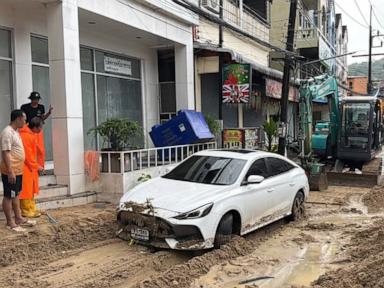
Heavy monsoon rains routinely trigger severe flash floods across Thailand's Phuket island, submerging major tourist hubs like Patong, Kamala, and Old Phuket Town within hours. While official weather reports blame seasonal downpours and overflowing canals, the real culprit is decades of unchecked hillside deforestation, aggressive real estate speculation, and outdated drainage infrastructure designed for a sleepy tin-mining province rather than a global luxury destination. When torrential rain hits the Andaman coast, water no longer absorbs into the tropical soil. Instead, it sheets down concrete-covered slopes, turning narrow coastal roads into fast-moving rivers and paralyzing the local economy.
Standard news coverage treats every flooded street in Phuket as an act of nature. A storm rolls in from the Andaman Sea, water levels rise, emergency crews deploy pumps, and the water eventually recedes. That narrative is convenient. It absolves local authorities, urban planners, and billion-dollar property developers of responsibility.
Look closer at the topography of Phuket, and a very different picture emerges. The island is essentially a mountainous spine rising abruptly out of the sea, flanked by narrow coastal flatlands where almost all commercial activity takes place. Historically, dense rubber plantations and primary rainforest covered those steep interior hills. The root systems acted as a massive biological sponge, intercepting heavy rainfall and releasing it slowly into natural watershed channels.
Over the past twenty years, that sponge has been systematically paved over.
How Luxury Villas Turned Mountains Into Waterslides
Drive up the winding roads behind Patong, Kata, or Surin Beach, and the mechanism behind the flooding becomes immediately obvious. Cliffside resorts, infinity-pool villas, and multi-story condominium complexes cling to gradients that civil engineers in stricter jurisdictions would never approve for dense construction. To build these structures, developers strip away native vegetation and excavate deep into the granite-and-clay hillsides.
When a tropical cloudburst drops 100 to 200 millimeters of rain in a single morning, the physics are unforgiving. Impervious surface runoff replaces natural groundwater absorption. Instead of soaking into the earth, millions of liters of water accelerate down paved access roads, retaining walls, and bare construction sites.
By the time that runoff reaches the coastal plain, it carries massive amounts of red clay, gravel, and construction debris. This sediment is lethal to municipal drainage systems. Even if a coastal town has wide storm drains, those channels choke on mud within the first thirty minutes of a severe storm. Water backs up rapidly, seeking the lowest available elevation—which happens to be the ground-floor lobbies of beachfront hotels, busy retail intersections, and working-class residential neighborhoods.
The Regulatory Blind Spot
Thailand possesses environmental zoning laws designed to prevent precisely this scenario. Building regulations restrict construction above certain elevations—specifically targeting slopes steeper than 35 degrees and heights exceeding 80 meters above sea level—to protect watershed forests.
Enforcement tells another story. Through a combination of fragmented municipal oversight, aggressive land-title upgrades, and political pressure from the real estate sector, hillside development has continued largely unabated. When a project faces scrutiny, construction often pauses briefly before resuming under modified permits. Meanwhile, the municipal drainage networks down in the valleys remain frozen in time, built to handle a fraction of the current population and building density.
The Anatomy of a Coastal Bottleneck
To understand why water lingers for hours or days in places like Patong, Bangla Road, or Phuket Town, you have to look at the intersection of land runoff and ocean mechanics. Flooding on an island is fundamentally different from inland river flooding.
Phuket's drainage canals, known locally as klongs, rely on gravity to flush rainwater out into the Andaman Sea. This system works reasonably well at low tide. However, if a heavy downpour coincides with a king tide or a storm surge driven by strong westerly winds, the ocean acts like a concrete wall slamming shut at the mouth of every canal.
The water has nowhere to go. Freshwater rushing down from the denuded hills collides with saltwater pushing inland from the coast. Pressure builds inside the underground pipes, blowing off manhole covers and forcing raw stormwater—often mixed with untreated wastewater—up through street grates.
| Flooding Factor | Natural State | Current Reality | Impact on Runoff |
|---|---|---|---|
| Hillside Cover | Dense rainforest and rubber trees | Concrete villas, roads, bare earth | Speeds up water velocity and volume |
| Soil Absorption | High permeability | Sealed under asphalt and stone | Eliminates natural groundwater recharge |
| Canal Capacity | Wide, unobstructed natural estuaries | Narrowed by encroaching buildings | Creates severe hydraulic bottlenecks |
| Sediment Load | Minimal organic leaf litter | Heavy red clay and construction silt | Clogs storm drains within minutes |
Consider a hypothetical example of a standard coastal catchment area in western Phuket. Suppose a two-square-kilometer hillside receives 150 millimeters of rain over three hours. In a forested state, the canopy and soil might retain up to 60 percent of that volume, releasing the rest gradually over 24 hours. Once 70 percent of that same slope is covered in roofs, driveways, and compacted soil, nearly 90 percent of the rainwater hits the valley floor within 45 minutes. No municipal pump station can clear that volume fast enough when the sea is pushing back.
The Hidden Financial Toll on Tourism and Locals
Tourism operators work hard to project an image of effortless tropical paradise, which means the true economic cost of Phuket's flash floods rarely makes it into official press releases. When water rises waist-deep in commercial districts, the damage extends far beyond a few delayed airport transfers.
Small business owners bear the immediate brunt. Ground-floor restaurants, tailors, convenience stores, and motorbike rental shops frequently operate without comprehensive flood insurance, as underwriters either refuse coverage in high-risk zones or price premiums out of reach. A single morning flood can ruin hundreds of thousands of baht in inventory, electrical wiring, and refrigeration equipment.
For the broader hospitality sector, the damage is reputational and logistical:
- Stranded Transit Corridors: The main arteries connecting Phuket International Airport to the southern beaches—particularly Route 402 (Thepkrasattri Road) and the coastal roads through Kamala and Patong—have notorious low-lying choke points. A single flooded intersection can turn a 45-minute airport run into a four-hour ordeal, causing travelers to miss international connections.
- Landslide Liability: Saturated hillsides do not just shed water; they fail. Mudslides triggered by heavy rain have repeatedly damaged hillside access roads, severed power lines, and threatened luxury properties built on unstable cuts.
- Public Health Hazards: Floodwaters in dense urban zones quickly become contaminated with sewage, motor oil, and chemical runoff. Wade through knee-deep water in a commercial district, and the risk of bacterial skin infections or leptospirosis spikes immediately.
Why Emergency Pumps Are a Band-Aid
Whenever major flooding hits the headlines, provincial officials respond with predictable optics. Heavy-duty mobile water pumps are trucked into hotspots, excavators clear mud from blocked culverts, and promises of master drainage plans dominate local press conferences.
Pumps are useful for clearing stagnant water after the rain stops, but they are completely inadequate as a primary flood defense. Pumping water out of a flooded street only works if you have somewhere lower and drier to send it. When the surrounding water table is saturated and the ocean tide is high, pumping merely moves water from one neighborhood to another.
What Real Flood Mitigation Actually Requires
Fixing Phuket's chronic flooding is not a mystery of engineering. Cities from Tokyo to Rotterdam manage far more complex water challenges every year. The obstacle in Phuket is political will and the willingness to confront powerful economic interests.
First, authorities must enforce an immediate moratorium on new hillside construction above established elevation limits, paired with mandatory retention ponds for existing large-scale developments. If a resort or housing estate alters the natural runoff profile of a mountain slope, the developer should be legally and financially required to build on-site holding tanks capable of capturing peak stormwater flows and releasing them slowly after the storm passes.
Second, coastal municipalities need to reclaim encroached canal buffers. Over the decades, shops, homes, and hotel walls have been built right up to—and sometimes directly over—public drainage klongs, choking their width by half. Restoring these waterways requires buying back or demolishing illegal structures so canals can actually carry their designed capacity.
Third, urban planners must transition away from solid concrete toward permeable urban surfaces, expanded green buffer zones in low-lying towns, and modernized underground storm tunnels with one-way tidal flap gates to prevent seawater backflow.
Navigating Phuket During the Wet Season
For travelers and expatriates living on the island, waiting for municipal reform is not a practical strategy. The southwest monsoon runs roughly from May through October, with September and October typically bringing the heaviest, most sustained rainfall.
- Check Topography Before Booking: If visiting during peak monsoon months, look at elevation maps rather than just distance to the beach. Properties situated slightly above the coastal flatland—without being perched on unstable, newly excavated cliffs—avoid both street flooding and landslide risks.
- Buffer Airport Transfers: When heavy rain is forecast, add at least two hours to any journey heading north toward the airport. Route 402 near Thalang and the Heroines Monument routinely experiences severe pooling that brings traffic to a standstill.
- Avoid Flooded Roads on Two Wheels: Motorbikes are the default mode of transport in Phuket, and they are uniquely dangerous during flash floods. Submerged potholes, lifted manhole covers, and hidden currents routinely sweep riders off the road, while water ingestion ruins scooter engines instantly.
Phuket's geography guarantees that heavy tropical rain will always test the island's limits. Water always finds the path of least resistance, and until Phuket stops trading its watershed forests for short-term real estate gains, every severe monsoon storm will continue to turn the island's prime real estate into an expensive, muddy reservoir.