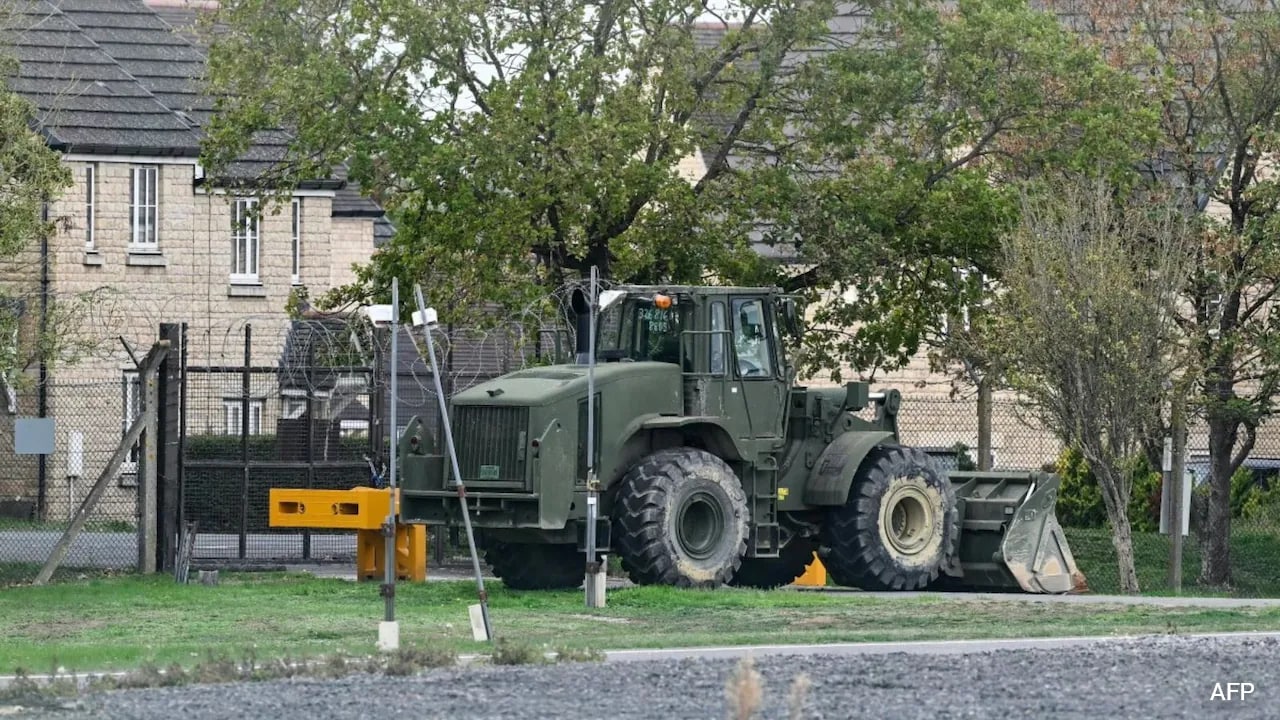
When three men were formally indicted by federal prosecutors in New York for orchestrating a terror plot against RAF Fairford in Gloucestershire, the headlines focused heavily on the distant shadow of Tehran. Yet the real story of the disrupted attack on the British Royal Air Force base—which houses critical United States military aircraft and personnel—points to a much more uncomfortable reality. The modern battlefield is not confined to contested airspace or naval bottlenecks in the Middle East. It runs straight through suburban residential streets, unsecured perimeter fences, and the quiet vulnerabilities of allied counter-intelligence networks.
For decades, facilities like RAF Fairford have operated with a Cold War mindset, treating European host nations as safe rear-echelons far removed from active theaters of kinetic engagement. That illusion shattered when investigators uncovered an Iran-backed operational cell actively purchasing surveillance assets, acquiring delivery vans, and coordinating reconnaissance on American heavy bombers stationed on British soil.
The Mechanics of Shadow Warfare
The operational blueprint unsealed by the U.S. Justice Department exposes how proxy networks function in open societies. Instead of deploying uniformed military personnel or specialized saboteurs across international borders, the architects of the plot relied on local proxies and fragmented communication chains. Court documents revealed that directives flowed from handlers connected to regional militant organizations, bouncing through intermediaries and digital channels before reaching boots on the ground in the United Kingdom.
Even more alarming for intelligence officials was the communication pipeline discovered inside a high-security Brooklyn detention facility. An operative already jailed on related terrorism charges managed to pass coded instructions to external handlers using casual family phone calls. By disguising operational commands as mundane inquiries about outstanding debts and paused projects, the network demonstrated an ability to maintain command-and-control from behind bars.
This resilience exposes the core weakness of traditional counter-terrorism structures. Bureaucracies move vertically, while modern non-state and proxy networks operate horizontally. By the time British counter-terrorism police seized three suspicious vans and began arresting local suspects in Gloucestershire, the operational cell had already progressed from preliminary reconnaissance to material acquisition.
The Cost of Complacency
The immediate fallout was swift. The United States military quietly withdrew its strategic bombers from Fairford, relocating assets away from what suddenly appeared to be an unacceptably soft target. Refueling aircraft at neighboring installations faced similar threat adjustments. This tactical retreat underscores a vital strategic miscalculation: assuming that geographical distance equals insulation from asymmetric threats.
When host-nation police forces and domestic security services are forced to police installations integrated into superpower warfighting logistics, coordination friction is inevitable. Local cells exploit the seams between municipal law enforcement, national intelligence services, and foreign military security detachments. In the case of Fairford, local arrests were followed by complex cross-border indictments, highlighting a reactive posture that is always playing catch-up to agile threat networks.
Security analysts have long warned that asymmetric warfare relies on the principle of minimal investment for maximum disruption. Grounding multi-million-dollar strategic bombers and forcing emergency redeployments because a local cell purchased delivery vans and scoped a perimeter fence is a massive asymmetric victory for any proxy force.
The Broader Strategic Horizon
The incident at Fairford does not stand alone. It forms part of a sprawling dossier of attempted operations stretching across Europe and the United States, targeting infrastructure, dissidents, and military hubs. As direct confrontation between major states remains constrained by the threat of escalation, the shadow war fought through proxies, espionage, and sabotage becomes the default mode of engagement.
If Western defense establishments continue to treat base security as a routine gate-guard duty rather than a frontline defense against active foreign intelligence operations, similar breaches will recur. The resilience of an alliance depends entirely on the strength of its weakest node. Right now, those nodes are the quiet, civilian-adjacent logistics hubs situated thousands of miles away from the primary theater of conflict.
The bombers may return to Gloucestershire eventually, but the strategic calculus has changed permanently. The perimeter fence is no longer a boundary line. It is the front line.