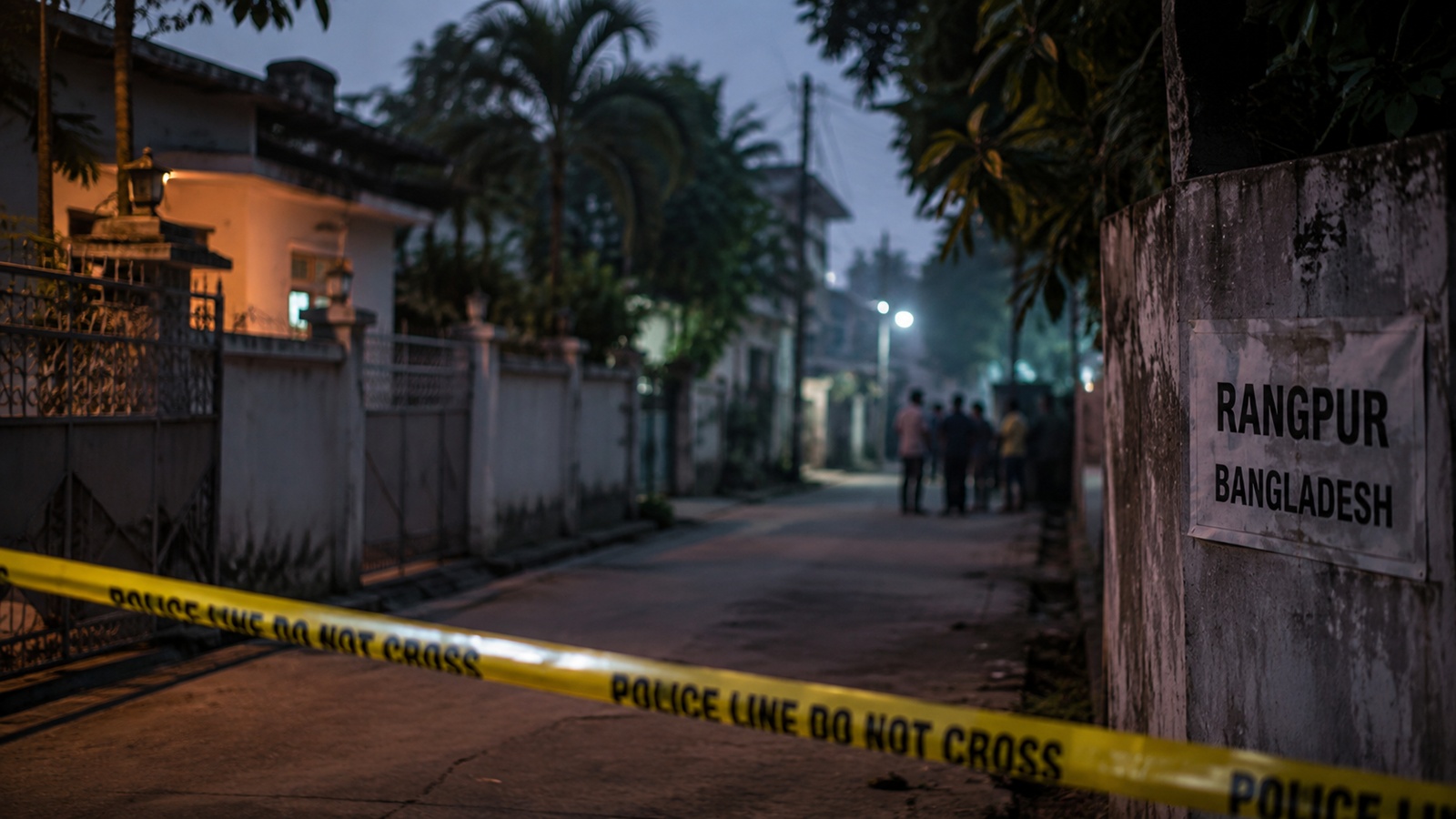
When a retired schoolteacher named Ganapati Chakraborty walked onto his rooftop in the Daspara area of Rangpur city, he expected nothing more than the source of an unwelcome late-night noise. Instead, his routine check transformed into a horrifying crime scene that wiped out an entire family. Two young cousins, identified as Mughdho and Siddhartha, had scaled an adjoining building to consume Yaba—a pervasive, highly addictive methamphetamine-and-caffeine concoction that has quietly hollowed out communities across South Asia. When the 65-year-old educator challenged their presence, he was strangled with the cotton towel draped over his shoulder. What followed over the next six hours inside that locked three-storey house reveals an chilling portrait of modern criminal desperation.
The subsequent investigation led by the Rangpur Metropolitan Police, the Detective Branch, and the Criminal Investigation Department laid bare a sequence of events that shocks the conscience. Hearing the initial struggle, Chakraborty's 50-year-old wife, Pritilata, hurried to the staircase where she met a similar violent end. Their 23-year-old daughter, Agami Chakraborty Prarthi, and 12-year-old son, Priyam Chakraborty, were also killed. Investigators believe the young boy was targeted deliberately because he recognized the intruders, one of whom was an acquaintance of his circle.
The Anatomy of a Descent
Addiction does not operate in a vacuum. The substance driving this tragedy, Yaba, has evolved from a marginalized urban nuisance into a public health catastrophe tearing through towns and villages across the region. Cheaply manufactured, fiercely potent, and easily concealed, the pill alters neurological pathways instantly, plunging users into states of hyper-paranoia and erratic aggression.
When Mughdho and Siddhartha found themselves caught by an elderly homeowner, the chemical influence governing their cognitive functions left zero room for rational negotiation. Survival for them meant absolute elimination of witnesses.
Yet, the most disturbing element uncovered during the joint police briefing was not the speed of the violence, but the chilling normalcy that followed it. The suspects did not flee into the night. They stayed inside the blood-soaked house for nearly half a day.
Hours Inside the Crime Scene
Investigators discovered forensic evidence showing that the two cousins remained inside the Chakraborty residence for six to seven hours after the murders. They raided the refrigerator, consumed cucumbers, cracked open seeds, and bathed to wash away the physical evidence of their crime. They deliberately scattered belongings and killed the household lights to fabricate the illusion of a botched burglary.
This calculated attempt to mislead detectives highlights a terrifying evolution in street-level criminality. The casual detachment required to sit eating food in a home where four bodies lie cold points to a profound erosion of empathy. Decades of reporting on narcotics networks show that habitual users develop an insulated psychosis, separating their internal reality entirely from human consequence.
The Wider Vulnerability of Neighborhoods
Urban density creates a false sense of security. Shared rooftops, incomplete boundary walls, and neglected interstitial spaces transform quiet residential quarters into invisible thoroughfares. The Chakraborty family lived a quiet, unassuming life. Neighbors described them as courteous and entirely detached from local disputes.
Families across the subcontinent increasingly find themselves on the front lines of a war they never enlisted to fight. Law enforcement agencies can intercept shipments and raid distribution dens, but the raw availability of synthetic drugs at the hyper-local level means that any roof, alleyway, or abandoned landing can become a makeshift consumption zone.
When citizens attempt to reclaim their immediate surroundings, the risks are fatal. A retired teacher armed only with civic decency stands defenseless against chemical-fueled panic.
Accountability and the Long Shadow
The swift detention of the two primary suspects offers a measure of procedural closure, but it does little to heal the community or reverse the structural decay that allowed the incident to occur. Interrogations conducted separately and together yielded full confessions, anchored by physical traces left behind on the premises.
As the legal machinery grinds forward, the broader public conversation must shift past surface-level shock. Synthetic narcotics are rewriting the rules of street violence, turning domestic spaces into operational hazards.
The lights remain out in the Daspara residence, and a community is left to reckon with a brutal reality where stepping outside to ask a stranger for quiet can cost an entire generation its life.