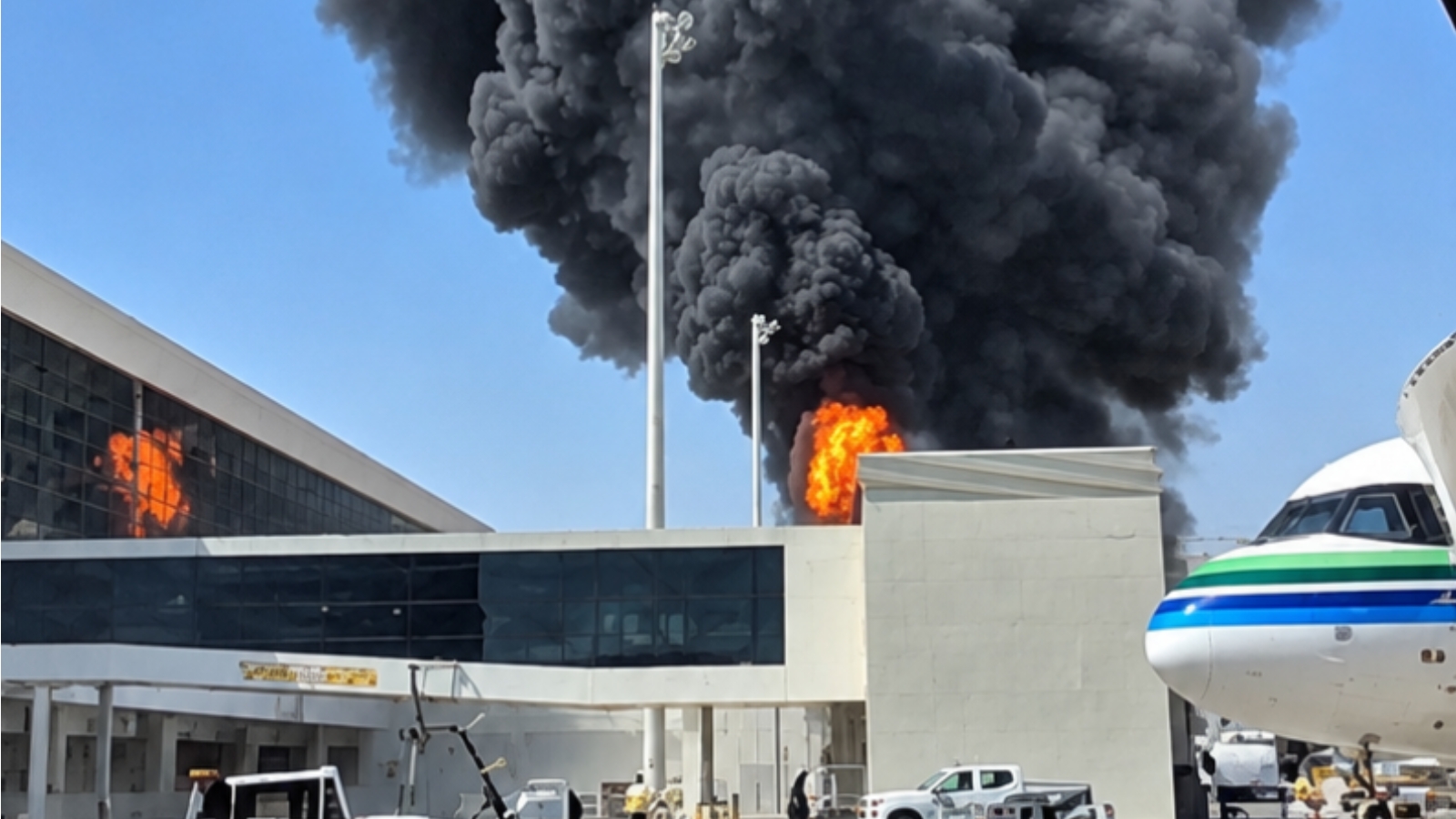
When ballistic fire pierced the terminal complex of King Khalid International Airport in Riyadh, it did more than shatter glass and claim lives. It tore apart a carefully scripted American foreign policy narrative. For months, Washington attempted to ring-fence its regional footprint, hoping to park the sprawling conflicts across Iran and Yemen while managing domestic economic anxieties. That illusion evaporated the moment Houthi projectiles shut down a primary Gulf aviation hub. President Donald Trump’s subsequent admission that the White House was "going to look at" rejoining the air war alongside Saudi Arabia exposed the fundamental fragility of unilateral disengagement. You cannot simply wish away asymmetric warfare when critical infrastructure burns.
The tactical reality on the ground reveals why the royal court in Riyadh panicked. The offensive launched by Saudi-backed forces into Yemen was supposed to clear the Bab el-Mandeb strait and push the resilient militia away from vital shipping lanes. Instead, it triggered a violent kinetic rebound. Ansarullah forces absorbed the push and launched coordinated salvos against deep-territory targets, hitting not just the capital's aviation gateway, but energy hubs in Yanbu and Dammam. This escalation demonstrated a terrifying operational reach. The kingdom's defensive umbrella, despite billions in sophisticated hardware, proved porous against low-cost, high-yield drone and missile technologies.
For the White House, the dilemma is structural rather than rhetorical. Trump has spent the better part of a year trying to wind down direct American exposure in Middle Eastern theater operations, acutely aware of the staggering financial and political toll. Operating a sustained air campaign against decentralized insurgent networks is an expensive endeavor. Past iterations of anti-Houthi operations drained billions of dollars weekly while failing to achieve strategic dominance. Yet, standing aside while key economic partners absorb structural blows invites a different kind of disaster. If regional airspaces remain closed and oil facilities burn, global markets react immediately, transforming a localized Middle Eastern battle into a worldwide economic shockwave.
The strategic miscalculation stems from a failure to recognize that containment is a two-way street. Washington assumed that by exerting maximum financial pressure on Tehran through oil blockades, the broader axis of resistance would fold or retreat. History proves otherwise. When cornered economically, asymmetric actors leverage their regional proxies to raise the costs for America's local allies. The strikes on Saudi airports were designed to send an unvarnished message to Washington: economic strangulation in Tehran will be met with regional conflagration in the Gulf.
Rejoining the fray alongside the Royal Saudi Air Force carries immense military baggage. Interceptor stockpiles are not infinite. The United States Navy and Air Force have been strained by prolonged deployments across multiple global flashpoints, leading to chronic shortages of precision-guided munitions. Committing American tactical assets back to the skies over Yemen risks locking the superpower into a quagmire with no clean exit strategy.
Yet, doing nothing carries an equal and opposite penalty. A superpower that abandons its security guarantees under fire loses the architectural leverage it spent decades building across the Arabian Peninsula. As defense planners scramble to recalibrate, the rubble at King Khalid International Airport stands as a stark monument to the limits of detachment. The missiles did not just target concrete and steel; they demolished the fantasy that America can wall itself off from the chaotic realities of the modern Middle East.
Houthis hit Saudi airport, ships in Hormuz sunk & more
This video provides visual context and expert analysis regarding the Houthi missile strikes on Saudi infrastructure and the resulting regional escalation.