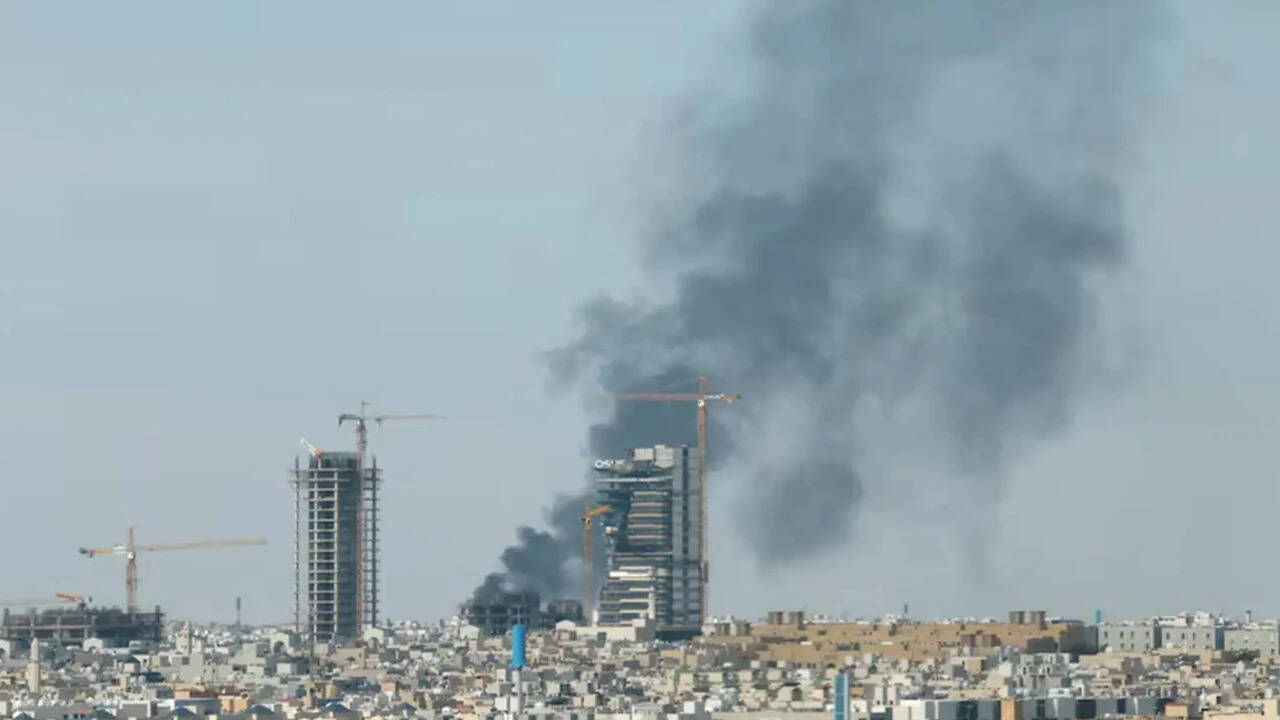
The regular thump of kinetic interceptions over Riyadh has ceased to be background noise for aviation analysts and security officials monitoring the Arabian Peninsula. When ballistic projectiles and explosive drones began piercing the airspace surrounding King Khalid International Airport, the illusion of absolute aerial impunity over the Saudi capital evaporated. This escalation marks a dangerous turn in a regional conflict that has shifted from localized border skirmishes to direct attacks on high-value civilian infrastructure.
For months, official communications from the Saudi-led coalition maintained a predictable narrative of total interception. Yet, the ground reality tells a different story. Shrapnel damage, structural fires near fuel depots, and recurrent flight suspensions expose the limitations of modern missile defense systems when faced with low-cost, asymmetrical saturation tactics.
The Mechanics of Aerial Saturation
Military doctrine relies heavily on the calculus of cost and interceptor inventory. Sophisticated Patriot and allied defense batteries are exceptionally effective against individual targets, but they face severe economic and logistical strain when confronted with incoming waves of modified ballistic missiles and loitering munitions.
A single interceptor missile costs millions of dollars, whereas the incoming threat is often manufactured for a fraction of that price. When multiple vectors are utilized simultaneously—targeting financial districts, petroleum infrastructure, and civil aviation hubs like King Khalid International Airport—defense networks experience severe capacity stress.
To understand the operational disruption, one must look beyond the physical impact zones. An international aviation hub does not need to sustain a direct hit to grind to a halt. The mere declaration of a hostile aerial threat over a capital city triggers immediate protocol changes. Departures are held at gates, inbound long-haul aircraft are forced into prolonged holding patterns or diverted to secondary regional airports, and crew duty-hour limits quickly unravel flight schedules.
The economic fallout radiates outward. Insurance risk premiums for carriers flying into the region spike instantly. Ground handlers, maintenance crews, and cargo logistics operators face cascading delays that take days to untangle. This systemic vulnerability is precisely what asymmetric operators exploit. They trade precision for disruption, achieving strategic psychological and economic effects through repeated airspace violations.
Strategic Shifts and Regional Realities
The intensification of strikes against the Saudi capital is tied directly to the breakdown of broader regional ceasefires and the hardening stances of regional actors. The conflict in Yemen has long ceased to be a domestic insurgency; it operates as an interconnected theater involving advanced missile technology, smuggled guidance components, and decentralized launch protocols.
Intelligence assessments indicate that the projectiles launched toward Riyadh utilize improved trajectory profiles designed to complicate radar acquisition. By altering flight paths and utilizing composite materials that reduce radar cross-sections, these weapons test the limits of existing warning infrastructure. When alarms sound across northern Riyadh and residents capture plumes of smoke near major transport arteries, the psychological contract between the state and its populace is tested.
The Cost of Retaliation and Deterrence
Military options for neutralizing these launch sites remain fraught with tactical complications. Aerial retaliation by coalition aircraft against remote or heavily fortified mountainous terrain in Yemen has historically yielded limited permanent deterrence. Mobile missile launchers and drone assembly units are easily concealed in rugged topography, civilian structures, or subterranean tunnels, making preemptive destruction exceptionally difficult even with advanced surveillance platforms.
Diplomatic channels, meanwhile, find themselves caught in a deadlock. International mediation efforts struggle to establish durable deterrence mechanisms when non-state actors operate with high autonomy and external logistical support.
As long as the technological divide between low-cost offensive saturation and high-cost defensive interception remains wide, critical infrastructure hubs will stay vulnerable. The strikes on the Saudi capital are not isolated anomalies; they represent a permanent evolution in modern aerial warfare where civilian gateways function as primary pressure points in geopolitical conflicts. Security architectures designed for conventional state-on-state wars must adapt rapidly to an era where asymmetric projectiles routinely challenge the skies above major global capitals.