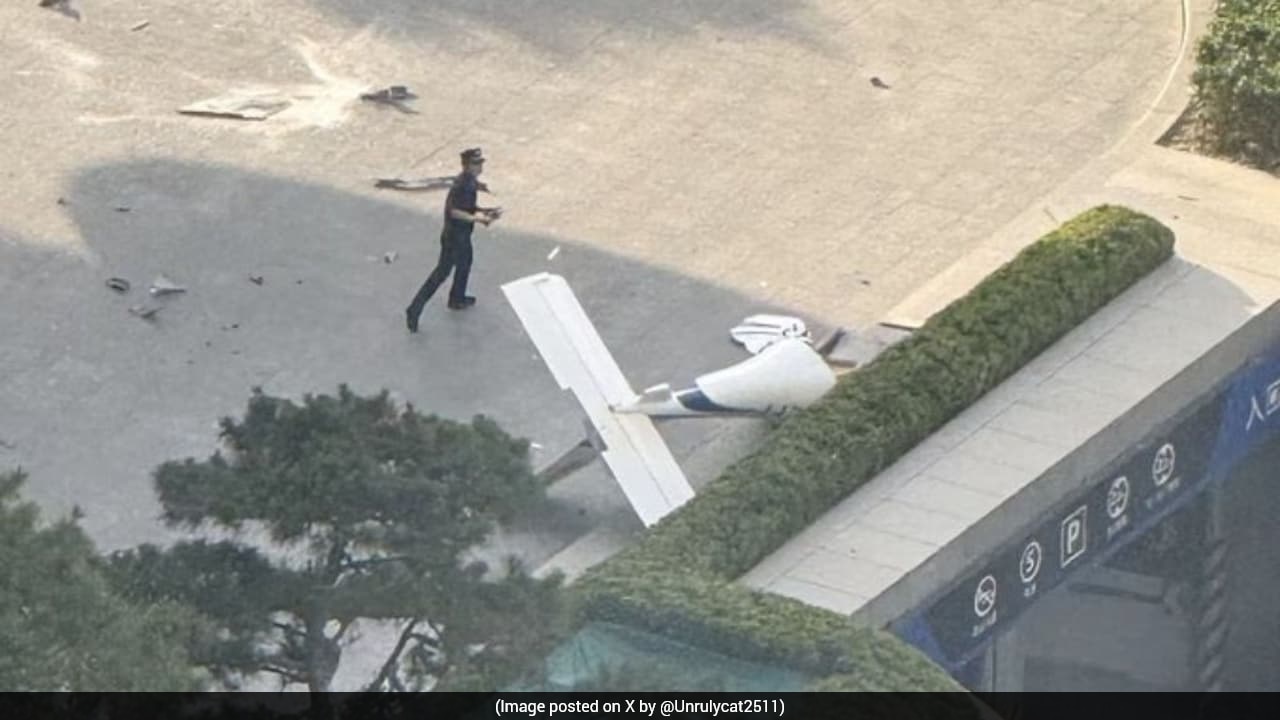
The push to open China's low-altitude airspace has hit a wall of dense smog, military bureaucracy, and a string of poorly documented disasters around the capital. Over the past two decades, general aviation accidents in and around Beijing have been treated less like systemic infrastructure failures and more like state secrets. While the government champions the "low-altitude economy" as a multi-billion-dollar driver of future economic growth, the reality on the ground—and in the skies—tells a story of unsafe airspace management, regulatory blind spots, and a terrifyingly high rate of pilot error.
For twenty years, small aircraft crashes around Beijing have followed a predictable, tragic pattern. Wealthy hobbyists, poorly trained commercial pilots, and experimental drone operators have consistently run afoul of the world's most restrictive airspace, resulting in fatalities that rarely make the front pages of the state-controlled press.
To understand why Beijing’s skies are so dangerous for small planes, one must first understand who actually controls the air. In Western nations, civil aviation authorities manage the vast majority of domestic airspace, leaving specific corridors for the military. China reverses this equation. The People’s Liberation Army (PLA) controls roughly 80 percent of the nation's airspace. Civil aviation is squeezed into the remaining 20 percent. Around Beijing, that commercial slice is even smaller, choked by political exclusion zones, missile defense perimeters, and the heavy traffic of three major commercial airports.
When a small helicopter or a light sports aircraft takes off in the Beijing-Tianjin-Hebei region, it enters a geographical shooting gallery. The margin for error is zero.
The Myth of Airspace Liberalization
Every few years, policymakers announce sweeping reforms intended to free up airspace below 1,000 meters for private and commercial use. Venture capitalists pour money into flight schools, light aircraft manufacturers, and medical evacuation startups. Then, a small aircraft clips a power line or strays too close to a restricted military installation outside Beijing, and the entire apparatus locks down for months.
This cycle of hype and panic has paralyzed the domestic general aviation sector. Private pilots face a logistical nightmare just trying to file a flight plan. In the United States, a pilot can check the weather, log onto an automated system, and take off within minutes. In Beijing, securing approval for a short cross-country flight can take days, requiring sign-offs from multiple regional air traffic control bureaus and military commanders.
Faced with these barriers, some operators choose to fly illegally. These unapproved flights, known colloquially in the industry as "black flights," are a primary driver of the region's accident rate.
Without air traffic control oversight, these pilots fly blind. They lack real-time updates on military exercises, temporary no-fly zones, and sudden weather shifts. The mountainous terrain surrounding northern and western Beijing creates violent, unpredictable downdrafts. A pilot in a light Cessna or a local Robinson R44 helicopter, lacking the instruments or the experience to handle these microclimates, can find themselves slammed into a hillside before they can even broadcast a distress signal.
Training Failures and the Culture of Deference
The mechanics of these crashes point to a deeper structural flaw: the dismal state of pilot training and the lack of a mature safety culture.
Flight hours are expensive in China, largely because of the fuel taxes, maintenance scarcity, and the cost of importing foreign aircraft. Consequently, many private pilots graduate from flight programs with the bare minimum of experience. They are book-smart but structurally unprepared for sudden emergencies.
Compounding this is a rigid cultural hierarchy within Chinese aviation companies. In a traditional cockpit environment, a junior co-pilot might hesitate to correct a senior captain, even if the captain is making a fatal error. In the general aviation sector, this manifests as a dangerous deference to the aircraft owner or corporate executive sitting in the back seat. If a wealthy real estate mogul demands to fly through heavy fog to reach a business meeting in neighboring Hebei province, pilots frequently override their own safety protocols to appease the client.
The machines themselves are also under immense strain. The gray market for aircraft parts in mainland China is notoriously difficult to police. Mechanics trained on large commercial jetliners are often hired to service small, foreign-built piston-engine planes, despite lacking the specific type certifications. They apply heavy-transport logic to delicate light aircraft frames. It is a recipe for catastrophic mechanical failure mid-flight.
The Invisible Toll of the Drone Boom
While manned aircraft crashes draw the most scrutiny, the quiet proliferation of heavy commercial drones has introduced a completely new layer of risk to the capital region.
Beijing has banned consumer drones within the Sixth Ring Road, a massive highway encircling the city center. Yet, agricultural spraying drones, topographical mapping units, and experimental cargo drones operate continuously just beyond that border. These are not small, plastic quadcopters bought at an electronics store. These are industrial machines weighing up to several hundred pounds, often powered by hybrid gas-electric engines.
The software managing these autonomous flights is far from infallible. Signal jamming near military installations frequently causes these drones to lose their GPS lock, triggering flyaway events where the machine drifts aimlessly until its fuel runs out.
When an industrial drone crashes into a rural village outside Beijing, the incident is rarely logged in public safety databases. Local officials routinely classify these events as industrial accidents rather than aviation incidents to shield local tech manufacturers from regulatory blowback. This lack of transparency prevents the industry from learning from its mistakes. The same software bugs and structural flaws are repeated across different manufacturing lines, waiting to cause the next mid-air collision.
The Price of Capital Protection
The overarching priority for air traffic management around Beijing is not efficiency, nor is it the economic health of private aviation businesses. It is the absolute, uncompromising protection of the political center.
This hyper-focus on security creates a high-pressure environment for civilian air traffic controllers. When a small plane deviates even slightly from its assigned, narrow corridor, controllers face intense pressure to ground the aircraft immediately or divert it into unfamiliar, dangerous territory to keep it away from sensitive areas.
Consider the geography of the region. The western edge of Beijing is bordered by the Xishan mountains. To the north lie the Yanshan mountains. A pilot diverted away from the city center is forced directly toward these high-altitude traps. If the pilot is already dealing with an engine issue or poor visibility, this forced redirection transforms a minor emergency into a fatal impact.
The tension between the government's economic desires and its security paranoia remains unresolved. The state cannot build a thriving, modern low-altitude economy while simultaneously treating every light aircraft like a potential national security threat. Until the military surrenders a significant portion of its low-altitude monopoly to an independent, transparent civilian regulator, the hills around Beijing will continue to serve as a graveyard for small aircraft.
To fix this crisis, the civil aviation authority must establish an independent accident investigation body modeled after global standards—one that publishes full, unedited reports regardless of who owned the aircraft or which manufacturer built it. Pilots need access to decentralized, real-time weather monitoring stations across the northern mountain passes, and air traffic control must prioritize flight safety over political zoning when an aircraft declares an emergency. Without these structural updates, any attempt to expand private flight operations around the capital is simply an invitation for more wreckage.