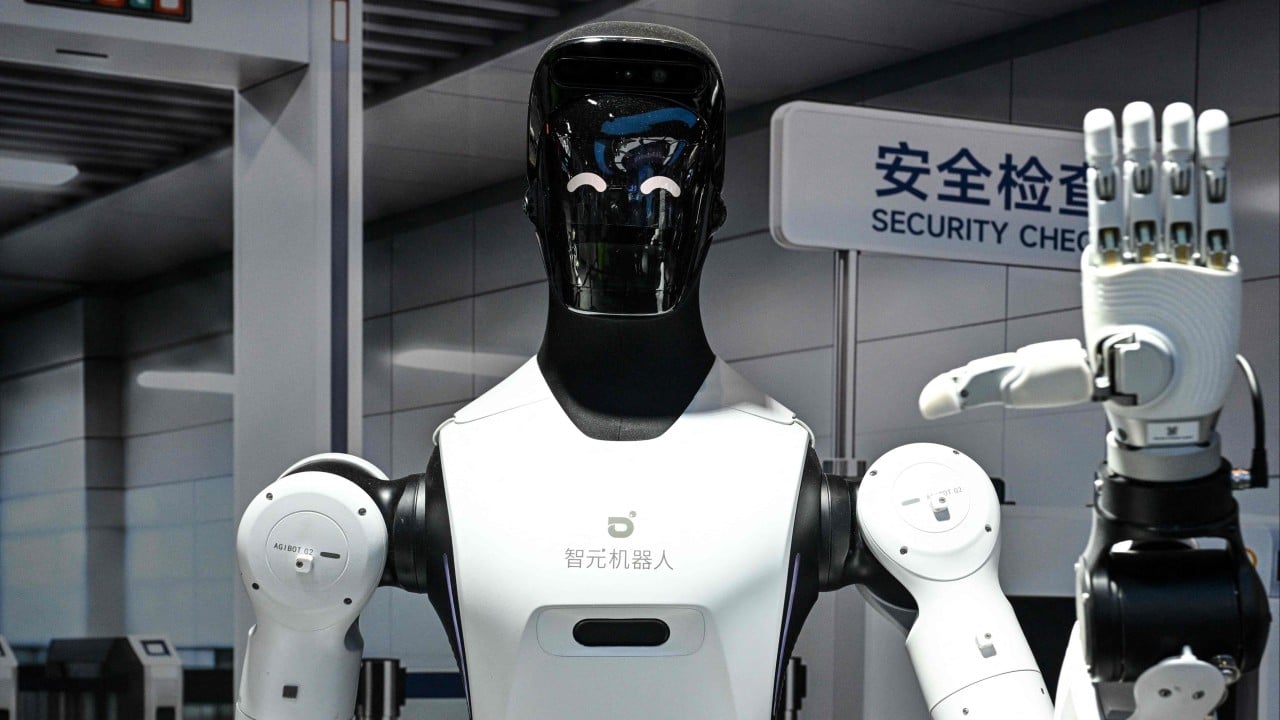
United States security officials and federal lawmakers are quietly constructing a regulatory wall to block Chinese humanoid robots from entering domestic supply chains, defense facilities, and industrial plants. Driven by fears of embedded espionage, remote sabotage, and critical infrastructure mapping, the push aims to preemptively ban bipedal and general-purpose machines built by foreign competitors before they achieve commercial scale. Unlike previous technological friction points that focused purely on software or fixed telecom hardware, this initiative target machines that possess physical mobility, high-definition environmental sensors, and real-time cloud connections.
The political movement mirrors earlier restrictions levied against Chinese telecommunications giant Huawei and drone manufacturer DJI. However, the stakes in embodied artificial intelligence are fundamentally different. A humanoid robot operates as a mobile computer platform equipped with direct mechanical agency over its surroundings. If an foreign-built unit gains access to an American logistics hub, defense manufacturing plant, or energy facility, the potential risks extend far beyond data theft. The machine can actively alter physical processes, map classified facilities in three dimensions, or halt operations through remotely executed firmware commands. For a closer look into this area, we suggest: this related article.
The Physical Threat Profile of Embodied Systems
To understand why national security advisors are sounding alarms, one must examine what actually goes inside a general-purpose robot. Modern bipedal machines do not function as isolated mechanical assemblies running fixed scripts. They rely on multi-modal neural networks that require vast streams of visual, acoustic, and spatial telemetry to maintain balance and manipulate objects.
Every active unit carries an array of high-resolution visual sensors, stereo depth cameras, micro-doppler radar, and Light Detection and Ranging units. These systems sweep environments continuously, constructing dense 3D spatial maps known as point clouds. In an industrial context, a fleet of bipedal units operating inside a semiconductor foundry or defense contractor factory would collect hyper-accurate structural blueprints, machine cycle frequencies, inventory volumes, and operational workflows. For broader information on this issue, comprehensive reporting is available at ZDNet.
When these machines connect to off-site servers for model updates, telemetry uploading, or fleet optimization, that spatial data inevitably moves across networks. Even if local data storage rules are mandated, verifying that proprietary model weights or background sensory data are not transmitted back to foreign servers presents an auditing nightmare. A single corrupted software patch could convert an industrial worker into an active surveillance node or a physical disruptor.
Consider a hypothetical security scenario involving an automated fulfillment center handling dual-use components. An operator uploads a routine over-the-air firmware update supplied by the foreign vendor. Hidden within the update is a latent routine designed to misalign high-torque joint actuators by fractions of a millimeter during heavy lifting. The result is catastrophic mechanical wear or direct physical destruction of critical inventory, disguised entirely as ordinary component failure.
The Shenzhen Hardware Advantage vs Western Software Superiority
The geopolitical challenge facing American policymakers is complicated by severe industrial imbalances. Western companies currently maintain a distinct advantage in fundamental artificial intelligence research, large behavior models, and foundation software architectures. China, conversely, dominates the physical manufacturing supply chain required to mass-produce complex electromechanical hardware.
Humanoid robots require high-density brushless direct current motors, high-precision planetary and harmonic strain wave gearboxes, custom force-torque sensors, and high-efficiency power management systems. Supply chain hubs in Shenzhen, Hangzhou, and Suzhou have spent two decades perfecting the mass manufacturing of these exact components for industrial automation, drones, and electric vehicles.
Chinese manufacturers can source, assemble, and test a fully functional general-purpose bipedal robot for a fraction of what it costs a Western counterpart. Units manufactured in Hangzhou are entering the commercial market at price points below thirty thousand dollars. Equivalent Western test platforms frequently cost upwards of one hundred fifty thousand dollars, largely because domestic component supply chains remain fragmented and low-volume.
This cost disparity creates a massive economic pull for domestic logistics providers and manufacturing companies. Business executives, pressured to cut operational overhead and offset rising domestic labor shortages, see low-cost foreign machines as an immediate operational necessity. Banning foreign hardware outright risks putting domestic firms at a severe cost disadvantage against international competitors who adopt lower-cost automation without regulatory friction.
Component Level Dependence Creates a Policy Trap
Washington faces a structural contradiction that complicates any blanket embargo. Banning finished Chinese humanoid robots is legally simple through existing executive authorities, but banning the underlying components within those robots could cripple the domestic robotics industry itself.
A significant percentage of Western robotics startups rely on Chinese suppliers for fundamental mechanical building blocks. Precision strain wave gears, custom motor stators, specialized neodymium magnets, and low-cost motor controllers are routinely imported from Asian factories to build American prototypes. If the Department of Commerce or the Federal Communications Commission imposes blanket restrictions on all sub-assemblies produced overseas, American robotics companies will see their own hardware costs skyrocket and development timelines stall.
Legislators are currently evaluating several statutory tools to address these vulnerabilities without shutting down domestic research labs.
- Section 301 Tariffs Expansion: Imposing severe duty hikes specifically targeted at foreign general-purpose autonomous machines and multi-axis joint assemblies.
- FCC Equipment Authorization Revocations: Restricting wireless spectrum access and network certification for hardware containing foreign-sourced communication chips and mainboards.
- National Defense Authorization Act Mandates: Prohibiting federal contractors, military bases, and critical infrastructure operators from deploying foreign-built autonomous physical platforms.
- Entity List Additions: Blacklisting foreign humanoid developers from accessing American silicon, such as specialized edge-computing microprocessors required for real-time spatial processing.
These legal instruments have precedent, but their enforcement in physical systems presents novel technical hurdles. Unlike a stationary cell tower, a mobile robot can be modified post-purchase. An importer might purchase a base mechanical chassis from an overseas supplier, retrofitting it domestically with American compute boards and proprietary software, blurring the boundary between foreign and domestic technology.
The Real Risk of Preemptive Overregulation
Industry analysts warn that an overly broad regulatory crackdown could yield unintended economic consequences. If the federal government restricts hardware access too early, it risks creating a domestic vacuum where automation costs remain artificially inflated.
China is actively deploying thousands of bipedal and quadrupedal units directly into its own state-backed industrial manufacturing plants. This aggressive operational deployment allows foreign engineering teams to gather real-world behavioral data at scale, rapidly refining motion control algorithms, hardware durability, and operational safety.
If American operators are prevented from acquiring low-cost physical platforms while domestic alternatives remain years away from mass manufacturing, the overall pace of domestic industrial modernization could stall. The United States could find itself in a situation where its artificial intelligence models are world-class, but its physical factories lack the accessible hardware required to run them.
Furthermore, national security regulations often lag behind technical realities. Securing a mobile machine requires auditing every layer of its stack, including low-level motor firmware, field-programmable gate arrays, micro-controllers, wireless transceivers, and high-level behavioral networks. Federal regulatory agencies currently lack the technical workforce and testing facilities required to perform deep hardware-level security audits on thousands of incoming autonomous machines.
Auditing the Silicon and the Steel
A practical regulatory framework will ultimately require hardware transparency rather than absolute isolationism. Security experts argue that true protection against foreign tampering requires open hardware architectures and mandatory source-code escrow for any automated system operating inside critical domestic supply chains.
Without mandatory zero-trust architecture built directly into the physical components, any imported motor controller or sensor array remains a potential vector for exploitation. A high-torque actuator with an embedded micro-controller contains enough onboard flash memory to store secondary, unverified operational routines. Detecting such hidden code inside a sealed epoxy-potted component requires advanced X-ray inspection and signal analysis, techniques far beyond the current scope of standard import inspections.
The battle over general-purpose robotics represents the next frontier of global industrial rivalry. As artificial intelligence transitions from abstract software screens into physical machines capable of moving through human environments, the boundary between consumer technology, industrial machinery, and national defense disappears completely.
Washington's attempt to draw a hard regulatory line against foreign physical hardware is not merely a trade dispute. It is a preemptive attempt to secure the physical ground upon which the future of industrial automation will be executed. Whether federal authorities can successfully balance national security imperatives against the cold economic reality of domestic manufacturing costs will determine which nations control the automated industrial base of the coming decades.