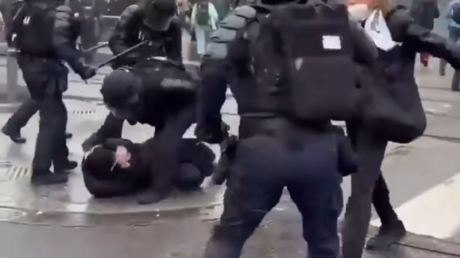
French riot police deployed batons, tear gas, and stun grenades against demonstrators in Lyon during recent street protests, a tactical escalation driven by a rigid crowd-control doctrine that treats public dissent as an immediate territorial threat. While viral clips capture the visceral shock of Compagnies Républicaines de Sécurité (CRS) units charging down narrow cobblestone streets near Place Bellecour, those ten-second videos strip away the institutional machinery behind the violence. What looks like spontaneous chaos on a smartphone screen is actually the predictable output of France's centralized policing model, a system built for rapid suppression rather than de-escalation.
To understand why Lyon repeatedly erupts into clouds of CS gas, you have to look past the immediate spark of any single demonstration. Whether the crowd gathers over pension reforms, environmental policy, or labor disputes, the choreography on the pavement remains virtually identical. A peaceful march moves along a pre-approved route. Friction builds at a chokepoint. Suddenly, flashbangs echo off nineteenth-century stonework, tear gas canisters arc over the crowd, and armored officers advance with batons raised.
The videos circulating online show the impact. They rarely show the architecture of the response.
The Anatomy of a Lyon Street Confrontation
Lyon's geography makes it uniquely volatile for public demonstrations. Unlike Paris, where wide Haussmannian boulevards allow large crowds to disperse easily and give police clear lines of sight, central Lyon is squeezed onto a narrow peninsula—the Presqu'île—sandwiched between the Rhône and Saône rivers.
When tens of thousands of people march between Place Jean Macé and Place Bellecour, they are funneling into a geographical bottleneck. Bridges become natural choke points. Side streets are narrow, lined with outdoor café seating, construction scaffolding, and storefronts that offer zero room for maneuver once a police charge begins.
In this tight urban corridor, the French doctrine of maintien de l'ordre (maintenance of public order) collides directly with basic crowd physics. Standard protocol relies on holding strict perimeter lines and using chemical irritants to clear squares quickly. When police fire tear gas in a confined street on the Presqu'île, the gas does not dissipate upward; it pools between five-story buildings, blinding peaceful marchers, bystanders, and journalists alike.
Panic follows instantly. People run toward the only open exits, which are frequently blocked by stationary lines of Gendarmerie Mobile vans. Trapped between choking gas and armored shields, the crowd compresses. From the police perspective, a surging crowd looks like an imminent breach of the line. From the protesters' perspective, they are simply trying to breathe. That perceptual gap is where baton charges happen.
How French Crowd Control Diverges From Europe
If you cover protests across Western Europe long enough, you notice stark philosophical divides in how states manage angry citizens. Germany, the United Kingdom, and Scandinavian nations spent the last three decades overhauling their public-order policing after disastrous riots in the 1980s and 1990s. They shifted toward de-escalation policing—a model built on dialogue, visible communication teams, targeted arrests of violent individuals, and keeping heavy riot gear out of sight until an actual threat materializes.
France took the opposite path.
The French model remains rooted in a post-war paramilitary tradition. Units like the CRS and the Gendarmerie Mobile are housed in barracks, trained in military formations, and deployed as heavy infantry rather than community peacekeepers. Their primary objective is not to facilitate the safe expression of protest, nor is it to isolate individual troublemakers while letting the main march proceed. Their objective is spatial dominance: hold the perimeter, protect state buildings, and clear the street on command.
Consider the equipment sitting on a standard French riot squad's belt compared to their counterparts in Berlin or London:
- Tear Gas Launchers (Cougar): High-velocity launchers capable of firing multiple canisters of CS gas across long distances, creating an immediate chemical barrier that makes no distinction between a stone-thrower and an elderly union member.
- Sting-Ball Grenades (GM2L and GENL): Explosive devices that combine a deafening acoustic blast with tear gas and, in certain models, hard rubber projectiles designed to scatter crowds through acute pain and disorientation.
- LBD 40 Launchers: 40mm semi-automatic launchers firing dense foam-tipped projectiles—intermediate weapons banned or strictly restricted for crowd control in nearly every other European Union member state due to the high risk of permanent eye and cranial injuries.
- Telescopic and Tonfa Batons: Used in rapid shock-charges (charges de dégagement) meant to push crowds back dozens of meters in seconds.
When an officer carries kinetic launchers and explosive grenades as standard issue, every operational plan bends toward using them. You do not deploy armored units armed with intermediate military ordnance to engage in gentle crowd psychology.
The Rise of Non-Specialist Units on the Front Line
For decades, veteran CRS commanders knew how to absorb tension. Even within a rigid system, specialized riot officers understood crowd rhythms; they knew when to hold back, when to absorb insults without flinching, and how to clear an intersection without triggering a stampede.
That institutional restraint eroded significantly following the Yellow Vest (Gilets Jaunes) movement that began in late 2018.
Faced with simultaneous demonstrations in dozens of cities every weekend, the French Interior Ministry ran out of trained riot personnel. To plug the gap, commanders began deploying Brigades Anti-Criminalité (BAC) and BRAV-M (motorized rapid-response units) to police political demonstrations.
This was a structural turning point. BAC officers are plainclothes and tactical units trained to hunt down armed drug dealers, carjackers, and violent criminals in high-crime suburbs. Their entire professional conditioning revolves around rapid, aggressive takedowns and neutralizing dangerous suspects at close range. They receive minimal training in crowd psychology, constitutional assembly rights, or static perimeter patience.
When you drop anti-crime units into a chaotic protest in Lyon, they do not manage a crowd; they hunt targets. Numerous investigations by French media outlets and human rights monitors—including Amnesty International and the Council of Europe's Commissioner for Human Rights—have documented that the sharpest spikes in baton beatings and indiscriminate tear-gassing occur when non-specialist tactical units operate alongside traditional riot squads.
Why Viral Videos Distort the Full Picture
Social media algorithms reward visual shock, which creates a dangerous blind spot for anyone trying to understand what actually happens on the ground in Lyon.
A fifteen-second clip showing an officer swinging a baton at a retreating protester generates millions of views and immediate outrage. Conversely, a ten-second clip posted by a police union account showing masked individuals hurling cobblestones and commercial fireworks at a stationary police line generates equal outrage from the opposite political camp. Both clips are real. Both are completely incomplete.
In my years covering civil unrest, the most critical moments almost never appear on X or TikTok because they look boring on camera. The real story happens twenty minutes before the first baton swings.
It happens in the prefectural command room, where the local Préfet—an unelected state representative appointed directly by Paris—decides whether to authorize a route or ban a gathering at the eleventh hour. In Lyon, the Rhône prefecture has repeatedly used last-minute administrative bans to outlaw demonstrations in central districts. When a protest is declared illegal an hour before it starts, thousands of people who are already downtown instantly become unlawful assembly participants. Police are then legally obligated to disperse them, turning a routine political march into an immediate confrontation.
It also happens through the tactic known as kettling (nasse), where police surround a section of a march on all sides, cutting off exits for hours while periodically firing tear gas into the trapped pocket. Kettling rarely produces a single dramatic viral moment, yet it inflicts intense psychological and physical distress on everyone inside, guaranteeing that the crowd's anger will boil over the moment an exit finally opens.
The Black Bloc Dilemma and Mutual Escalation
Any honest assessment of street clashes in Lyon has to confront the reality of Black Bloc tactics. Pretending that every person in the street is holding a cardboard sign and singing union songs insults the intelligence of anyone who has actually stood on the pavement during a French protest.
Lyon has long hosted a dedicated radical activist scene, alongside far-right nationalist groups in neighborhoods like Vieux Lyon, creating a volatile political ecosystem. During major national mobilization days, loosely organized groups dressed in black infiltrate the front of marches. They smash bank windows, torch municipal trash bins, pry up paving stones, and launch heavy mortars directly at police lines.
For rank-and-file officers standing in heavy Kevlar armor for eight hours without a break, facing incoming projectiles and commercial explosives is genuinely terrifying. Police unions—such as Alliance Police Nationale and UNSA Police—rightly point out that hundreds of officers suffer burns, fractures, and concussions every year during protest duty.
Yet here lies the central operational failure of the French strategy: collective punishment does not stop Black Bloc radicals.
Experienced street militants show up prepared. They wear industrial respirators, swim goggles, helmets, and heat-resistant gloves. When police flood an avenue with tear gas and launch baton charges, the militants simply put on their masks, slip down a side alley, and regroup three blocks away to smash another storefront.
The people who actually absorb the brunt of the tear gas and the batons are the unequipped majority—students, nurses, teachers, retirees, and local shopkeepers—who came out to exercise a constitutional right and have no protective gear when the air turns toxic. By reacting to localized property damage with area-wide chemical saturation and blind charges, police alienate the peaceful majority, validate the radicals' narrative that the state is inherently violent, and guarantee even larger, angrier crowds the following week.
Accountability and the Oversight Vacuum
When baton strikes cross the line into unlawful assault—hitting compliant protesters on the ground, striking credentialed journalists clearly wearing press armbands, or firing launchers at head level—the mechanism for accountability in France moves at a glacial pace, if it moves at all.
Allegations of misconduct are referred to the Inspection Générale de la Police Nationale (IGPN), often referred to as the "police of the police." Unlike independent civilian oversight boards in countries like the United Kingdom (the IOPC), the IGPN is staffed primarily by active police commissaires answering directly to the Interior Ministry.
Statistical data published by French judicial monitors and investigative outlets like Mediapart and Libération consistently show a massive bottleneck between complaints filed and actual sanctions delivered. Out of hundreds of formal investigations opened into protest-related injuries following major demonstrations, only a tiny fraction ever reach a criminal courtroom, and even fewer result in meaningful disciplinary action.
Two structural hurdles protect officers in the field:
- Anonymity in Full Riot Gear: Despite legal mandates requiring officers to display their seven-digit identification number (RIO) visibly on their uniforms, inspectors and journalists routinely document riot squads covering their badges with Velcro patches, tactical vests, or simply omitting them entirely. Without a visible RIO number, identifying which specific officer swung a baton in a cloud of tear gas becomes nearly impossible.
- Institutional Solidarity and Political Backing: Successive French interior ministers have treated any structural criticism of riot policing as an attack on the republic itself. Because police unions wield immense political leverage in France—capable of staging slowdowns or threatening to withhold cooperation ahead of major elections—governments are deeply reluctant to ban controversial weapons or reform rules of engagement.
What Meaningful Reform Actually Requires
Fixing the cycle of violence in Lyon does not require inventing a new theory of law enforcement. The blueprint already exists across the border.
In Germany, police forces adopted the 3D philosophy—Dialogue, De-escalation, De-confrontation—backed by strict legal frameworks governing proportionality. German anti-conflict teams (Konfliktmanager), dressed in clearly marked vests without heavy armor, walk alongside and inside marches, speaking directly with organizers in real time to resolve bottlenecks before tension peaks. When small groups throw objects, specialized snatch squads make targeted arrests of the specific individuals responsible, leaving the rest of the march completely untouched. Tear gas and water cannons are treated as absolute last resorts requiring high-level authorization, not routine crowd-dispersal tools deployed at the first sign of friction.
In Switzerland and Sweden, similar dialogue-driven models have dramatically reduced both protester injuries and officer casualties over the past twenty years. The core insight is simple: when the state treats a crowd as an enemy army, the crowd begins to behave like one. When the state protects the right to march while surgically removing violent actors, the peaceful majority isolates the extremists on its own.
France's current Schéma National du Maintien de l'Ordre (National Crowd Control Plan), updated in 2021, pays lip service to communication and de-escalation on paper. On the cobblestones of Lyon, however, nothing has changed because the underlying incentives, weaponry, and command structures remain intact.
Until Paris strips non-specialist anti-crime units off protest duty, enforces mandatory badge visibility with real legal consequences, and retires indiscriminate area-denial weapons in favor of targeted policing, those viral videos from Lyon will keep appearing in your feed every few months—same narrow streets, same clouds of gas, same preventable casualties.