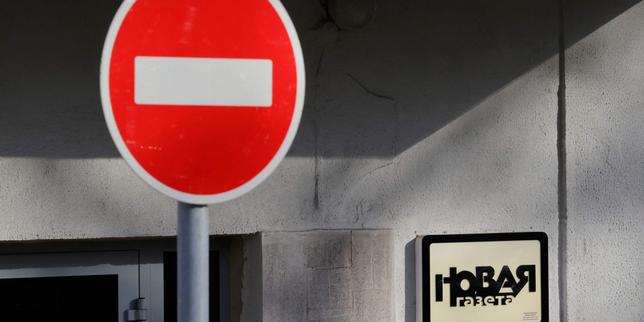
The Norwegian Nobel Committee’s demand that Russian authorities end the crackdown on Novaya Gazeta highlights a stark geopolitical reality. An international peace prize cannot stop a domestic regulatory guillotine. Following the suspension of the newspaper’s print license by Russia’s media watchdog, Roskomnadzor, and the revocation of its registration by Moscow’s Basmanny District Court in September 2022, the Nobel Committee warned that the dismantling of Russia's last major independent newspaper represents a severe blow to press freedom. Yet the Kremlin’s strategy reveals a calculated shift away from overt censorship toward bureaucratic asphyxiation, leaving international institutions with moral authority but almost zero enforcement power.
The numbers tell a grim story. Before its forced suspension, Novaya Gazeta operated for nearly three decades as an anomaly in the post-Soviet media ecosystem. Founded in 1993 with funds from former Soviet leader Mikhail Gorbachev’s own 1990 Nobel Peace Prize, the outlet survived financial collapses, cyberattacks, and the targeted killings of six of its journalists and contributors, including Anna Politkovskaya. When editor-in-chief Dmitry Muratov was awarded the Nobel Peace Prize alongside Filipino journalist Maria Ressa in October 2021, observers hoped the global spotlight would act as a protective shield. Don't miss our previous post on this related article.
It did not. Within five months of Muratov accepting the medal in Oslo, Russia launched its full-scale invasion of Ukraine, and the legal architecture designed to tolerate controlled dissent vanished overnight.
How Bureaucratic Lawfare Replaced Direct Censorship
To understand how Moscow silenced an institution that survived thirty years of political turbulence, you have to look at the mechanics of modern authoritarian media control. The Kremlin rarely relies on crude, singular decrees anymore. Instead, state agencies deploy overlapping administrative, financial, and judicial pressures that make legal operation mathematically impossible. To read more about the context of this, BBC News offers an excellent summary.
In early March 2022, the Russian parliament passed sweeping amendments to the criminal code. These laws criminalized the dissemination of what the state defines as "false information" about the Russian Armed Forces, carrying penalties of up to fifteen years in prison. Simultaneously, Roskomnadzor issued strict directives forbidding media outlets from using words like "war," "invasion," or "occupation" to describe the conflict in Ukraine. Journalists were legally required to rely exclusively on official Russian Ministry of Defense briefings.
For Novaya Gazeta, compliance meant surrendering its journalistic mandate; defiance meant immediate imprisonment for its staff in Moscow. On March 28, 2022, after receiving two formal warnings from Roskomnadzor—the statutory threshold required for a state agency to petition a court to revoke a media license—the newspaper announced it was suspending both its print and online operations until the end of the "special military operation."
The state did not wait for the war to end. By September 2022, Roskomnadzor successfully petitioned the courts to strip Novaya Gazeta of its print registration entirely, citing a technicality regarding the failure to submit editorial charter updates following a change of ownership in 2006. Days later, the Supreme Court revoked the license of its website.
This legal maneuver achieved two critical objectives for Russian authorities:
- Criminalizing Journalism by Default. Without a valid media registration, any investigative reporting conducted inside Russia loses its legal press protections, exposing reporters to immediate prosecution as unauthorized actors or foreign agents.
- Severing Domestic Revenue Streams. State advertisers had abandoned independent media years earlier, leaving outlets like Novaya Gazeta reliant on crowdfunding and reader subscriptions. Revoking official status disrupts payment processing, banking access, and physical distribution networks inside the country.
The Nobel Committee’s Dilemma in an Era of Hard Power
When Berit Reiss-Andersen, then-chair of the Norwegian Nobel Committee, issued statements condemning the revocation of Novaya Gazeta's license and calling on Russian authorities to end the repression of independent media, she was exercising the primary tool available to Oslo: reputational pressure.
Historically, the Nobel Peace Prize has occasionally altered the calculus of authoritarian regimes. When Carl von Ossietzky won in 1935 while imprisoned in a Nazi concentration camp, or when Andrei Sakharov won in 1975 during the height of Soviet stagnation, the prize forced global diplomacy to confront domestic human rights abuses. In the late Cold War, the Soviet leadership cared deeply about its international standing, trade agreements, and cultural legitimacy in Western Europe.
That diplomatic leverage has largely evaporated. By late 2022, Moscow had already absorbed unprecedented Western economic sanctions, diplomatic expulsions, and cultural boycotts. To Russian policymakers operating under a wartime siege mentality, condemnation from a committee in Oslo carries negligible political cost. In fact, state media apparatus routinely weaponizes Western accolades, framing Nobel laureates and foreign-funded NGOs as instruments of Western intelligence agencies designed to destabilize Russian society from within.
Dmitry Muratov himself recognized the limits of the prize's protective aura early on. In March 2022, he auctioned off his physical Nobel gold medal—which sold for a record $103.5 million—to raise funds for Ukrainian child refugees through UNICEF. The gesture underscored a pragmatic truth: the symbolic prestige of the medal was worth far less to surviving journalists than tangible humanitarian aid.
The Exile Split and the Fight for the Domestic Audience
The closure of Novaya Gazeta in Moscow did not end the publication, but it fractured its identity and forced a grueling strategic debate that now defines all independent Russian journalism.
Following the March 2022 suspension, a group of Novaya Gazeta journalists who had fled Russia established Novaya Gazeta Europe in Riga, Latvia. Operating outside the jurisdiction of Roskomnadzor, the Riga-based newsroom immediately resumed aggressive investigative reporting on Russian military casualties, economic sanctions evasion, and domestic political repression. However, Russian authorities swiftly blocked the Novaya Gazeta Europe website inside Russia and later designated the organization as "undesirable"—a legal classification that makes it a criminal offense for any Russian citizen to share its links, donate money to it, or participate in interviews with its reporters.
Meanwhile, Muratov and a core group of staff remained in Moscow, attempting to preserve a legal foothold inside the country. They launched a new magazine, Novaya Rasskaz-Gazeta, which Roskomnadzor blocked within days of its first issue.
This division highlights the central paradox facing exiled media ecosystems today:
- Freedom vs. Reach. Journalists operating from Latvia, Lithuania, Germany, or Georgia enjoy complete editorial freedom and physical safety, yet they face severe technical barriers reaching readers inside Russia. Virtual Private Networks (VPNs) are regularly throttled or banned by Russian telecom regulators, turning everyday news consumption into an act of technical subversion.
- Presence vs. Self-Censorship. Journalists who stay inside Russia retain an intimate, irreplaceable understanding of the domestic mood and direct access to local sources. Yet they operate under the constant threat of arrest, forced to navigate an ever-shifting maze of unspoken red lines where yesterday’s permissible phrasing becomes tomorrow’s felony.
Critics of Western media strategy argue that international observers often overestimate the domestic impact of exiled outlets. While publications like Novaya Gazeta Europe, Meduza, and The Insider produce vital journalism for policymakers, researchers, and urban, tech-savvy Russians, the vast majority of the Russian population continues to consume news through state-controlled television networks and heavily moderated domestic social platforms like VKontakte and Telegram.
What Happens When Investigative Journalism Goes Dark
The silencing of Novaya Gazeta is not merely a press freedom metric for international watchdogs; it represents the removal of an institutional check on state corruption and military accountability.
For nearly thirty years, Novaya Gazeta functioned as an unofficial ombudsman in a political system with weak judicial independence. When local officials in distant regions embezzled public funds, when prison guards tortured inmates, or when security forces carried out extrajudicial detentions in the North Caucasus, citizens brought their documents to Novaya Gazeta’s editorial office on Potapovsky Pereulok in Moscow. Investigations published in the paper frequently triggered official criminal inquiries—not because the Kremlin loved the press, but because central authorities used independent reporting to monitor the incompetence and graft of regional elites.
Without that reporting mechanism, information flows upward through state hierarchies unchallenged. Bureaucracies incentivized to report success rather than reality inevitably distort the data reaching top decision-makers.
At the same time, the crackdown has exposed the vulnerability of legacy journalism models in closed societies. Relying on formal state registration, physical printing presses, and centralized newsrooms made Novaya Gazeta easy to target once the state decided to pull the plug. Newer, decentralized collectives—operating through encrypted messaging channels, distributed researcher networks, and cross-border open-source intelligence (OSINT) partnerships—have proven harder to eradicate entirely, though they lack the institutional weight and investigative depth of a legacy newsroom.
The Norwegian Nobel Committee’s call to end the repression in Russia remains a vital record of international solidarity, ensuring that the dismantling of Novaya Gazeta is not normalized as a routine administrative dispute. Yet inside Russia, the mechanics of survival have moved far beyond diplomatic statements. Independent reporting now survives not through international shields or court appeals, but through encrypted servers, anonymous tip lines, and readers willing to bypass state firewalls just to read the news.