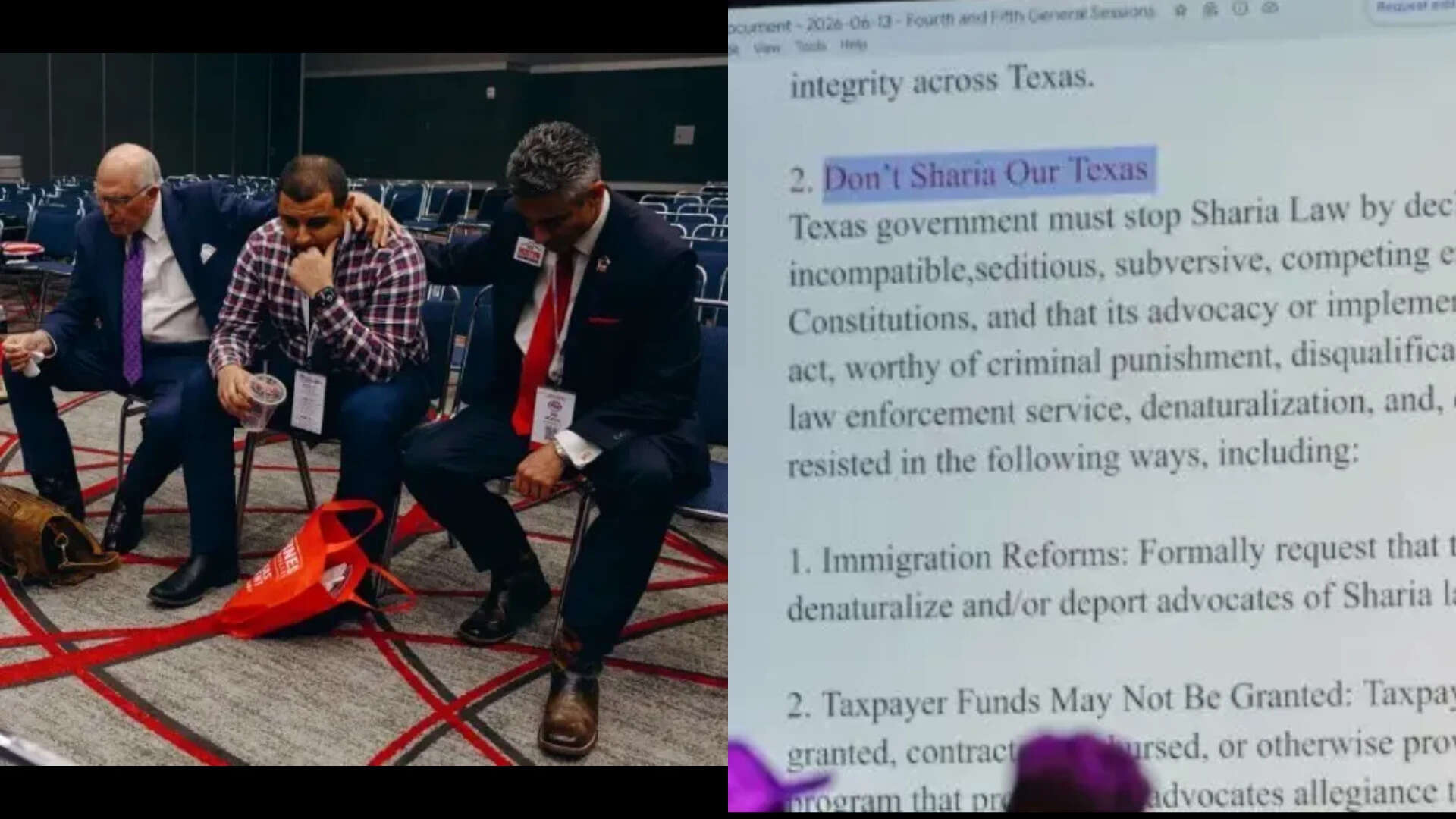
The internal war for the ideological soul of the Texas Republican Party reached a raw, visible flashpoint inside Houston’s George R. Brown Convention Center. Registered Muslim delegates, who arrived to participate in the democratic process based on shared fiscal and social conservatism, faced aggressive demands to renounce their faith, leave the party, and exit the country. The open hostility exposes a widening structural rift within the state's dominant political machine, where the traditional big-tent coalition is being dismantled in favor of an unyielding, institutionalized Christian nationalism.
This friction did not erupt in a vacuum. It represents the culmination of a deliberate, multi-year pivot by party leadership to replace traditional wedge issues like border security with targeted anti-Islam platform mandates.
Purging the Big Tent
For decades, conservative strategists pointed to the natural alignment between devout Muslims and the Republican platform. On paper, the overlap is substantial. Both groups generally champion traditional family structures, strict opposition to gender fluidity, a distaste for gambling and alcohol, and a fierce commitment to entrepreneurial capitalism.
Engineering business owner Amjad Muhtaseb and his wife, Samar Halabi, a local school teacher, arrived at the biennial gathering as registered delegates. They did not come to protest. They came because they always vote Republican and wanted to build inroads for more conservative Muslims within the party structure. Instead, Halabi, wearing a traditional hijab, was met with open harassment from passing attendees who warned others not to sit near her.
The institutional response was even more severe. Outgoing state party chair Abraham George used his platform to openly direct Muslim delegates toward the political opposition, telling them from the stage that a Democratic convention was happening in a few weeks and that they should join it instead.
The immediate catalyst for the purge was an institutional policy decision tracking back to executive state leadership. Governor Greg Abbott previously designated the Council on American-Islamic Relations, the nation's largest Muslim civil rights organization, as a hostile entity. Because several of the delegates had historic ties to local chapters of the organization or had attended its civil rights press conferences, party hardliners weaponized the designation to demand their immediate expulsion from the convention floor.
The Friction of a New Purist Platform
When grassroots activists attempted to formally strip these individuals of their delegate credentials, they hit a bureaucratic wall. The permanent rules of the party did not grant the convention floor the authority to retroactively unseat properly registered county delegates.
Rather than backing down, the convention apparatus shifted toward permanent structural exclusion. Delegates voted to alter internal party rules for the 2028 convention, explicitly empowering the internal Credentials Committee to unilaterally remove any future delegate suspected of maintaining ties to organizations the party deems a threat.
The ideological shift was chiseled directly into the official 2026 Texas GOP platform. Delegates successfully approved a series of aggressive amendments designed to restrict Islamic religious expression while simultaneously expanding protections for Christian practices.
- Mandated Curriculum: Public schools must now explicitly teach that Islamic religious frameworks are fundamentally incompatible with the United States Constitution.
- Prayer Restrictions: The platform demands an end to requirements that public schools or private businesses provide designated time slots for daily prayers.
- Dietary Prohibitions: New provisions explicitly bar public schools from being forced to accommodate or serve halal certified meals.
Concurrently, the updated platform doubles down on the institutional promotion of Christianity, backing the mandatory display of the Ten Commandments in public school classrooms and explicitly carving out protected prayer times for Christian students.
The Strategist Calculation
This aggressive pivot toward absolute religious nationalism is a calculated survival mechanism for a state party facing shifting demographics. As internal polling suggests that traditional talking points around border security yield diminishing returns among an exhausted electorate, strategist factions have actively sought out an existential cultural adversary to maintain maximum grassroots mobilization.
The political risk of this strategy is severe. By telling socially conservative, high-income immigrant communities that they are structurally unwelcome, the Texas GOP risks freezing its own growth in rapidly expanding suburban battlegrounds like Fort Bend and Collin counties. These are the exact regions where business-minded, religious minority voters have historically tipped the scales to keep Texas red.
The party’s newly elected chair, D’rinda Randall, publically dismissed concerns over the treatment of religious minorities, asserting that the party remains fully unified and single-mindedly focused on general election victories.
Yet the emotional fallout on the convention floor tells a far more volatile story. Mohamed Hussein, a healthcare manager whose family emigrated from Egypt in 1992, was left in tears after a confrontation with prominent evangelical leaders who told him to convert to Christianity or leave the United States entirely. The exchange ended not with an apology, but with an offer from the activists to pray for his conversion.
The modern Texas Republican machinery has made its choice clear. It is no longer interested in a grand coalition built on shared economic principles or shared social conservatism. It is actively transforming itself into a theological vanguard, betting the future of its political dominance on the absolute exclusion of anyone who does not look, vote, and pray exactly like its leadership.