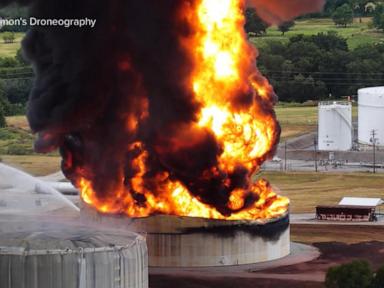
When a lightning strike triggered a catastrophic multi-tank explosion at the Explorer Pipeline facility in Glenpool, just outside Tulsa, Oklahoma, the resulting fireball sent jagged shards of steel flying through the air and forced immediate local evacuations. Beneath the dramatic footage of black smoke billowing near Tulsa International Airport lies a much quieter, more unsettling reality. This regional disaster is not just an isolated act of weather-related misfortune. It is a glaring stress test of America's refined product distribution network, exposing how quickly a single lightning bolt can ripple through regional fuel markets and disrupt the delicate supply chains feeding the Midwest.
The incident began in the pre-dawn hours, striking the heart of Explorer's 1,800-mile pipeline architecture. Three storage tanks containing natural gasoline caught fire, turning a vital 3.4-million-barrel storage hub into an active hazard zone. For decades, facilities like the Glenpool tank farm have operated with the tacit understanding that severe weather remains an occupational hazard. Yet, as atmospheric volatility increases across the Great Plains, the engineering margins protecting these multi-million-barrel hubs face unprecedented scrutiny.
The Anatomy of a Critical Infrastructure Failure
To understand why a fire in suburban Oklahoma matters to drivers hundreds of miles away, you have to look at the plumbing of domestic energy. The Glenpool facility acts as a major artery junction. It manages product flow across a system capable of pumping hundreds of thousands of barrels of motor gasoline, diesel, and jet fuel daily from the Texas Gulf Coast up into major metropolitan markets like St. Louis and Chicago.
When Explorer officials ordered a complete operational shutdown of the hub, neighboring entities scrambled. Phillips 66 halted operations at directly connected facilities as a precautionary measure, illustrating the domino effect inherent in modern petroleum logistics.
Insurance adjusters and safety engineers talk about redundancy, but pipeline architecture often operates on razor-thin efficiency margins. When a primary junction goes dark, rerouting millions of gallons of refined product is not as simple as flipping a switch. Storage depots are designed to buffer supply fluctuations, but when those tanks are actively burning or cordoned off by emergency responders, the buffer disappears.
The Vulnerability of Lightning Protection Systems
Industrial tank farms are heavily armored against the elements. Grounding grids, lightning mast protection, and floating roof seals are standard components of modern petroleum storage engineering. Yet, nature routinely finds the tolerances that human engineering missed.
Natural gasoline, a highly volatile liquid hydrocarbon extracted during natural gas processing, demands rigorous vapor containment. When a direct lightning strike breaches primary defense mechanisms, the margin for error evaporates in seconds. Investigators from federal and state agencies are now left asking a rigorous question: Did standard lightning mitigation fail, or did the sheer electrical intensity of the storm overwhelm systems built to decades-old code requirements?
Industrial safety experts note that older tank farms often grandfather in legacy infrastructure. While newer facilities incorporate advanced static dissipation membranes and rapid-suppression foam systems capable of dousing pool fires before they escalate, retrofitting an entire 30-tank complex requires capital expenditures that corporations frequently defer until regulatory mandates force their hand.
The Broader Market Fallout
Energy markets react to uncertainty faster than physical fuel can be trucked across state lines. Even though Explorer maintained that pipeline segments outside the Glenpool hub remained functional, the temporary suspension of inbound and outbound custody transfers creates immediate pricing friction.
Traders tracking regional spot prices immediately priced in the risk of constrained supply. Natural gasoline serves dual masters as a vital blending component for high-octane motor gasoline and a primary diluent exported to Canada for heavy crude extraction. Disrupting the supply at a major distribution nexus places upward pressure on wholesale costs at precisely the time of year when consumer demand remains high.
Local residents forced behind police perimeters are left dealing with immediate property and environmental concerns, while national logistics coordinators grapple with structural fragility. Emergency services deployed specialized foam trucks to starve the remaining fuel of oxygen, a painstaking process that can take days when multiple high-volume tanks are compromised simultaneously.
The smoke over Tulsa will eventually dissipate, and the twisted metal of the Glenpool yard will be hauled away for salvage. But the systemic vulnerability remains baked into the landscape. Until energy corporations commit to modernizing lightning and fire defense systems across secondary and tertiary storage hubs, the next severe thunderstorm will always carry the threat of a multi-state supply crisis.