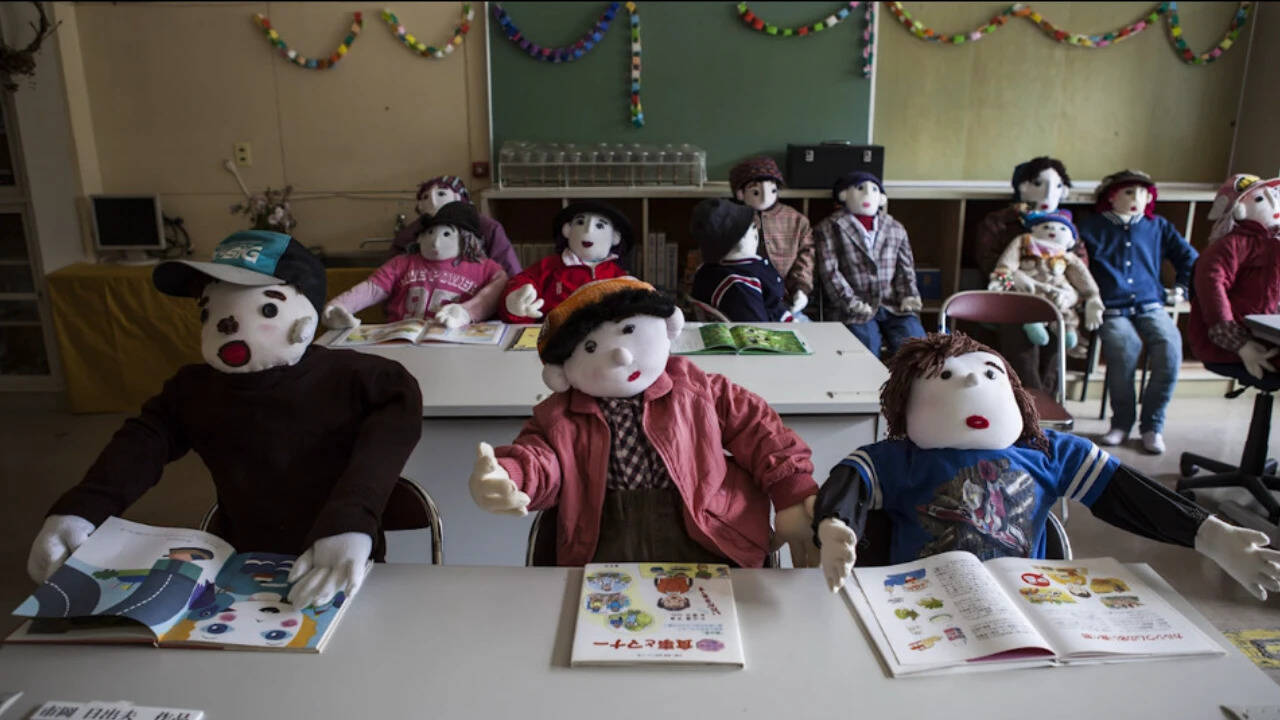
The road to Nagoro does not invite casual travelers. It demands patience, worn suspension, and a tolerance for hairpin turns that cling to the steep walls of Japan's Iya Valley. Located deep in Tokushima Prefecture, this remote mountain settlement once hummed with the quiet industry of forestry and dam construction. Today, the primary population metric is stark. Life-size fabric dolls outnumber breathing residents by roughly ten to one.
When people search for Nagoro village dolls, they are usually looking for a bizarre tourist curiosity, a viral curiosity piece about a ghost town populated by handmade effigies. They imagine a whimsical open-air museum designed to attract thrill-seekers or art critics. That assumption misses the underlying reality completely. The dolls are not an art installation or a marketing stunt. They are an unyielding monument to grief, a desperate local archive created by a single resident named Tsukimi Ayano to fight the crushing erasure of her hometown.
To understand Nagoro is to understand the terrifying velocity of rural depopulation in modern Japan. This is not just a localized tragedy tucked away in Shikoku. It serves as a stark preview of what awaits thousands of aging communities across the developed world as birth rates plummet and youth migrate toward hyper-dense metropolitan cores.
The Anatomy of an Abandoned Settlement
Nagoro did not empty overnight. The erosion of the community happened through the slow, agonizing mechanics of demographic decay. Decades ago, employment opportunities vanished. The young adults packed their bags for Tokyo, Osaka, and Kyoto, lured by the promise of steady corporate salaries and urban convenience. Schools lost their students. Local commerce withered away.
By the time Tsukimi Ayano returned to Nagoro after living in Osaka for decades, her childhood home was unrecognizable. The community had shriveled into a handful of elderly residents. The local school, once the energetic heartbeat of the valley, had permanently locked its doors after the final few children graduated.
Isolation in the mountains is a physical weight. When you walk past empty houses every morning, the silence becomes loud. Ayano did not set out to create a tourist attraction. She initially made a scarecrow to protect the seeds in her small garden, dressing it in old clothes belonging to her late father. When she placed it in the dirt, a passerby mistook the figure for a real neighbor.
That misidentification sparked a profound realization. If a dummy could trick a living person for a fleeting second, perhaps memory could be stitched back into the empty spaces of the village.
Crafting the Silence
The construction method is remarkably industrial in its domestic scale. Ayano builds her creations using wooden dowels for skeletons, stuffed with old newspapers and newspapers for volume, wrapped in layers of padding, and finished with realistic silicone or fabric skin. Faces are hand-painted, often capturing specific expressions that mimic the former residents who once walked these exact paths.
Unlike conventional art pieces meant to be viewed behind glass, these figures inhabit the landscape actively. You will find a dummy wearing a hard hat, leaning against a rusted guardrail as if waiting for a shift change that will never arrive. Another sits at a wooden desk inside the shuttered schoolhouse, clutching a pencil above an empty notebook. A group of figures gathers near a bus stop, frozen mid-conversation under a faded metal awning.
This is where the standard media narrative breaks down. Observers often label the scene creepy or macabre. That reaction stems from urban discomfort with mortality and decay. To someone standing in the valley, the dolls are remarkably comforting. They represent a refusal to let the dead and departed be forgotten. They are physical manifestations of absence, designed to fill the void left by a collapsing society.
The Broader Demographic Crisis
Japan faces an unprecedented population contraction. The total fertility rate remains far below the replacement level of two point one. Rural prefectures like Tokushima bleed residents every single year. Small towns close their municipal offices, merge with larger cities, and eventually become ghost towns swallowed by aggressive mountain vegetation.
Economic incentives offered by the central government to lure remote workers back to the countryside have yielded minimal results. High-speed rail and fiber-optic cables cannot replace the social infrastructure of a functioning community. When a village lacks a grocery store, a hospital, a post office, and a school, no amount of subsidy will convince young families to plant roots.
Nagoro represents the extreme end of this trajectory. While other towns shrink by one or two percent annually, Nagoro bypassed slow decline and plunged straight into structural extinction. The remaining human residents are mostly in their seventies and eighties. Within a decade, the village will likely cross a historic threshold where zero living humans remain.
At that point, the dolls will inherit the valley entirely.
Tourism and the Paradox of Attention
As word spread via digital media and international documentaries, Nagoro experienced an influx of outsiders. Tour buses and independent travelers began navigating the dangerous mountain roads to witness the doll village firsthand.
This creates a peculiar modern paradox. The very isolation that killed the community is now pierced by spectators seeking an unconventional afternoon out. Visitors take photographs, marvel at the craftsmanship, and leave trash along the narrow shoulders of the road. Some treat the settlement as a spooky theme park, missing the profound melancholy embedded in every stitched seam.
Ayano has largely embraced the attention, recognizing that the visitors keep her work visible and ensure that the memory of Nagoro survives in the global consciousness. Yet, the tourism remains superficial. A traveler can spend a few hours marveling at the fabric population before driving back down the mountain to a hotel with Wi-Fi and hot water. They return to comfort. The valley stays frozen in its quiet decline.
The Future of Abandoned Spaces
What happens when an entire region simply stops existing in the traditional sense? Municipal governments across Japan are grappling with how to manage vast tracts of privately owned land whose owners have died without heirs or moved to cities generations ago. Property registries are outdated. Locating legal owners to acquire abandoned homes for demolition or repurposing is an administrative nightmare.
Unmaintained houses rot from the inside out. Roofs cave in under heavy winter snowfalls. Wild boars and monkeys move into abandoned kitchens.
Ayano's approach in Nagoro offers a radical alternative to passive abandonment. Instead of letting nature erase the human footprint completely, she actively curates the memory of the space. It is a one-person rearguard action against oblivion.
The physical materials used to make the dolls will eventually degrade. Fabric rots, wood splinters, and paint fades under the harsh mountain sun and damp valley fog. Without ongoing maintenance, the dolls will join the human residents they represent, crumbling back into the soil of the Iya Valley.
Until that day arrives, the figures stand shoulder-to-shoulder along the asphalt, staring silently across a river that continues to carve its way through the mountains, indifferent to the demographic storm that emptied the banks above it.