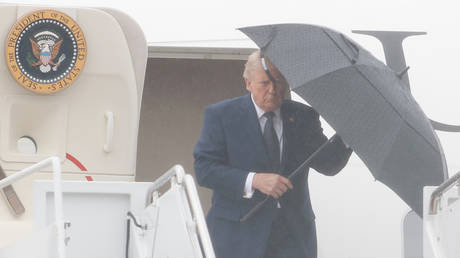
President Donald Trump canceled his weekend trip to the Bahamas for Donald Trump Jr.’s wedding to Bettina Anderson, choosing instead to remain locked in the White House. The official reason presented to the public centers on a critical 24-hour window in the ongoing US-Iran war, where failing diplomatic talks have put the military on high alert for an imminent strike.
But looking beneath the surface of the administration's public statements reveals a more complex reality. Trump is currently caught between an incredibly unpopular war that has damaged his poll numbers ahead of the November midterm elections, a collapsed economy driven by soaring oil prices, and intense pressure from hawkish congressional leaders to eschew diplomacy entirely. By weaponizing the optics of the Situation Room over a private family celebration, the president is executing a calculated political gamble designed to project absolute executive focus while shifting the blame for an intractable foreign conflict.
The 24 Hour Ultimatum and the Myth of Imminent Breakthroughs
The administration has carefully cultivated the narrative that the president is staying in Washington because a historic peace deal or a massive military escalation is just hours away. Speaking in Suffern, New York, before abruptly altering his schedule to fly back to the White House, Trump claimed the war with Iran "will be over soon" and promised that "oil prices will go down."
The reality on the ground contradicts this optimism.
Direct diplomacy in Muscat broke down after the initial outbreak of hostilities on February 28, when US and Israeli strikes hit Iranian targets. Since then, the diplomatic heavy lifting has fallen to Pakistan's top military and intelligence officials, who have been shuttling between Washington and Tehran. Pakistan is pushing a frantic, last-minute proposal for a temporary 30-day ceasefire to keep the two nations from plunging deeper into total war.
The core mechanics of these negotiations reveal a fundamental, unresolved deadlock that a single weekend in Washington is unlikely to fix.
- The Uranium Stumbling Block: Iranian Foreign Ministry spokesperson Esmaeil Baghaei explicitly stated that Tehran will not entertain any deal if the US insists on dismantling or inspecting Iran's stockpile of highly enriched uranium. Iran views its nuclear progress as its ultimate leverage.
- The War-Only Focus: Iranian negotiators have instructed semi-official state media like the Tasnim news agency to reiterate that they are only negotiating an end to active hostilities. They refuse to touch broader regional security or nuclear terms until the shooting stops.
- The American Position: Secretary of State Marco Rubio offered a far more grounded assessment than the president, noting that while there has been minor progress through Pakistani mediators, the public should neither exaggerate nor diminish it. "We're not there yet," Rubio admitted.
With both sides completely dug into their positions, the administration's leak to intelligence insiders that Trump will order a devastating strike within 24 hours if negotiations fail looks less like a standard military timeline and more like a high-stakes bluff to force an Iranian concession.
The Backroom Pressure to Finish the Job
While Trump publicly laments the timing of the war, he faces an internal rebellion from the defense establishment and key congressional allies who do not want a diplomatic resolution.
Republican Senator Roger Wicker, the powerful chair of the Senate Armed Services Committee, went public with a sharp critique of the administration's current path. Wicker urged Trump to completely abandon the Pakistani-led talks, arguing that any agreement signed with the Iranian regime would "not be worth the paper it is written on."
Instead, the hawkish faction of the legislature is demanding that the president unleash the full conventional weight of the United States military. The goal of this faction is not a ceasefire; it is the total destruction of Iran's conventional military infrastructure and the forced, unilateral reopening of the blockaded Strait of Hormuz.
This domestic political pressure creates an impossible trap for the White House. If Trump accepts a weak, temporary ceasefire brokered by Islamabad to alleviate economic pressure at home, his own party will pillory him for displaying weakness. If he listens to the hawks and launches a deeper campaign, he risks a prolonged, multi-year conflict that could completely destroy his party's chances in the upcoming midterms.
The Political Math of the Mar-a-Lago Absence
Every move a modern president makes is evaluated through the lens of public perception, and Trump explicitly acknowledged this calculated reality before making his final decision to stay in Washington. "That’s one I can't win on," Trump told reporters in the Oval Office. "If I do attend, I get killed. If I don’t attend, I get killed."
Had the president flown to the Bahamas for a lavish, exclusive wedding with fewer than 50 high-society guests while American service members remained in harm's way, the political damage would have been immediate. Cable news networks would have run split-screen broadcasts showing the wealthy elite celebrating on a private island juxtaposed against the daily economic pain of voters dealing with high fuel costs caused by the maritime conflict.
[Optics Trap: Bahamas Wedding vs. Situation Room]
         |
         +--> Attend Wedding ----> Images of luxury during wartime -> Voter Backlash
         |
         +--> Stay in DC -------> Project Commander-in-Chief focus -> Shift Blame to Iran
By canceling his attendance and posting a highly visible statement on Truth Social citing his "love for the United States of America," Trump effectively flipped the narrative. He transformed a potentially damaging family event into a moment of manufactured executive sacrifice.
The Broader Conflict and the Oil Bottleneck
Beyond the immediate political optics lies the harsh reality of global energy markets. The conflict has severely disrupted shipping lanes through the Strait of Hormuz, causing a massive spike in global crude prices that has trickled down to American gas stations.
The economic fallout is the primary driver of voter anger ahead of the midterms. Trump’s promises that the war will end quickly and oil prices will drop are designed to calm volatile energy markets and anxious consumers. However, oil traders remain deeply skeptical. A temporary 30-day pause suggested by Pakistan will not permanently lower risk premiums on global shipping lanes if the underlying threat of a massive US conventional strike remains on the table.
The administration’s sudden pivot back to Washington puts the entire burden of proof on the upcoming 24 hours. By setting a hard, implicit deadline linked to his absence from a significant family event, Trump has escalated the stakes of his foreign policy strategy. If the Pakistani mediation fails to produce a verifiable breakthrough by the end of the weekend, the president will have little choice but to either launch the strikes his defense planners are demanding or face a severe loss of credibility on the international stage. The coming hours will determine whether this dramatic display of executive focus was a prelude to a massive military campaign or an elaborate diplomatic theater meant to buy time.