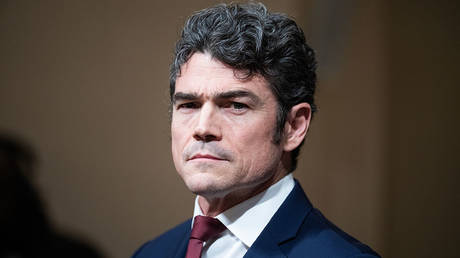
Nathan Sales spent years in the windowless rooms where the air is recycled and the secrets are heavy. As the State Department’s former coordinator for counterterrorism, his job wasn’t just to read the news; it was to read the tea leaves of global catastrophe before the kettle boiled over. But lately, Sales has been sounding an alarm that isn't about a specific bomb or a clandestine cell. It is about a failure of hearing.
Washington, he suggests, has developed a selective deafness toward the growing storm clouds gathering over the Middle East, specifically regarding the signals emanating from Tehran. It is the kind of silence that precedes a landslide.
To understand how a superpower misses the obvious, we have to look past the satellite photos and the encrypted cables. Think of a veteran air traffic controller. They sit in a dark room, staring at green blips. They know the flight paths by heart. They can sense when a plane is banking too steeply just by the rhythm of the transponder. Now, imagine that controller reporting a potential mid-air collision, only to have the supervisor tell them to ignore it because the paperwork for an emergency is too tedious.
That is the essence of the warning Sales is issuing. The data is there. The blips are screaming. But the political will to acknowledge the trajectory has flatlined.
The Ghost in the Machine
The intelligence community functions on a cycle of collection, analysis, and dissemination. It’s a conveyor belt of raw data turned into actionable truth. But there is a human friction point at the very end of that belt: the policymaker.
Sales points to a specific, chilling trend. The intelligence regarding Iran’s regional ambitions and its technical escalations isn't being suppressed by some shadowy cabal. It is being set aside because it doesn't fit the current architectural plans for the region. When the "intel" says the bridge is swaying, but the "policy" says the bridge is the centerpiece of the new neighborhood, the swaying gets labeled as a minor vibration.
Consider a hypothetical analyst—let’s call her Sarah. Sarah spends fourteen hours a day tracking the movement of precision-guided munition components across the Syrian border. She sees the serial numbers change. She notes the increased frequency of the shipments. She writes a memo that says, in no uncertain terms, that the threat level has shifted from "simmer" to "boil."
In a healthy system, Sarah’s memo triggers a meeting. In the current environment Sales describes, Sarah’s memo hits a wall of "strategic patience." It is filed under "complications" rather than "emergencies." This isn't a failure of Sarah’s eyes; it’s a failure of the recipient's ears.
The Architecture of Denial
Why would a government ignore warnings about a known adversary? It isn't always incompetence. Sometimes, it’s a desperate hope that if you don't acknowledge the monster, it will stay under the bed.
The geopolitical landscape of 2024 and 2025 has been defined by an attempt to pivot away from the Middle East. The prevailing wisdom was that if the United States focused its energy on the Pacific or the gray-zone conflicts in Eastern Europe, the Middle East would somehow stabilize itself through sheer exhaustion.
But Iran didn't get the memo about the pivot.
Sales argues that by ignoring the tactical warnings, Washington has allowed Tehran to build a "ring of fire." This isn't just a catchy phrase for a briefing slide. It’s a physical reality of drones, missiles, and proxy forces that now encircle key interests and allies. Every time a warning about a new drone factory or a refined enrichment technique was met with a shrug in D.C., a brick was added to that wall.
The cost of this denial is measured in "deterrence decay." Deterrence is a psychological state. It exists only as long as your opponent believes you are watching and that you are willing to act on what you see. When you stop responding to the small provocations, you aren't being "the bigger person." You are teaching your opponent that the sirens are broken.
The Data Deluge and the Human Filter
We live in an era of "Omniscience Fatigue." We have more sensors, more signals, and more AI-driven analysis than at any point in human history. We can see a truck moving in the Iranian desert in high definition from a phone in Virginia.
This creates a paradox. The more we see, the less we seem to understand.
Sales’s critique hits on a fundamental truth of the information age: data is not wisdom. You can have a mountain of evidence, but if the person at the top of the mountain is looking at the stars, the landslide at the base doesn't matter. He suggests that the "warnings" weren't just ignored—they were drowned out by a desire for a different reality.
Modern intelligence work often uses complex models to predict behavior.
$$P(A|B) = \frac{P(B|A)P(A)}{P(B)}$$
This is Bayes' Theorem, a staple of risk assessment. It calculates the probability of an event (A) based on prior knowledge of conditions (B) that might be related to the event. If the "prior knowledge" is skewed by a political desire to see Iran as a manageable, rational actor that is currently "de-escalating," then every new piece of data gets filtered through that bias. The math stays the same, but the result is a lie.
The Invisible Stakes
When these warnings are ignored, the consequences don't usually happen in a single, cinematic explosion. They happen in the "gray zone." They happen when a shipping lane becomes too dangerous for commercial insurance. They happen when a local militia feels empowered to seize a civilian official because they know no one is coming to the rescue.
Sales is describing the hollowing out of American credibility. It’s like a bank that keeps telling its customers their money is safe while the vault door is visibly hanging off its hinges. Eventually, there is a run on the bank.
The human element here is the sense of betrayal felt by those on the front lines. The analysts, the field officers, and the regional partners who provide the raw intel are watching their work evaporate into the ether of Washington’s indifference. When you tell a scout that the tracks they found aren't actually there, the scout eventually stops looking.
This isn't about being "pro-war" or "anti-diplomacy." It’s about the basic duty of a state to see the world as it is, not as it wishes it to be. Sales’s warning is a plea for a return to cold, hard realism.
The silence of the sirens isn't because the danger has passed. It’s because the people in charge of the volume have turned it down to zero so they can sleep better at night. But the storm doesn't care if you're asleep. It only cares that the windows are open.
The most dangerous moment for any nation is the gap between the arrival of the truth and the acceptance of it. That gap is where disasters live. Right now, according to those who have sat in the rooms where the secrets are kept, that gap is wider than it has been in decades.
The sirens are still spinning. The lights are flashing red. The only question left is whether anyone is left in the building who still knows how to listen.