Panic sells. That is the baseline rule of modern internet media. When headlines started screaming about an impending asteroid strike near Australia, social media feeds lit up with nervous speculation. People picture Hollywood blockbusters whenever words like space rock and impact enter the same sentence. They imagine shockwaves, shattered windows, and evacuation orders.
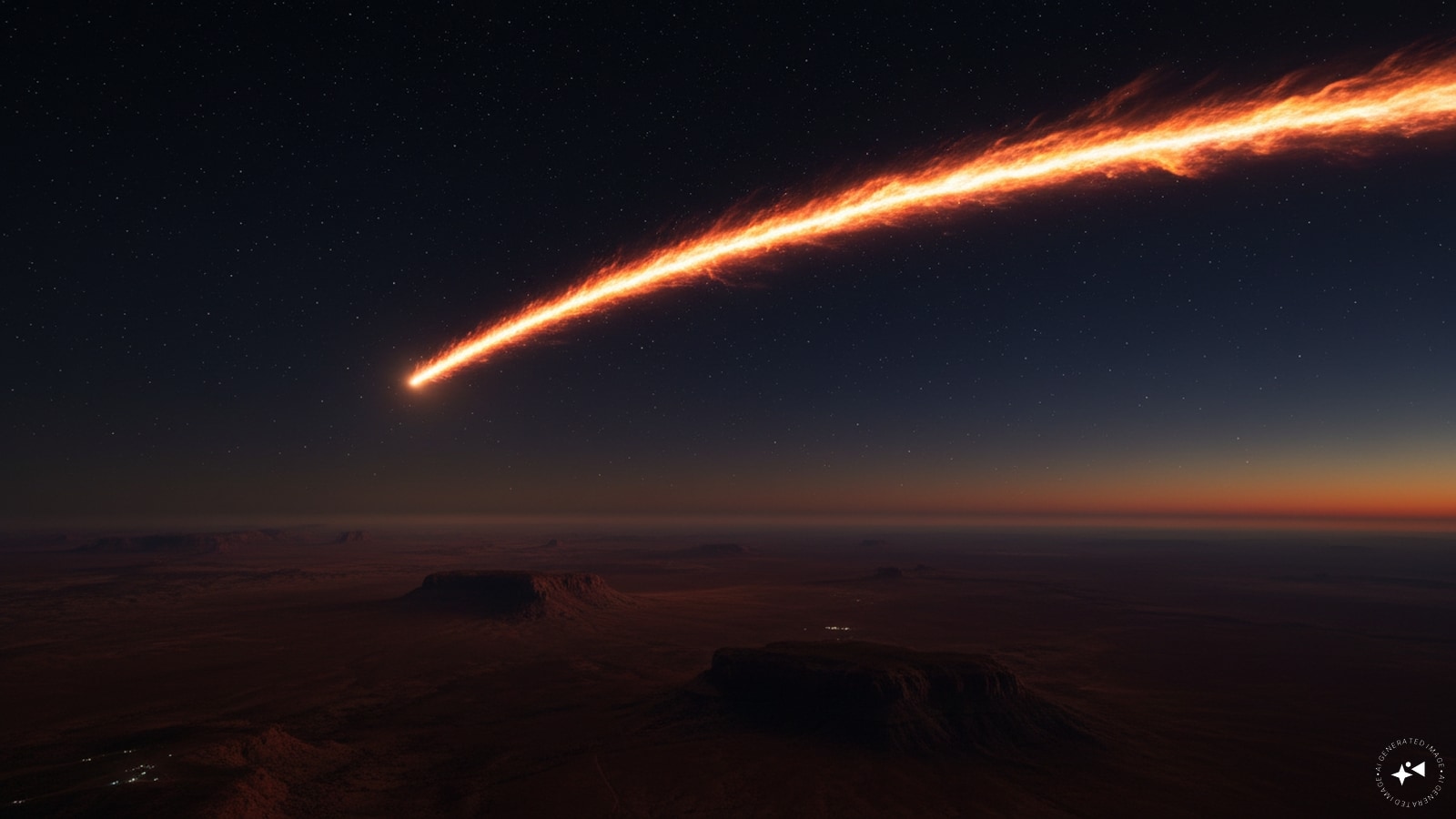
The reality of asteroid CERNQ52 was far less cinematic and vastly more encouraging. On September 6, 2026, a tiny space rock measuring less than a meter across entered Earth's atmosphere over the Indian Ocean. It produced a brilliant flash of light, tore apart due to extreme atmospheric friction, and vanished without a trace. No buildings shook. No sirens wailed. Nobody even spilled their coffee.
Instead of an apocalyptic disaster, the event marked a massive victory for international planetary defense. Astronomers caught the object hours before it hit. They tracked its trajectory, calculated its precise entry zone, and watched their models play out in real time. Understanding what actually happened requires looking past the breathless social media panic and examining how science handles the cosmic debris field we call home.
How Astronomers Spotted CERNQ52 Just in Time
Finding a rock roughly the size of a kitchen table against the infinite backdrop of space is genuinely difficult. Telescopes must scan vast swaths of the sky, capturing light reflections from dark, fast-moving objects that do not emit their own illumination.
The breakthrough for CERNQ52 came from the Catalina Sky Survey. Operating out of the Mount Lemmon Observatory in Arizona, automated systems picked up the faint, moving pinprick of light late on September 6. Observers quickly logged the data and sent it to global clearinghouses.
European Space Agency tracking centers and NASA's Center for Near-Earth Object Studies immediately went to work. Richard Moissl, who heads planetary defense at the European Space Agency, used social media to broadcast the incoming trajectory hours before impact. The math pointed toward a remote stretch of the Indian Ocean northwest of Australia.
The timing mattered immensely. Catching an asteroid before impact happens rarely. CERNQ52 marked only the thirteenth time in scientific history that researchers spotted an incoming space rock prior to atmospheric entry. Every previous detection of this nature provided valuable data, but this specific event added a fresh layer of technical insight.
Astronomers suspect that CERNQ52 belongs to a rare category known as Aten-class asteroids. These objects spend most of their time orbiting closer to the Sun than Earth does. Almost every previously caught impactor belonged to the Apollo class, which follows a wider orbit. If confirmed, catching an Aten-class rock right before entry expands our observational capabilities into a brand new orbital category.
Why Small Rocks Usually Fly Under the Radar
People often ask why planetary defense networks cannot spot every single object heading toward Earth weeks or months in advance. The answer comes down to physics, scale, and lighting.
Space is profoundly empty, yet it contains millions of small fragments left over from the formation of the solar system. Objects measuring a few meters across reflect very little sunlight. Telescopes on Earth rely on nighttime viewing conditions, clear skies, and favorable geometry to spot them. If an asteroid approaches from the direction of the Sun, the glare completely blinds ground-based optics.
Sub-meter objects like CERNQ52 are essentially invisible until they get desperately close. Detecting one hours before impact requires a combination of automated sky-scanning algorithms, sharp telescope optics, and rapid international data sharing.
NASA maintains the Planetary Defense Coordination Office, established to track near-Earth objects and coordinate responses to potential threats. Systems like Scout automatically evaluate every new telescope observation to see if a rock is on a collision course. When CERNQ52 popped up in the data feeds, these systems crunched the variables instantly. They confirmed that the object posed zero threat to populated areas.
Smaller rocks strike Earth constantly. Dust-sized particles burn up as shooting stars every night. Larger rocks, measuring a few meters wide, hit the planet several times a year. Most of them plunge harmlessly over remote oceans or unpopulated wildernesses, leaving nothing behind except a streak of light across a dark sky.
The Physics of a Harmless Cosmic Fireworks Show
The word impact triggers anxiety because people picture solid iron or rock smashing into the dirt at high speeds. When it comes to objects under twenty-five meters across, that picture is entirely wrong.
Earth possesses an invisible shield that handles small space debris effortlessly: the atmosphere. As CERNQ52 plunged toward the Indian Ocean at tens of thousands of kilometers per hour, it slammed into an increasingly dense wall of air molecules.
Air cannot move out of the way fast enough at hyper-velocity speeds. It compresses violently in front of the incoming rock, generating extreme heat. Temperatures skyrocket into thousands of degrees Celsius.
This thermal shock overwhelms the structural integrity of a small asteroid. Most space rocks are not solid blocks of pure steel; they are often porous aggregates of stone, carbon, and nickel-iron held together by weak gravity and internal friction. The immense pressure differential between the front and back of the rock causes it to fracture, shatter, and vaporize in seconds.
This process is called an airburst. The kinetic energy converts rapidly into thermal energy, light, and a sharp pressure wave. For CERNQ52, the entire event unfolded miles above the ocean surface. A few pebble-sized fragments might have survived the plunge and splashed into the water, but the bulk of the asteroid turned into glowing gas and dust before ever touching the earth.
What This Means for Global Planetary Defense
Skeptics love to mock space agencies when they announce small impacts, asking why scientists spend billions tracking rocks that burn up anyway. The logic misses the entire point of modern space monitoring.
Practicing with real-world targets is the only way to test tracking infrastructure. When an automated survey telescope spots a faint dot moving against the stars, software must calculate its orbit, predict its atmospheric entry point, and estimate its size within minutes.
If a genuinely dangerous object ever heads toward a major population center, astronomers will not have months of luxury prep time. They might have hours or days. The emergency protocols must run smoothly on the first try.
Events like the CERNQ52 entry serve as vital live-fire exercises for planetary defense teams. They test communication channels between observatories in Arizona, space agency headquarters in Europe, and tracking networks worldwide. They check whether prediction models match reality. In this case, the models performed with remarkable accuracy.
Space is full of surprises, but humanity is getting better at watching the skies. The next time a sensational headline warns of an incoming asteroid, remember the story of CERNQ52. Most space rocks are tiny messengers from the early solar system, putting on a quiet light show over the ocean while scientists quietly verify that our cosmic neighborhood remains secure.