The Echo of a Late Night Laugh
The studio lights are blinding. They hum with a specific kind of electric energy that signals a job well done. In the heart of Los Angeles, the audience is roaring. It is the kind of sound a comedian lives for—the sharp, collective intake of breath followed by an explosive release of laughter. But miles away, in a quiet room where the television glow is the only source of light, that same laughter feels like a serrated edge.
Comedy has always been our cultural safety valve. We rely on late-night hosts to poke holes in the egos of the powerful, to strip away the artifice of politics, and to make the unbearable world a little more digestible. However, a recent monologue by Jimmy Kimmel has ignited a firestorm that transcends partisan bickering. It has touched a nerve that sits right on the boundary between public accountability and private grief. If you found value in this post, you should read: this related article.
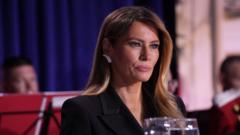
When Melania Trump issued a public demand for ABC to "take a stand" against Kimmel, she wasn't just defending her husband’s political legacy. She was pointing to a moment where a joke stopped being about a politician and started being about a widow.
The Joke That Stayed in the Room
To understand why this specific moment curdled, we have to look at the mechanics of the bit. Kimmel, known for his sharp-tongued critiques of the Trump administration, took aim at a sensitive target: Corey Comperatore’s widow. Comperatore was the man who lost his life during the attempted assassination of Donald Trump in Butler, Pennsylvania. He was a father. A husband. A man who, by all accounts, died shielding his family from gunfire. For another perspective on this development, see the recent update from Wall Street Journal.
Kimmel’s monologue veered into a territory that felt, to many, like a betrayal of the basic empathy that holds a society together. He mocked the widow's interaction with the former President, turning a moment of profound personal tragedy into a punchline for a coastal audience.
Laughter is a social contract. We agree to find humor in the absurd. But what happens when the "absurd" is a woman mourning a man who was killed in front of her?
The former First Lady’s intervention was swift and uncharacteristically direct. Through her office, she called the joke "vile" and "distressing." She didn't just ask for an apology; she asked the network to examine its soul. This wasn't a policy debate. It was a plea for a return to a standard of human decency that doesn't evaporate just because the person on screen has a different political affiliation.
The Ghost of the Public Square
Consider the hypothetical person sitting in their living room in a small town, far from the writers' rooms of Burbank. This person doesn't see a "MAGA supporter" or a "political prop." They see a neighbor. They see the guy who helped fix their fence or the woman who volunteers at the bake sale.
When those people see their grief used as a setup for a gag, something breaks. It isn't just the trust in the media; it’s the belief that we are all part of the same human experiment.
Satire is a weapon. In the right hands, it punches up. It takes on the giants, the monarchs, and the autocrats. But when satire punches down—or in this case, sideways into the lives of private citizens caught in historical crossfires—it loses its moral authority. It becomes mere bullying with a high production budget.
Melania Trump’s stance highlights a growing exhaustion with the "us versus them" binary. By demanding that ABC take a stand, she is forcing a conversation about the responsibilities of the platform. Does a network have an obligation to monitor the cruelty of its stars? Or is the First Amendment a shield that protects even the most tasteless jab?
The Stakes of the Silence
The silence from ABC has been heavy. In the media industry, silence is often a calculated strategy—wait for the news cycle to churn, let the next outrage bury the current one. But some things don't bury easily.
The invisible stakes here involve the very fabric of our public discourse. If we decide that certain people are "fair game" because of who they vote for or who they stand next to in a time of tragedy, we are effectively dehumanizing half the country.
The "widow joke" wasn't just a lapse in judgment. It was a symptom of a deeper rot where the desire for a viral clip outweighs the instinct for compassion. We have become so accustomed to the "burn" and the "takedown" that we have forgotten how to sit with someone in their pain, regardless of the hat they are wearing.
Melania Trump, a woman who has spent years being the target of intense media scrutiny, recognized this. Her advocacy in this instance wasn't about the "Be Best" campaign or a specific policy initiative. it was a defense of the sanctity of mourning.
A Mirror Held Up to the Audience
We are all complicit in this. We click the links. We share the clips. We enjoy the dopamine hit of seeing someone we dislike get "owned."
But there is a cost to that high. The cost is a coarsening of the spirit. It is the slow, steady erosion of the idea that some things are sacred. A funeral is sacred. A widow’s grief is sacred. The memory of a man who died protecting his daughters is sacred.
When we allow those things to be converted into late-night fodder, we aren't just laughing at a joke. We are laughing at the idea that we owe each other anything.
The tension between the First Lady and the late-night host is a microcosm of the modern American struggle. It is a battle between the right to speak and the responsibility to be human. Kimmel has built a career on being the "everyman," the relatable guy who calls it like he sees it. But in this moment, he seemed more like the man in the ivory tower, looking down at the "flyover" grief with a detached, cynical eye.
The Choice of the Network
ABC finds itself in a precarious position. To discipline Kimmel is to risk the ire of their most loyal, progressive viewers. To do nothing is to signal that there are no boundaries left.
This isn't about censorship. It’s about culture. A culture that rewards cruelty will eventually be consumed by it. If the only standard for a joke is "will it get a laugh from the people who already agree with me?" then we have abandoned the true purpose of comedy, which is to reveal truth through humor.
There was no truth in mocking a widow. There was only a cheap shot.
Melania Trump’s call for a "stand" is a challenge to all of us. It asks us to consider where our own lines are drawn. Are we willing to defend the dignity of those we disagree with? Or are we only interested in "decency" when it serves our team?
The lights in the studio eventually go down. The audience goes home. The writers start on the next script. But for the woman in the quiet room, the laughter doesn't stop. It echoes. It reminds her that in the eyes of the cultural gatekeepers, her loss is just a punchline, and her husband’s life was just a setup for a gag.
We are left waiting to see if the network will acknowledge that some lines, once crossed, leave a stain that no amount of laughter can wash away.


