The velvet rope is rarely thicker than a human thumb. At a major golf tournament, it hangs from thin metal stakes, swaying gently in the afternoon breeze while thousands of spectators lean forward, squinting against the sun to catch a glimpse of a white dimpled ball resting in the rough. On one side of that braided cord stands the crowd, clutching cold drinks and folding chairs. On the other side stands the arena, a manicured expanse of emerald turf where millionaires hit leather-wrapped spheres with titanium clubs.
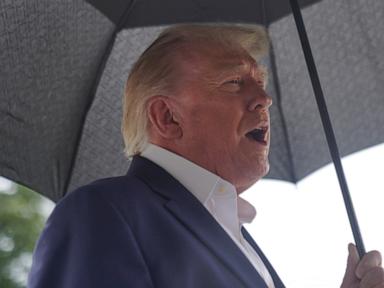
Now picture a second rope, invisible and infinitely heavier, stretching across that exact same grass. When Donald Trump steps onto the grounds of the Presidents Cup, the air around the eighteenth green changes its chemical composition. The familiar, rhythmic murmur of golf commentary—a cadence usually reserved for discussions of spin rates, grain direction, and subtle breaks on the putting surface—suddenly collides with the jagged, high-voltage static of modern American politics.
To understand why a sitting or former president walking down a fairway generates such intense friction, you have to stand in the gallery yourself. You have to feel the vibration of the helicopters overhead before you even see them. I have spent years covering the intersection of professional sports and public power, walking the humid fairways of the American South and the windswept links of the northeast, watching how stadiums and golf courses transform when the presidency enters the gates. The Secret Service agents do not wear caddie bibs, yet they walk the exact same lines, their eyes scanning the treeline rather than the pin placement. The standard rhythms of a sporting event—the polite applause, the hushed anticipation before a backswing—are instantaneously rewritten.
The Architecture of a Modern Spectacle
Golf has always maintained a complicated relationship with the American presidency. Since William Howard Taft first swung a club in the early twentieth century, the links have served as an unofficial extension of the West Wing. Dwight D. Eisenhower played hundreds of rounds during his two terms, using the fairways of Augusta National as a pressure valve for Cold War anxiety. John F. Kennedy hid his smooth, natural swing from the cameras to avoid appearing overly aristocratic. Barack Obama logged more than three hundred rounds, treating the course as a sanctuary where the relentless noise of Washington could be muted for four hours at a time.
Yet Donald Trump broke that historical mold entirely. For his predecessors, golf was an escape from the office, a private pasture rented for an afternoon. For Trump, golf was never merely a pastime; it was an empire, a brand, and a stage. When his personal golf tour—a deliberate, high-profile series of appearances at major championships, LIV Golf events, and international team competitions—brings him back to the Presidents Cup, the dynamic shifts from leisure to theater.
Consider what happens on the first tee of a biennial team competition like the Presidents Cup, an event explicitly named after the highest office in the United States, where the sitting president traditionally serves as the honorary chairman. Let us imagine a composite spectator—we will call him Arthur—who bought his grounds pass eighteen months in advance. Arthur is a retired civil engineer from Ohio who knows the exact loft of a pitching wedge and tracks strokes-gained statistics on Sunday nights. He came to see the world’s top golfers represent the United States against an International squad drawn from every corner of the globe outside Europe.
Arthur arrives at seven in the morning to secure a spot near the ropes. By noon, however, the perimeter shifts. Metal detectors appear at choke points that were wide open at dawn. Snipers take positions on the rooftops of temporary hospitality chalets. Suddenly, the conversation around Arthur is no longer about whether the American captain made a mistake pairing two aggressive drivers in alternate-shot play. Instead, half the gallery is chanting political slogans, while the other half stands in tight-lipped silence or mutters frustrations about security delays that kept them from watching the morning matches.
Arthur’s dilemma is the central tension of modern sports. Can an arena remain neutral ground when the most polarizing figure in contemporary politics claims a front-row seat?
The History Written in Divots
To answer that question, we have to look closely at how the Presidents Cup itself was born. Unlike the Ryder Cup, which grew organically out of a friendly challenge between British and American professionals in 1927, the Presidents Cup was engineered by the PGA Tour in 1994. Its founders wanted a global stage for international stars—players from Australia, South Africa, Japan, Canada, and South America—who were excluded from the transatlantic rivalry between the United States and Europe.
From its inception, the tournament leaned heavily on political prestige to manufacture instant legitimacy. Gerald Ford served as the first honorary chairman. Over the ensuing decades, Bill Clinton, George W. Bush, and Barack Obama all lent their names and occasional presence to the matches. In those eras, the appearance of a president at the event functioned like a ceremonial ribbon-cutting. It was a symbol of institutional continuity, a brief moment where partisan warfare paused so the country could cheer for a unified team wearing red, white, and blue sweaters.
Trump’s relationship with the tournament, and with the PGA Tour that operates it, carries a far more intricate history. During his first presidency, he attended the 2017 Presidents Cup at Liberty National Golf Club in New Jersey, just across the Hudson River from the Manhattan skyline that built his early fame. That Sunday afternoon, he became the first sitting president to present the trophy to the winning American team on the eighteenth green, standing alongside commissioner Jay Monahan and captain Steve Stricker while thousands of spectators roared and cameras flashed against the twilight.
At the time, the moment looked like a traditional marriage of sport and state. Yet beneath the surface, tectonic plates were already grinding against one another. Over the next several years, the golf world fractured along lines that mirrored the broader cultural divisions of the nation. The arrival of LIV Golf, backed by Saudi Arabia’s Public Investment Fund, tore through the professional ranks like a hurricane. Trump opened his own resorts—properties in Bedminster, Doral, and Washington, D.C.—to the breakaway league, hosting their tournaments while simultaneously criticizing the PGA Tour’s leadership for failing to negotiate a merger on his preferred timeline.
When a public figure moves from being a ceremonial guest to an active stakeholder in a sport’s civil war, every subsequent appearance carries the weight of unresolved conflict.
The Gravity of the Gallery
Watch the faces of the players when the motorcade arrives. Professional golfers spend their entire lives training their nervous systems to ignore external chaos. They practice hitting three-foot putts while cameras click, while children cry in the distance, while wind gusts rattle the flagstick. Their entire livelihood depends on narrowing their focus down to a dimple on a golf ball.
Still, nobody is entirely immune to the gravitational pull of a presidential entourage. According to interviews and press conferences given by tour veterans over multiple tournament cycles, the arrival of a president creates an unmistakable atmospheric pressure. Some players welcome the energy, feeding off the stadium-like roar that erupts when a polarizing leader waves from a skybox or walks along the edge of the green. Others admit quietly in the locker room that the heightened security, the altered tee times, and the sudden politicization of their workplace create a distraction they cannot entirely block out.
Think of the mechanics of a golf swing as an analogy for institutional trust. A driver swing lasts barely more than a second from takeaway to impact, yet it relies on a delicate kinetic chain. The hips must clear before the shoulders turn; the wrists must hinge at the precise microsecond; the clubface must return to the ball square within a fraction of a degree. If a sudden gust of wind forces the golfer to flinch, or if an unexpected shout causes a muscle in the forearm to tighten by two percent, the ball does not merely miss the target by a few feet. Three hundred yards downrange, that microscopic flinch translates into a hook deep into the woods.
Sports institutions operate along that same kinetic chain. A tournament like the Presidents Cup relies on an unspoken agreement among three groups: the athletes providing the excellence, the fans providing the passion, and the governing bodies providing a fair, apolitical stage. When political theater enters the arena, every group adjusts its posture. Sponsors watch nervously from corporate tents, calculating whether television cameras will linger too long on controversial banners or partisan chants. Broadcasters walk a tightrope in the production truck, deciding how many seconds to show a political figure in the stands before cutting back to a crucial bunker shot on the fourteenth hole.
The Business of Proximity
Why does Donald Trump keep returning to the fairways, and why do golf’s power brokers continue to navigate his orbit? The answer lies in the overlapping currencies of attention and prestige.
In the attention economy, golf has always faced a structural challenge. Outside of the four major championships and the biennial team cups, regular tour events struggle to capture the casual viewer who does not already track the FedEx Cup standings. A four-day stroke-play tournament unfolds slowly, across seventy-two holes and roughly sixteen hours of broadcast television. It lacks the compressed, violent urgency of a fourth-quarter NFL drive or the ninth-inning tension of a World Series game.
Trump, regardless of how one views his policies or rhetoric, operates as a human megaphone. Wherever he steps, the cameras follow. His presence transforms a regional sporting event into a global news story within seconds. For a media ecosystem hungry for viral moments—a fist pump from a luxury suite, a handshake with a superstar athlete, a sudden eruption of cheers or boos—the visual contrast between the serene, pastoral beauty of a golf course and the raw pugilism of modern politics is irresistible.
For Trump himself, the golf course serves an equally vital strategic purpose. On a campaign stage or inside a courtroom, the environment is explicitly adversarial. Every word is parsed by political correspondents; every gesture is framed through the prism of partisan combat. On the golf course, however, Trump is surrounded by a culture that naturally overlaps with his core base of support—affluent business owners, suburban executives, and traditional sports fans—while simultaneously projecting an image of vigor, leisure, and command.
Notice the subtle choreography of these appearances. He rarely slips quietly into a private box without acknowledging the crowd. Instead, he steps to the glass or walks along the perimeter ropes, pointing to spectators, tossing signed hats, and soaking in the immediate, visceral feedback of a live audience. In those moments, the golf tournament ceases to be the main event. The fairways become a green velvet backdrop for a rally without a podium.
The Invisible Cost to the Game
Yet every spectacle extracts a price, and in professional golf, that cost is paid in the currency of cohesion.
Consider the International team at the Presidents Cup. Unlike the Ryder Cup, where twelve European players unite under a single blue-and-gold flag with decades of shared history, the International squad is a fragile coalition. Its roster brings together athletes from South Korea, Australia, Canada, South Africa, Japan, and Latin America—men who speak different languages, grew up in vastly different cultures, and share no common anthem. For decades, the organizers of the Presidents Cup worked tirelessly to forge an identity for this team, introducing a unified shield logo and cultivating a spirit of global sportsmanship to match the intense patriotism of the American side.
When domestic American politics floods the venue, that delicate international balance tilts sharply. Suddenly, a competition designed to celebrate global golf takes on the unmistakable flavor of an American domestic political rally. International players, who generally avoid commenting on the internal political battles of their host nation, find themselves fielding questions in post-round press conferences about crowd behavior, security lockdowns, and the presence of a figure whose policies on trade, immigration, and foreign alliances directly affect their home countries.
I remember standing outside a media tent during an international team event a few years ago, watching a young player from East Asia stare at a transcript of his own press conference. He had just shot a brilliant sixty-five in the afternoon four-ball session, sinking a twenty-five-foot birdie putt on the final hole to halve a crucial match. Yet four of the six questions he had been asked by reporters had nothing to do with his iron play or his putting stroke. They were all attempts to bait him into offering a soundbite about the political figure watching from the clubhouse balcony. He shook his head slowly, folded the paper into a tight square, and walked toward the players' dining room without saying a word.
That silence captures what is lost when the boundaries between sport and state dissolve. Fans tune into athletics precisely because the rules are clear, the scoreboard is objective, and the outcome is decided by merit rather than spin. A ball either drops into the cup or it lips out. A drive either finds the short grass or splashes into the water hazard. Politics, by contrast, is the art of permanent ambiguity, a realm where victory is declared regardless of the score and every angle is contested.
The Unfinished Round
There is no easy mechanism to separate golf from power. The two have been intertwined since Scottish kings banned the game in the fifteenth century because their soldiers were spending too much time hitting feather-stuffed balls instead of practicing archery. As long as presidents play the game, and as long as billionaires build the courses where championships are contested, the motorcades will continue to roll past the clubhouse gates.
The PGA Tour and the organizers of the Presidents Cup remain caught in an ongoing balancing act. They rely on the prestige of the presidency to elevate their tournament above ordinary tour stops, yet they must manage the volatile reality of what that prestige now entails. Spectators like Arthur, standing behind the ropes with a folded pairing sheet in his pocket, are left to navigate the space between the game they love and the cultural storm swirling around it.
Late in the afternoon on the final day of the matches, when the shadows stretch long across the fairways and the helicopters begin warming their rotors behind the trees, the gallery crowds tightly around the eighteenth green. The players line up their final putts in near-total silence, every eye fixed on the white sphere resting on the shaved bentgrass. High above the green, behind tinted glass and rows of dark suits, a familiar silhouette leans forward against the railing, watching the ball roll toward the cup.



