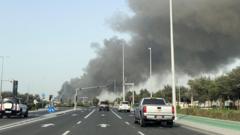
The night sky over the Persian Gulf is rarely truly dark. Between the rhythmic flare of oil refineries and the constant hum of desalination plants, the horizon glows with the nervous energy of global commerce. But lately, that glow has been punctuated by something far more sinister: the silent, streaking descent of a "suicide" drone or the thunderous arc of a ballistic missile.
For the citizens of Abu Dhabi, Riyadh, or Manama, these aren't just headlines in a geopolitical chess match. They are the sounds of a dinner interrupted. They are the sight of an intercepted projectile blossoming into a fireball over a luxury shopping mall. While the world watches the friction between Washington and Tehran through the lens of high-level diplomacy, the neighbors standing in the middle are the ones catching the shrapnel.
The Geography of a Neighborhood on Fire
To understand why the Gulf states are bearing the brunt of this shadow war, you have to look at a map not as a collection of borders, but as a series of vulnerabilities. Imagine living in a glass house while two giants throw stones at each other over your roof. Even if they aren't aiming for you, your windows are the first to shatter.
The United States maintains a massive military footprint in the region, from the Fifth Fleet in Bahrain to the Al Udeid Air Base in Qatar. These installations are meant to be deterrents. They are the "big sticks" of American foreign policy. However, in the eyes of Iranian military strategists, these bases are also high-value targets. When tensions spike—whether due to a collapsed nuclear deal or a strike on a proxy commander—Tehran often chooses to signal its displeasure not by attacking the U.S. mainland, which is thousands of miles away, but by hitting the partners who host American power.
It is a strategy of "maximum pressure" applied in reverse. By making life unstable and dangerous for the UAE and Saudi Arabia, Iran aims to drive a wedge between Washington and its allies. They are betting that if the cost of the alliance becomes too high in blood and burnt infrastructure, the Gulf states will eventually blink.
The Architecture of the Shadow War
The weapons being used aren't the massive, carrier-sinking missiles of Cold War fantasies. They are cheaper, smaller, and frustratingly effective. Consider the Shahed-136 drone. It is a slow-moving, propeller-driven triangle of explosives that costs less than a mid-sized sedan.
When dozens of these are launched in a "swarm," they can overwhelm even the most sophisticated radar systems. A multi-million-dollar Patriot missile battery is an incredible piece of engineering, but using one to shoot down a $20,000 drone is like using a sniper rifle to kill a mosquito. It is economically unsustainable.
In 2019, the world felt the literal shockwaves of this reality when the Abqaiq–Khurais processing plants in Saudi Arabia were hit. In a matter of minutes, five percent of the global oil supply vanished. Prices spiked. Markets panicked. But for the engineers on the ground, the "global oil supply" was a secondary concern. Their reality was a rain of fire and the terrifying realization that the sky was no longer a ceiling, but a door.
The Psychological Toll of the "Buffer"
There is a specific kind of exhaustion that comes from being a buffer state. It is the fatigue of the perpetual bystander who keeps getting punched.
Take a hypothetical resident of a high-rise in Dubai—let’s call her Sarah. Sarah works in logistics, ensuring that goods move smoothly from the port of Jebel Ali to markets in Europe. When news breaks of a tanker being harassed in the Strait of Hormuz, or a missile being intercepted over a neighboring emirate, her phone doesn't just light up with news alerts. It lights up with messages from panicked clients asking if their cargo is safe, if the insurance rates will triple overnight, and if it’s time to move their operations to Singapore or Rotterdam.
The "brunt" isn't just physical destruction. It is the erosion of confidence. The Gulf states have spent decades transforming themselves into global hubs for tourism, finance, and technology. This entire economic model relies on the perception of safety. You don't build a "City of the Future" in a war zone. By targeting the infrastructure of America’s allies, Iran is attacking the very identity these nations have built for themselves.
The Uneven Shield
One might ask: why doesn't the U.S. just provide better protection? The answer is a messy cocktail of physics and politics.
$D = \sqrt{2Rh}$
In the simple geometry of a missile defense horizon, the closer you are to the launch site, the less time you have to react. Because the Gulf states sit directly across the water from Iran, the flight time for a missile or drone is measured in seconds, not minutes. This proximity creates a "blind spot" that no amount of American hardware can fully close.
Furthermore, there is a growing sense of abandonment. When the Abqaiq facility was hit in 2019, the expected American kinetic response never came. The "red lines" seemed to have been drawn in disappearing ink. This led to a profound shift in the regional psyche. If the U.S. wasn't going to fight to protect the oil—the very thing that cemented the "oil-for-security" pact in 1945—then what exactly was the alliance for?
The Pivot to Self-Preservation
This realization has forced a radical change in behavior. We are seeing a new era of Gulf diplomacy that looks less like a bloc and more like a high-stakes survival game.
Saudi Arabia and the UAE have begun engaging in direct, often secret, talks with Tehran. They are hedging their bets. They are buying Chinese hardware, welcoming Russian investment, and diversifying their security portfolios. They are realizing that if they are going to bear the brunt of the attacks, they need to be the ones holding the leash on the escalation.
It is a quiet, desperate dance. On one hand, they remain deeply integrated with the U.S. military-industrial complex. On the other, they are sending flowers to their rivals in an attempt to lower the temperature. They are trying to find a way to coexist with a neighbor that has proven it can reach out and touch their most vital organs at any moment.
The Silence After the Boom
The conflict in the Gulf is often described as a "Cold War," but that term is a luxury for those who live far away. For the people on the ground, it is a very warm reality. It is the heat of a burning refinery. It is the jarring vibration of an air-defense battery firing from a nearby beach.
We tend to focus on the big players—the presidents, the ayatollahs, the generals. We track the movements of carrier strike groups and the rhetoric of UN resolutions. But the true story of the Gulf isn't found in a briefing room in D.C. It’s found in the quiet, watchful eyes of a father in Riyadh looking at the sky, wondering if the streak of light he sees is a shooting star or the end of his peace.
The allies of the West are not just strategic partners on a map. They are the human friction points where the gears of global power grind against one another. They are the ones who pay the "neighborhood tax" in a conflict they didn't start but are forced to host.
As the sun rises over the Gulf, the tankers continue to move. The skyscrapers continue to climb. The malls fill with shoppers. Life goes on, but it is a life lived with one ear always tilted toward the horizon, listening for the faint, high-pitched whine of a motor that shouldn't be there. The shield may be holding for now, but the people beneath it know exactly how thin the metal has become.