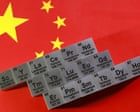
The warning light on a submarine console does not care about trade deficits. It only cares about physics.
Deep beneath the cold, slate-gray swells of the North Atlantic, a hypothetical Royal Navy commander—let’s call him Arthur—leans over a glowing sonar terminal. Around him, the air smells faintly of recycled oxygen, ozone, and diesel oil. His vessel is a marvel of British engineering, built to slip through the dark like a ghost. Inside the guidance system of the torpedoes resting quietly in the forward bay, and inside the permanent magnets spinning silently within the ship’s propulsion motors, sits a pinch of gray-white powder called dysprosium.
Without that dust, the magnets lose their grip at high temperatures. The guidance systems go blind. The ghost becomes a target.
And right now, the mine that dug that dust out of the earth, and the chemical bath that refined it into usable metal, are almost certainly located five thousand miles away in Inner Mongolia, controlled by a single geopolitical rival.
Silence.
That is what happens when a supply chain snaps. Not an explosion, not a dramatic headline, just the sudden, terrifying quiet of machines that can no longer think, see, or move. For years, policy wonks in Westminster and analysts in the City of London treated critical minerals like an obscure accounting problem, a line item buried beneath spreadsheets of quarterly GDP growth and green energy targets. Then came the parliamentary assessments, the stark intelligence briefings, and a phrase that finally cut through the bureaucratic fog: Britain is dangerously reliant on China for the raw elements powering its defense and artificial intelligence sectors.
To understand how an island nation that once ruled the waves ended up outsourcing the elemental ingredients of its own survival, you have to look past the sleek glass facades of London’s AI startups and the guarded perimeters of Barrow-in-Furness shipyards. You have to look at the dirt.
The Ghost in the Silicon
We like to think of artificial intelligence as weightless. We call it "the cloud," an airy, ethereal metaphor that makes data centers sound like cumulus formations drifting harmlessly over the Hertfordshire countryside.
Nothing could be further from the truth.
Walk into a modern AI server farm on a rainy Tuesday in Slough, and the first thing that hits you is the roar—a deafening, physical wall of sound generated by thousands of cooling fans fighting back the blistering heat of computation. Every time an algorithm trains on a dataset, every time a British medical researcher uses machine learning to fold a protein, electrons are slamming through silicon wafers laced with gallium and germanium.
These are not exotic luxury items. They are the foundational alphabet of modern computing. Gallium allows microchips to handle higher frequencies and voltages without melting into slag; germanium makes fiber-optic cables transparent enough to carry light across oceans without fading into static.
China controls roughly 98 percent of the world’s primary gallium production and around 60 percent of its germanium.
When Beijing introduced export controls on both metals, the tremor didn't just rattle commodity traders in Canary Wharf. It sent a cold chill through defense contractors in Bristol and semiconductor designers in Cambridge. Suddenly, the "cloud" felt very heavy, and its anchor was resting in someone else’s harbor.
I remember sitting in a cramped, fluorescent-lit conference room in Coventry three winters ago, listening to a mid-level aerospace engineer try to explain this vulnerability to a room full of regional investors. He held up a tiny, unremarkable cylinder of metal no bigger than a AA battery. "This," he said, his voice tight with the quiet exhaustion of someone who had spent months begging for budget approvals, "is what keeps a jet fighter’s radar locked onto an incoming missile. We design the software in the UK. We assemble the casing in the UK. We test it in the UK. But if a port authority in Tianjin decides to delay a shipping container for six weeks, this entire factory becomes a very expensive museum."
Nobody in the room laughed. A few people checked their phones. Most just stared at that little gray cylinder as if it were a ticking clock.
How Britain Sold Its Shovels
How did we walk into this trap with our eyes wide open?
The answer isn't a grand conspiracy; it’s a decades-long habit of mistaking financial convenience for strategic wisdom. Throughout the late twentieth century, Western economies—Britain foremost among them—decided that heavy extraction and toxic chemical refining were dirty, low-margin businesses best left to developing nations. Mining scarred the countryside. Processing rare earth elements produced lakes of mildly radioactive sludge.
Why ruin the rolling green hills of Cornwall or the rugged moors of Devon when you could buy refined neodymium, tungsten, and cobalt on the open market for pennies on the dollar?
Meanwhile, Beijing played a longer, patient game. While London focused on financial services, software, and high-end assembly, Chinese state-backed enterprises spent thirty years quietly buying up mining rights from the copper belts of the Democratic Republic of the Congo to the lithium flats of South America. More crucially, they mastered the messy, unglamorous middle step: refining.
Think of critical minerals like crude oil. Having a puddle of black sludge in your backyard does you no good if you don't own a refinery to turn it into aviation fuel. Even when raw ores are dug out of Australian deserts or Canadian tundra, they are almost universally shipped to China to be crushed, dissolved in acid, separated, and turned into high-purity oxides and metals.
Britain didn't just lose its mines; it lost its chemical memory. We dismantled the blast furnaces, closed the metallurgy departments at our universities, and let a generation of chemical engineers retire without passing down their craft. We kept the blueprint for the engine, while handing over the foundry that casts the pistons.
The Anatomy of a Chokehold
Consider what happens next if a diplomatic crisis over Taiwan, cyber espionage, or trade tariffs escalates from sharp words at the United Nations to quiet friction at customs checkpoints.
A hypothetical scenario—not a prediction, just a stress test drawn directly from defense ministry wargames—plays out like this:
Beijing does not declare a total embargo. Total embargoes make headlines, unite allies, and provoke immediate retaliation. Instead, export licenses for processed rare earths, tungsten, and battery-grade graphite simply begin to take longer. A paperwork audit here. An environmental inspection there. A sudden shortage of shipping containers in Shanghai.
Within sixty days, a British manufacturer building armored vehicles in Telford realizes its supply of tungsten carbide—the ultra-dense metal used in armor-piercing munitions and heavy-duty drill bits—has dropped to a three-week buffer. Over in Northumberland, plans to scale up domestic gigafactories for electric military vehicles and grid storage stall because high-purity spherical graphite is suddenly unavailable at any price.
By month four, the ripple hits the Crown Jewels: Britain’s sovereign AI ambitions and its next-generation defense programs, like the Global Combat Air Programme, the sixth-generation stealth fighter being developed alongside Italy and Japan. Every sensor on that aircraft, every actuator moving its wing flaps, every line of autonomous threat-detection code running on its onboard servers depends on supply chains that pass through a single bottleneck.
You cannot print a rare earth magnet on a 3D printer. You cannot code your way around a missing element on the periodic table.
It is a humbling, slightly terrifying realization for a country that prides itself on punching above its weight in science and intelligence. We spent years worrying about foreign code hidden inside our telecom networks, ripping out hardware from our 5G towers at enormous expense. Yet all the while, the physical atoms inside our own sovereign hardware were being refined under the supervision of the exact same state apparatus.
What Makes a Mineral "Critical" Anyway?
To the untrained eye, the UK’s official Critical Minerals Strategy reads like a chemistry textbook spilled across a map. There are eighteen listed minerals—soon expanding as technology shifts—ranging from household names like lithium and cobalt to tongue-twisters like praseodymium and tellurium.
What unites them isn't rarity. Despite the name, "rare earth elements" like neodymium and dysprosium are actually fairly abundant in the Earth’s crust; cerium is more common than copper. The problem is concentration. Unlike iron or coal, which sit in thick, convenient seams waiting to be scooped up, critical minerals are scattered through rock like salt shaken over a shag carpet.
Extracting them requires moving mountains of earth, grinding rock into talcum-fine dust, and washing it through dozens of stages of harsh chemical solvents to isolate fractions of a percent of usable metal.
Look at what those fractions actually do inside the machines keeping Britain safe and competitive:
- Neodymium and Dysprosium: The muscle behind permanent magnets. They allow electric motors in drones, submarines, and wind turbines to be tiny, lightweight, and ferociously powerful.
- Tungsten: Nearly twice as dense as lead, with the highest melting point of any pure metal. It stops bullets, pierces armor, and keeps factory cutting tools from dulling under extreme heat.
- Gallium and Germanium: The nervous system of modern defense. They power phased-array radar systems that can track a golf ball hundreds of miles away, alongside the night-vision optics and satellite solar cells watching over NATO’s eastern flank.
- Lithium and Cobalt: The stamina. Without them, field radios die, reconnaissance drones fall out of the sky after ten minutes, and backup power for AI data centers collapses during grid surges.
When parliamentary committees warn of "dangerous reliance," they aren't talking about an inconvenience. They are talking about a single point of failure across the entire nervous system of modern statecraft.
Digging Our Way Out of the Hole
So, can Britain simply reopen a few old tin mines in Cornwall and call it a day?
I wish it were that simple. Anyone who tells you this problem can be solved by waving a Union Jack over a quarry in the West Country is selling you a comforting fairy tale.
Down in Cornwall, beneath the granite cliffs where miners once hacked out tin and copper with pickaxes, there really is a genuine treasure trove. Hot geothermal brines bubbling deep underground are rich in lithium; old hard-rock sites hold promising deposits of tungsten and tin. Startups are already pumping test wells and building pilot extraction plants, their engineers muddy-booted and fiercely optimistic.
And they deserve every ounce of support they can get. Domestic extraction matters. Every ton of lithium pulled from Cornish brine or tungsten hauled out of Devon is one less ton hostage to maritime chokepoints.
Yet even if every single mine in Britain operated at maximum capacity tomorrow morning, an island of ninety-four thousand square miles simply does not hold all the geological ingredients needed for a twenty-first-century superpower. Geology doesn't care about national borders or parliamentary white papers. Britain has no commercially viable deposits of heavy rare earths, no vast reserves of cobalt, and limited graphite.
The real solution isn't isolationism; it’s building a parallel plumbing system with nations we actually trust.
That means forging binding, long-term supply alliances—often called "friend-shoring"—with resource-rich democracies like Australia, Canada, and Norway, alongside emerging partners in Africa and South America. It means British pension funds and state investment banks finally developing the stomach to finance capital-intensive refining plants in places like Teesside or Humberside, where existing port infrastructure and chemical engineering heritage could turn raw imported ores into sovereign metals.
Just as urgently, it means treating our scrap heaps like gold mines.
Right now, millions of obsolete smartphones, dead electric vehicle batteries, and decommissioned defense electronics sit in drawers or get shredded into low-grade scrap. Inside those discarded circuit boards lies a higher concentration of gold, palladium, copper, and rare earths than you will find in almost any natural ore body on Earth. Urban mining—using advanced hydrometallurgy and bio-leaching to harvest metals from e-waste—is no longer a niche environmental hobby. It is a national security imperative. Every magnet recovered from an old hard drive or decommissioned wind turbine is a magnet Beijing can never embargo.
The Weight of Small Things
There is a strange psychological blind spot that afflicts advanced nations right before a strategic shock. Because our screens are smooth, our algorithms fast, and our supply chains normally invisible, we start believing that the physical world has been conquered—that software eats hardware, and cleverness always trumps raw material.
History rarely rewards that kind of arrogance.
In 1914, Britain’s Royal Navy nearly ground to a halt because the optical glass used in every battleship rangefinder and submarine periscope came almost exclusively from factories in Jena, Germany. Ministers scrambled in panic, funding emergency glassworks in the Midlands while British sailors squinted through borrowed lenses. In 1973, an oil embargo turned bustling Western economies into queues of idling cars overnight, forcing a painful, decades-long reckoning with energy security.
We have been here before. We know what it feels like when an invisible dependency suddenly becomes visible.
The difference today is speed. A twentieth-century supply shock unfolded over months of slow cargo ships and telegraph cables; a twenty-first-century crunch in semiconductor metals or magnet alloys ripples through automated factories and defense procurement pipelines in days.
Think back to Commander Arthur, sitting in the dim red glow of that submarine control room beneath the North Atlantic, listening to the faint ping of sonar echoing through cold water. Everything he relies on—the hull protecting him from crushing pressure, the sensors listening for threats, the algorithms filtering ocean noise from enemy propellers—was designed by brilliant minds in Britain.
Yet the quiet truth humming inside those machines is that sovereignty is never purely digital. It is dug out of the mud, dissolved in acid, forged in heat, and held in the palm of a hand. Until Britain rebuilds its grip on those humble, heavy elements, the most advanced defenses in the realm will remain tethered to a thread someone else holds the scissors to cut.