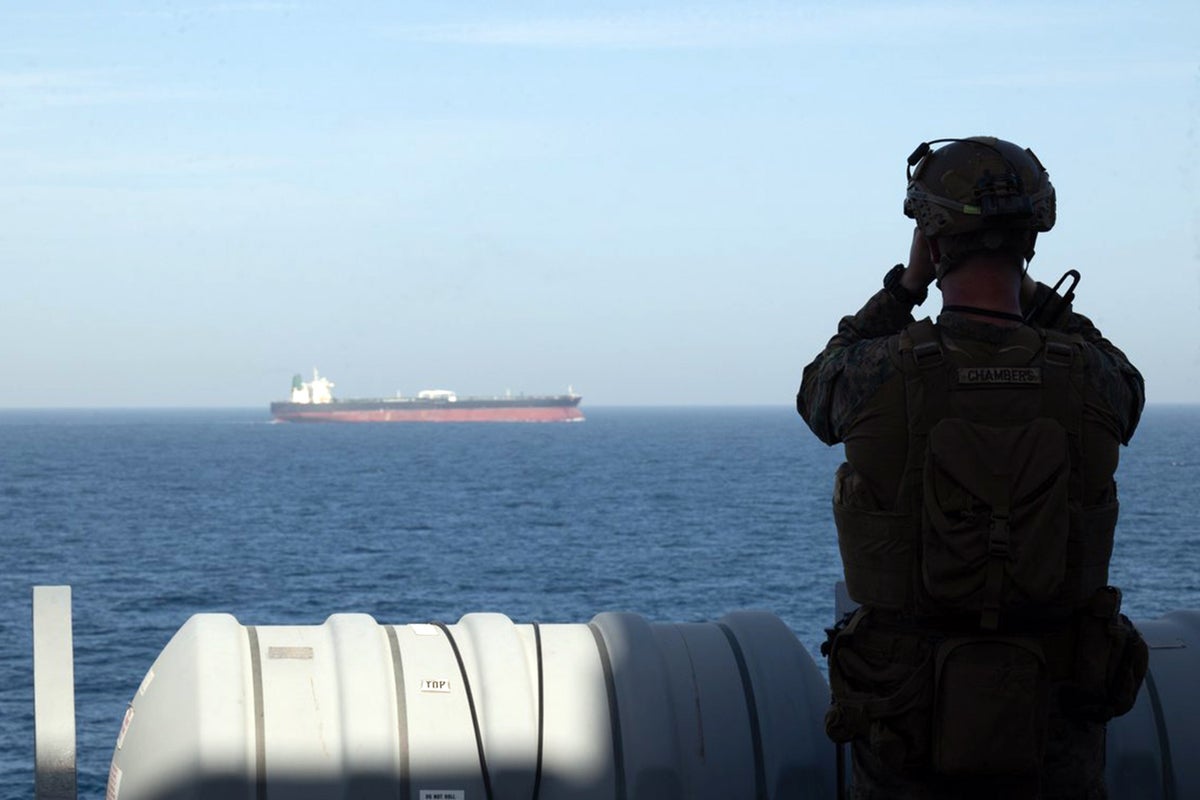
The headlines are screaming about "victory" and "seizure" as if we just won the Battle of Midway. They want you to believe the U.S. Marines boarding an Iranian vessel is a display of raw, unadulterated power. It isn't. It is the military equivalent of a debt collector repossessing a 2005 Honda Civic while the bank is on fire.
Mainstream media outlets are obsessed with the mechanics of the "blockade." They track ship coordinates like it’s a high-stakes game of Battleship. They miss the reality that a blockade in the modern era is a relic of 20th-century thinking being applied to a 21st-century ghost war. If you think seizing one ship stops the flow of illicit cargo or shifts the needle on Iranian influence, you aren’t paying attention to how asymmetric warfare actually functions.
The Myth of the Ironclad Blockade
Every "expert" on cable news is currently discussing how this seizure proves the efficacy of the naval blockade. They are wrong. A blockade is only effective if it is absolute. In the current geopolitical climate, an absolute blockade is a mathematical impossibility.
The Persian Gulf and the Gulf of Oman are not swimming pools. They are some of the most congested waterways on the planet. Attempting to "seal" these waters is like trying to stop every ant in a forest from reaching a piece of fruit. For every ship the Marines board, ten more "dark" vessels—ships with their Automatic Identification Systems (AIS) turned off—slip through the cracks using "flag of convenience" registries.
These ships aren't flying Iranian flags. They are registered in Panama, Liberia, or the Marshall Islands. They engage in ship-to-ship (STS) transfers in the middle of the night, swapping oil or hardware between hulls until the original source is scrubbed from the record. The U.S. Navy knows this. The Pentagon knows this. Yet, we celebrate the capture of one vessel that was likely "sacrificed" to keep the patrols busy while the real cargo moved elsewhere.
Kinetic Solutions for Non-Kinetic Problems
We are obsessed with kinetic action. We love the imagery of Marines fast-roping onto a deck because it looks like a movie. It provides a dopamine hit for a public hungry for "action." But here is the brutal truth: you cannot shoot your way out of a supply chain problem.
Iran’s export strategy is built on redundancy. Their logistics network is decentralized and fragmented. By seizing a ship, we are attacking the symptom, not the system.
- The Symptom: A single tanker carrying petroleum products or weapons components.
- The System: A global network of shell companies, front banks in East Asia, and brokers in Dubai who facilitate the paperwork that makes the illegal look legal.
If the U.S. actually wanted to cripple the Iranian maritime threat, they wouldn't send a boarding party. They would send a team of forensic accountants to dismantle the insurance providers and the registry offices that allow these "ghost" ships to operate. But accountants don't make for good recruitment posters.
The Escalation Trap
Everyone asks: "Will this stop Iran?"
The answer is no. In fact, it invites the very chaos we claim to be preventing.
In the world of asymmetric warfare, the smaller power doesn't try to win a head-on collision. They try to make the cost of the status quo unbearable for the larger power. Every time we seize a ship, we provide Iran with a "justification" to harass commercial shipping in the Strait of Hormuz.
They don't need to seize a U.S. Navy destroyer. They just need to make the insurance premiums for commercial tankers so high that global oil prices spike. They win by making the world's economy bleed, not by winning a naval engagement. By cheering for this seizure, we are cheering for a tactical win that leads to a strategic nightmare.
I’ve seen this play out in private security sectors across the Middle East. You tighten the grip in one area, and the pressure just squirts out somewhere else. We are playing Whac-A-Mole with a regime that has spent forty years perfecting the art of being a mole.
The Intelligence Failure of "Evading"
The official narrative claims the ship was "trying to evade" the blockade. This is a redundant observation. Of course it was. But why was it allowed to get close enough to be seized?
True maritime dominance means the ship never leaves the port, or it is turned back before it reaches international waters. The fact that a seizure had to happen at sea suggests a failure of intelligence or a failure of deterrence.
We are operating on a reactive footing. We wait for them to make a move, then we react with overwhelming force. This is the hallmark of a superpower that has lost its internal compass. We are using a sledgehammer to kill a mosquito, and we are surprised when the mosquito's friends keep coming back.
Stop Asking if the Blockade Works
The question "Is the blockade working?" is the wrong question. It assumes the goal is to stop shipping.
The real question is: Who benefits from the spectacle?
- Defense Contractors: Nothing justifies a bloated naval budget like "rising tensions" in the Gulf.
- The Iranian Hardliners: They use these seizures to fuel domestic propaganda about "American Piracy," consolidating power at home during times of economic strife.
- Oil Speculators: Every headline about a seized ship adds a "risk premium" to the price of a barrel.
The only people who don't benefit are the taxpayers and the sailors on the front lines who are being used as pawns in a theater of the absurd.
The Unconventional Reality
If we were serious about maritime security, we would stop the theater. We would admit that the era of the traditional naval blockade is over. In a world of digital finance and globalized shipping, a ship is just a floating barcode.
We need to pivot from "Seize and Search" to "Identify and Isolate."
- Step 1: Digital Sanctions. Target the individual mariners and the companies that own the vessels. Make them un-insurable and un-employable globally.
- Step 2: Transparency. Force every vessel in the Gulf to broadcast a cryptographically verified AIS signal that cannot be spoofed.
- Step 3: Admit the limitations. Acknowledge that as long as there is a buyer (often in the East), there will be a seller.
The Marine Corps is the finest fighting force on earth. Using them to play "Traffic Cop" in the Strait of Hormuz is a waste of their talent and a misunderstanding of the threat. We are celebrating a tactical footnote while the regional chapter is being rewritten by our enemies.
The ship is in custody. The problem is still at large.
Stop falling for the optics of "decisive action" and start looking at the spreadsheets. The war isn't happening on the deck of a tanker; it's happening in the ledgers of the shadow banks we refuse to touch.
You can seize the ship. You can't seize the motive.