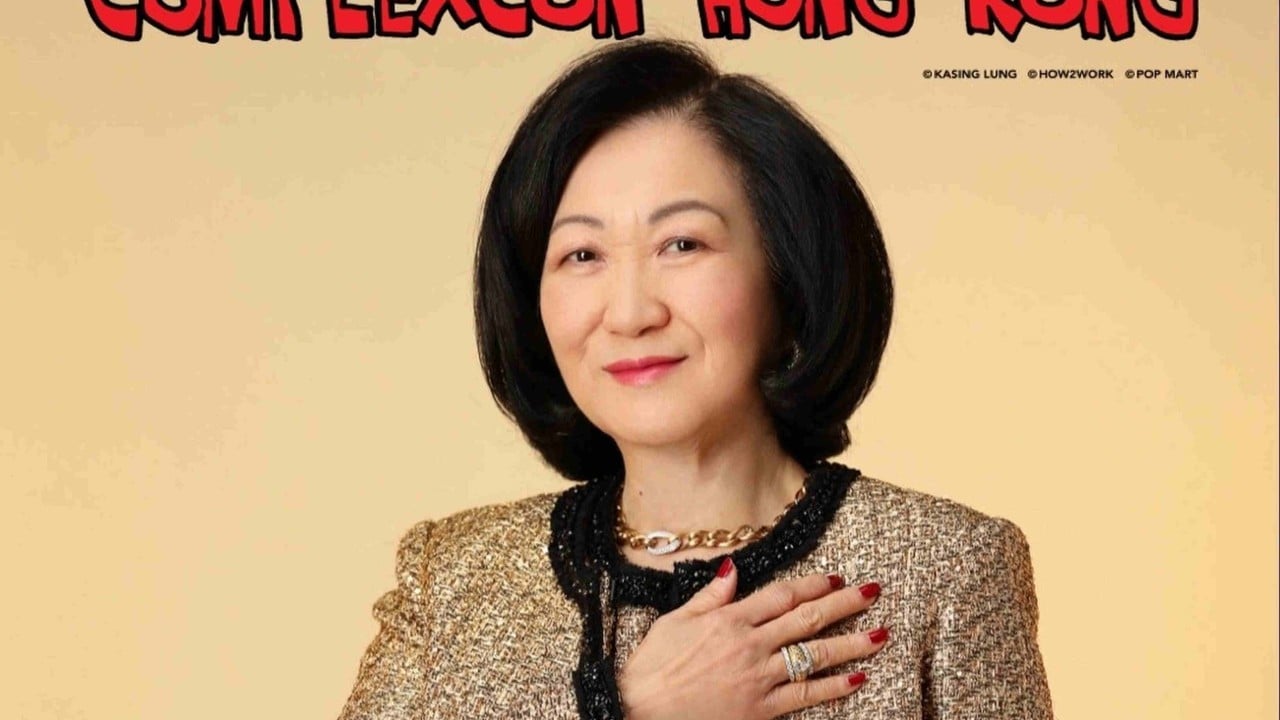
The humidity in Hong Kong has a way of softening even the sharpest edges, but Regina Ip has spent four decades remaining perfectly defined. She is the personification of the establishment. When she walks into a room, you expect the rustle of policy papers, the scent of expensive tea, and the weight of Legislative Council debates. You do not expect her to be hunting for a limited-edition photo card of a South Korean celebrity.
Yet, there she was.
The floor of AsiaWorld-Expo during ComplexCon is a sensory riot. It is a place where the air vibrates with bass and the price of a pair of sneakers can rival a month’s rent in Mid-Levels. It is the natural habitat of the "hypebeast," the Gen Z digital native, and the global street-culture elite. Into this neon-soaked fray stepped the 73-year-old Convenor of the Executive Council. She wasn't there to give a speech on trade tariffs or urban planning. She was there to play.
The Cultural Collision
Politics is usually a game of territory. You stay in your lane, you speak to your base, and you maintain a carefully curated dignity. Crossing the line into pop culture is a risk. Do it wrong, and you look like a grandparent trying to use "rizzed up" in a sentence—painful, forced, and instantly meme-able for all the wrong reasons. Do it right, and you find a bridge across a generational chasm that has felt uncrossable for years.
Regina Ip didn't just walk through the doors; she immersed herself in the ritual. She stood in lines. She navigated the labyrinth of booths. Most importantly, she engaged with the peculiar, high-stakes economy of the "photo card."
To the uninitiated, a photo card is a slip of cardboard. To the devotee, it is a relic. It is a physical manifestation of a digital obsession, a piece of a star that you can hold in your hand. In the world of K-pop and street culture, these cards are the currency of connection. By trading her legislative gravity for a holographic collectible, Ip wasn't just participating in a hobby. She was performing an act of radical relatability.
The Strategy of the Souvenir
Consider the optics. For years, the divide between the youth of Hong Kong and the political elite has been described as a canyon. One side speaks the language of stability and tradition; the other speaks in memes, fashion drops, and decentralized global trends. Usually, these two worlds only collide in friction.
But at ComplexCon, the friction turned into curiosity.
Ip’s presence served as a silent acknowledgement: I see what you value. By showing interest in the subcultures that drive the modern economy—art, music, and high-end collectibles—she signaled a willingness to learn a new dialect. It wasn't a policy shift, but it was a tonal one. In the theatre of public perception, tone often dictates the terms of the debate before a single word is even spoken.
She posed with fans. She examined the artwork of Daniel Arsham. She looked at the fusion of high fashion and street grit. Through it all, she carried herself not as a tourist in a foreign land, but as a student.
The Invisible Stakes of Cool
There is a cold, hard business logic beneath the neon lights. Hong Kong is in a relentless battle to reclaim its title as Asia’s premier cultural hub. After years of isolation and shifting social tides, the city needs more than just banks; it needs a pulse. ComplexCon is that pulse. It represents the invisible, multi-billion-dollar economy of "cool." It is the same reason why art fairs and sneaker conventions are as important as any trade summit. They attract the talent, the money, and the attention that creates a city’s gravitational pull.
By being there, Ip was effectively saying that the establishment takes this "frivolous" world seriously. She wasn't just collecting cards. She was collecting data on the future of the city’s identity. The stakes are immense: if a city loses its coolness, it loses its youth. If it loses its youth, it loses its soul.
The Paradox of the Photo Card
There is something deeply human about a 73-year-old woman in a tailored suit, clutching a glossy card of a K-pop idol. It is a moment of pure, unadulterated fandom that transcends age and ideology. It is a reminder that we are all, at some level, just looking for something to belong to.
Whether it is a political party or a musical fandom, the impulse is the same. We want a tribe. We want a souvenir of the moment. We want to be part of the story.
By the time Ip left the expo, she was no longer just a "former lawmaker" or a "policy expert" in the eyes of the attendees. She was something much rarer in the world of high politics: a person. She had stepped out of the sterile air of the legislative chambers and into the messy, vibrant, and incredibly loud world of the next generation. It was a trade-off that couldn't be calculated in any budget, but one that might pay dividends for years to come.
The image of her holding that card—delicate, shiny, and utterly disconnected from the world of tax codes—remains long after the crowds have dispersed.
In a world that demands we pick sides, she chose to pick a card instead.


