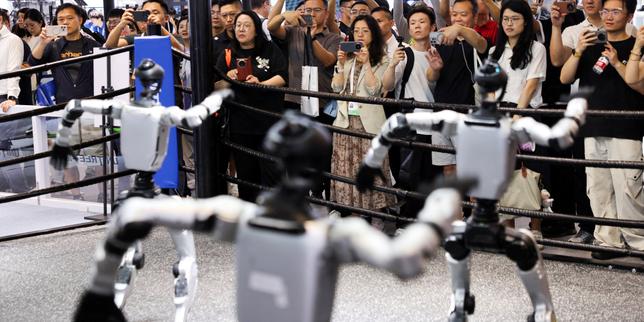
The factory floor smelled of warm ozone and stale coffee. It was three in the morning in a suburb outside Shanghai, and the only things moving were the overhead fluorescent tubes casting a pale, flickering jaundice over rows of silent assembly benches.
Then came the whir.
It was a low, rhythmic frequency, like a large cat purring inside a metal drum. Out of the shadows stepped a bipedal silhouette. It did not march with the rigid, jerky terror of old science fiction. It walked with a fluid, slightly rolling gait, its synthetic knee joints flexing just enough to absorb the shock of the concrete floor. In its carbon-fiber hands, it held a lithium battery pack the size of a paving stone. It did not drop it. It did not hesitate. It slotted the component into a chassis with a clean, satisfying click, turned around, and vanished back into the gloom.
To the casual observer scrolling through social media feeds, this was another shiny spectacle of humanoid robotics. A viral video designed to make stock prices flutter.
They missed the point entirely.
While the world stares slack-jawed at shiny chrome faces doing backflips and waving at trade delegations, something far more consequential is happening beneath the surface. The glittering humanoid craze is just the storefront window. Walk into the back room, and you will find the real machinery of economic survival. China is not building an army of mechanical butlers to pour tea in living rooms. It is industrializing a nervous system. And the stakes could not be higher.
The Quiet Panic Behind the Neon
To understand why the streets of Beijing and Shenzhen are suddenly flooded with venture capital for two-legged steel frames, you have to look at the demographic cliff.
For decades, the engine of the world's workshop was an endless, renewable resource of human hands. Millions of young workers migrating from rural provinces into coastal megacities, spending their youth soldering motherboards and stitching seams. That reservoir is draining dry. Birth rates are plunging. The population is aging with terrifying speed. The math is simple, brutal, and utterly unforgiving. There are simply not enough human beings left to do the heavy, repetitive, soul-crushing labor that keeps global supply chains humming.
Panic is a powerful muse.
When the labor pool shrinks, an economy has two choices. It can shrink right along with it, accepting a slower, quieter decline into economic irrelevance. Or it can invent a way out of the trap.
This is where the humanoid robot enters the narrative, but not for the reasons most people think. A humanoid form factor is terribly inefficient for most factory tasks. A wheeled cart is more stable. A fixed robotic arm is faster and cheaper. Why spend millions engineering an articulated waist, two shoulders, elbows, wrists, and five-fingered hands when you are just tightening bolts on a transmission?
The answer is shockingly mundane. Our world was built for us.
Door handles are at a certain height. Staircases have a specific rise and run. Hallways are narrow. Tools are shaped for human palms. If you want a machine to step into an existing automotive plant or electronics factory without tearing down the walls and rebuilding the entire infrastructure from scratch, that machine has to look like us. It has to fit into our clothes, so to speak.
(To be clear: when I describe these factories, I am drawing from documented manufacturing shifts in the Guangdong and Zhejiang industrial corridors, where labor shortages have accelerated automation timelines by nearly a decade.)
The Ghost in the Assembly Line
I spoke with a senior engineer last autumn who asked to remain nameless. He had spent twenty years designing traditional industrial arms for German and Japanese automotive lines.
"Everyone thinks we are building companions," he told me, leaning over a grease-stained blueprint in a cramped office filled with discarded circuit boards. "They think we want robots to feel emotions. That is a Western fantasy. We are building prosthetic labor. If a human worker leaves the line because their back gives out at forty-five, I need something that can slide directly into their station at six o'clock the next morning without retraining the supervisors."
Consider what happens next.
The humanoid chassis is merely the hardware vessel. The real battleground is the neural network driving it.
For years, industrial robots were gloriously stupid. They followed strict, hard-coded geometry. If a bolt was displaced by even a millimeter, the machine would keep driving the screw into empty air until a human hit the emergency stop. Today, algorithms trained on massive reinforcement learning datasets allow machines to adapt in real time. They feel resistance. They adjust grip pressure on the fly. If a fragile glass panel slips, the hand tightens just enough to save it, relying on artificial proprioception that mimics human muscle memory.
This is why the Chinese government has thrown its immense weight behind the sector. It is not just about consumer tech prestige. It is about industrial self-preservation.
When subsidies pour into humanoid robotics laboratories, they are subsidizing the foundational components of all advanced automation. The lightweight actuators, the high-density battery management systems, the spatial mapping chips, the torque sensors. These are the exact same technologies required to make factory floor arms faster, autonomous logistics drones smarter, and medical exoskeleton suits cheaper for an aging population.
The humanoid robot is the Trojan horse. Inside it hides the entire future of industrial robotics.
The Human Cost of Steel
It is easy to get swept up in the techno-optimism. The sleek presentations, the soaring lines of code, the promise of a future freed from drudgery. But let us sit with the discomfort for a moment.
What happens to the worker whose entire identity was forged on the assembly line?
In a small town in Sichuan, I met a man named Uncle Chen. For thirty-two years, his calloused thumbs knew every contour of the circuit boards he inspected. He could spot a micro-fracture in a solder joint with a glance that took a fraction of a second. He raised two daughters with the wages earned from those thumbs.
When I asked him about the machines coming for his old job, he did not rage against the dying of the light. He just looked down at his hands, scarred and stiff with arthritis, and smiled a sad, knowing smile.
"They are not stealing my job," he said softly. "They are stealing my replacement's job. And maybe that is a mercy. No one should spend forty years staring at a glowing microscope until their eyes go milky."
There is a profound dissonance in witnessing the dawn of this era. On one hand, we are watching the culmination of centuries of human ingenuity—building metal reflections of ourselves to bear the burdens we were never meant to carry forever. On the other hand, we are witnessing the final obsolescence of muscle as currency.
The factories of tomorrow will not be dark and empty. They will hum with a different kind of life. A colder, more precise rhythm.
As the morning shift began to break outside the window, casting long, sharp shadows across the concrete, the bipedal machine in the corner powered down its cooling fans. Its glowing blue optical sensors faded to a dull, matte black. For a second, it looked less like a marvel of modern engineering and more like a discarded mannequin.
Then the power grid surged again, and the eyes flickered back to life.