The coffee goes cold before you remember to drink it. That is the first rule of the high latitudes. You set the ceramic mug down on the chart table, distracted by the sudden, terrifying scream of stressed steel, and by the time your hand returns, the liquid has formed a thin skin of ice.
Four weeks. Twenty-eight days of watching the horizon turn from gray to white, then to a blinding, impossible blue that hurts the eyes even through polarized glass.
Most people think of the poles as empty. They imagine vast, static expanses of white postcard perfection, untouched and eternal. They are wrong. The polar regions are violent, moving, breathing entities. And right now, the global economy is holding its breath over who gets to navigate them.
(Note: To understand what happens when a vessel meets multi-year polar ice, imagine driving a car through a wall of wet concrete while the walls themselves are actively trying to crush the doors.)
The Weight of the Hull
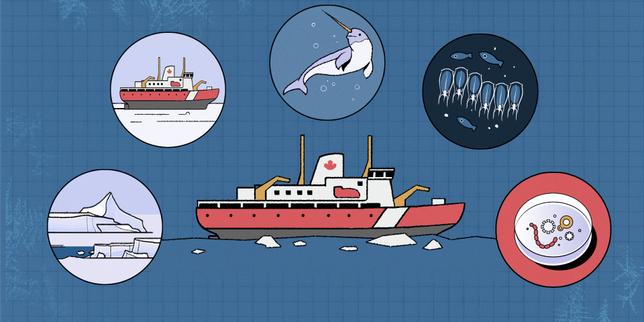
Look closely at the bow of an icebreaker. Forget the sleek, aerodynamic lines of modern container ships designed to cheat the friction of open water. This ship is shaped like a wedge. It is built backward from normal naval architecture.
Instead of cutting through the waves, a true polar icebreaker uses its sheer mass—tens of thousands of tons of displacement—to ride up onto the ice. It climbs. Gravity does the dirty work. The weight of the forward hull cracks the frozen armor from above, splintering meters of compressed crystals with a groan that reverberates through the deck plates and straight up into the soles of your boots.
For four weeks, that sound becomes your heartbeat.
Down in the engine room, the air smells of hot oil, ozone, and salt. Engineers watch digital readouts that pulse with terrifying numbers. When a ship rams a ridge of pressure ice, the propellers experience sudden, brutal torque spikes. Traditional shafts would snap like dry twigs. These systems rely on massive electric propulsion motors that can reverse direction in seconds, churning white water and crushed fragments to keep the rudders from being sheared off.
It is engineering born of desperation. For decades, these specialized vessels were viewed as expensive municipal tools—glorified snowplows of the sea, kept on standby by governments to rescue stranded research vessels or keep Arctic shipping lanes open for a few stubborn months a year.
Not anymore.
The Quiet Scramble
The ice is retreating. We can argue about the politics of climate change until our throats are dry, but the physical reality on the water remains absolute. Summer sea ice is thinning. Northwest and Northeast passages that defeated explorers for centuries are opening for longer windows each year.
Beneath those shifting floes lie vast, untapped reserves of rare earth minerals, oil, and natural gas. More importantly, the shortest maritime routes between major Asian manufacturing hubs and European ports cut straight across the roof of the world, shaving thousands of miles and millions of dollars off traditional transit times.
Nations are noticing.
Shipyards in Northern Europe and Asia are working around the clock. The technology required to build these hulls has shifted from a niche maritime sub-discipline into one of the most fiercely guarded industrial sectors on Earth. We are talking about hyper-specialized high-tensile steels that maintain their structural integrity at minus fifty degrees Celsius. We are talking about AI-driven ice-detection sonar that reads the subsurface density of a floe before the ship even touches it.
We are watching a gold rush, written in iron and frost.
Consider what happens next. When a polar route becomes viable for commercial container traffic, the entire geography of international trade shifts. Ports that were once sleepy Arctic outposts suddenly find themselves positioned to become the Singapore or Rotterdam of the twenty-first century.
Yet, the romance of the voyage obscures a sobering truth.
The Human Cost of the White Desert
Out here, on the bridge at three in the morning, the stars are so bright they look like pinpricks in black velvet. There is no internet. Satellite communication drops out behind towering pressure ridges. You are closer to astronauts on the space station than you are to the nearest coffee shop.
The psychological weight is heavier than the ice.
Seamen talk about the whiteout—not just the weather condition where sky and sea become indistinguishable, but the mental blur. After two weeks of identical monochromatic views, human brains start playing tricks. A distant hummock of ice looks like a polar bear, then a stranded ship, then nothing at all. Crew members become quiet. Meals in the mess hall are eaten in stretches of heavy silence, broken only by the rhythmic thrum of the diesel generators.
Experience teaches you respect. The Arctic does not forgive arrogance. Make a miscalculation in fuel consumption, misread a satellite ice chart, or underestimate the speed at which a polar storm can pack-ice a channel, and you are no longer a pioneer. You are a statistic.
Governments pouring billions into icebreaker technology often forget this part. They buy the steel. They fund the research. But they rarely account for the human bandwidth required to operate in an environment that actively wants to kill you.
The New Frontier
The video footage from that four-week voyage shows the majestic bow parting the floes like a knife through silk. It looks clean. It looks triumphant.
It misses the smell of stale coffee, the vibration in the teeth, the exhaustion in the eyes of the watch officer who has stared at a green radar screen for six hours straight. It misses the quiet realization that we are carving highways through ecosystems that have remained pristine for millennia, driven by an insatiable hunger for speed and resources.
The ice is breaking. The ships are ready.
And the world will never look at the top of the world the same way again.