The air inside the Turangga Express smelled of clove cigarettes and cheap coffee. It was 6:03 in the morning. Outside the windows, the rice paddies of Cicalengka were blurred by a thick, milky mist that clings to the valley floor before the sun burns it away. Passengers were still trapped in that liminal space between sleep and reality. Some adjusted their neck pillows; others watched the green landscape flicker by, a rhythmic strobe light of emerald and gray.
Then the rhythm broke.
Steel does not scream like a human, but when it twists, it makes a sound that stays in your marrow forever. It is a high-pitched, grinding shriek that signals the end of the world for anyone within earshot. In a fraction of a second, the Turangga Express, moving with the heavy confidence of a long-distance cruiser, met the Bandung Raya Commuter line head-on.
The kinetic energy had nowhere to go. It didn't just stop; it folded.
The Anatomy of a Second
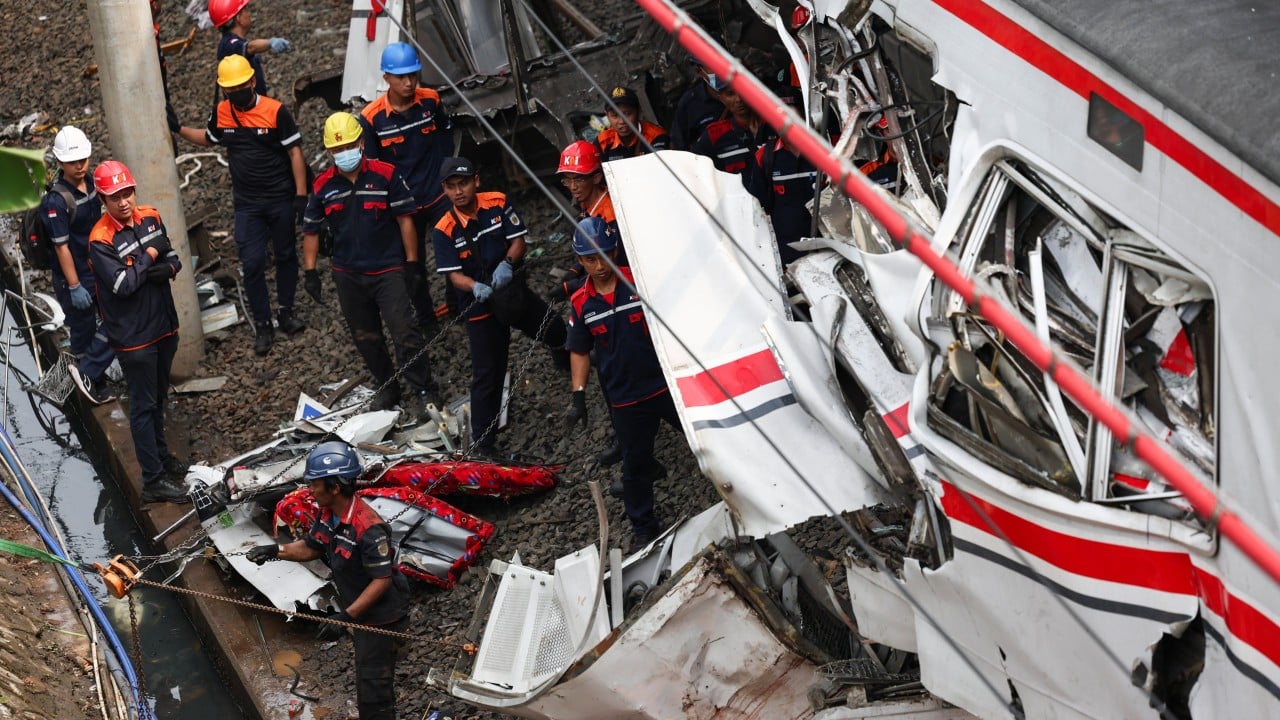
Imagine two titans made of iron, each weighing hundreds of tons, deciding to occupy the same few meters of track at the exact same moment. Physics is indifferent to human plans. When the impact happened, the lead carriages didn't just collide—they climbed. The commuter train's front car was vaulted into the air, its undercarriage exposed like the belly of a dying beast, while the Turangga’s locomotive buried itself into the earth and the wreckage of its counterpart.
Inside, the world became a centrifuge of glass and luggage.
Julian was a passenger who had been checking his watch, wondering if he’d have time for a second breakfast upon arrival. He describes the sensation not as a crash, but as an explosion of gravity. One moment he was seated; the next, he was pinned against the ceiling as the carriage rolled. The lights flickered and died, replaced by a terrifying, suffocating darkness.
Silence followed. But it wasn't the silence of peace. It was the heavy, pressurized quiet of shock. Then, the smell hit: ozone, burnt rubber, and the metallic tang of blood.
The Invisible Stakes of a Single Track
To understand why fifteen people are now memories instead of commuters, we have to look at the geometry of the Indonesian rail system. Much of the network in West Java relies on single-track lines. This is a high-stakes game of logistical chess where timing is the only thing preventing catastrophe. On that Friday morning, the clock failed.
The Turangga was a pride of the fleet, a "luxury" class connecting Surabaya to Bandung. The commuter line was the local heartbeat, carrying workers and students. They were never supposed to see each other. Somewhere in the chain of command—a signal not changed, a radio call missed, a mechanical relay that stayed open when it should have shut—the safety net vanished.
Indonesia has been racing to modernize its infrastructure, pouring billions into high-speed rail and shimmering new stations. Yet, this tragedy serves as a brutal reminder that a system is only as strong as its oldest switch and its most tired operator. We obsess over the speed of the future while the foundations of the present remain brittle.
Voices from the Twisted Metal
Rescue workers didn't arrive to a scene; they arrived to a jigsaw puzzle made of jagged steel. They had to use hydraulic shears to bite through the fuselage.
"We heard them before we saw them," one volunteer recounted, his hands still stained with the orange dust of the trackside. "People were calling out names. Not for help, mostly. Just names. They wanted to know if the person in the seat next to them was still there."
One woman, trapped for three hours near the wreckage of the dining car, spoke of a man she didn't know who held her hand through a gap in the debris. He told her stories about his daughter’s upcoming wedding. He told her the sun would be up soon. When the rescuers finally pulled her out, the man stopped talking. He wasn't there anymore. He had been a ghost of comfort, a final act of human defiance against a mechanical end.
The casualty list grew as the morning progressed. Four crew members were among the dead, including the drivers who stood at the literal front line of the failure. These were men who spent their lives navigating these bends, who knew every creak of the rails, yet were powerless when the headlight of an oncoming train emerged from the Bandung fog.
The Cost of Motion
We treat travel as a right, a seamless transition from Point A to Point B. We trust the engineers, the signalmen, and the cold logic of the timetable. But there is a hidden cost to our collective movement. Every time we board a vessel of such immense power, we are entering into a silent contract with the infrastructure.
When that contract is breached, the fallout isn't just a headline or a set of grim statistics about "15 dead" and "dozens injured." It is the sight of a stray shoe lying in the mud. It is a cell phone ringing incessantly in a pile of rubble, a caller on the other end wondering why their husband hasn't checked in yet.
The wreckage in Cicalengka was eventually cleared. Cranes arrived to lift the mangled carriages, looking like broken toys against the vastness of the volcanic hills. The tracks were repaired. New ballast was laid down. The schedule resumed, because the world demands that the trains must run.
But for the families standing on the platforms in Bandung and Surabaya, the air will always carry that faint, metallic scent of a morning when the rhythm stopped. They look at the tracks not as a path to a destination, but as a scar across the land.
The sun eventually burned through the mist that morning, illuminating the full scale of the carnage. It revealed the bright blue paint of the commuter train smeared against the yellow of the Turangga, a permanent record of the moment two lives became one tragedy. The rice paddies remained indifferent, the young stalks swaying in the breeze generated by the rescue helicopters, green and vibrant and utterly oblivious to the iron silence left behind.