Salt burns the eyes before you even touch the shore.
I remember standing on the pitching deck of a research cutter, watching the jagged silhouette of Socorro Island rise from the violent blue of the Revillagigedo Archipelago. Two hundred and fifty miles off the western coast of mainland Mexico, this volcanic chunk of rock feels less like a destination and more like an unfinished thought of the earth. It is wind-scoured, isolated, and utterly exposed to the Pacific fury. Learn more on a similar topic: this related article.
When sailors first dropped anchor here centuries ago, they brought with them a quiet catastrophe wrapped in wool.
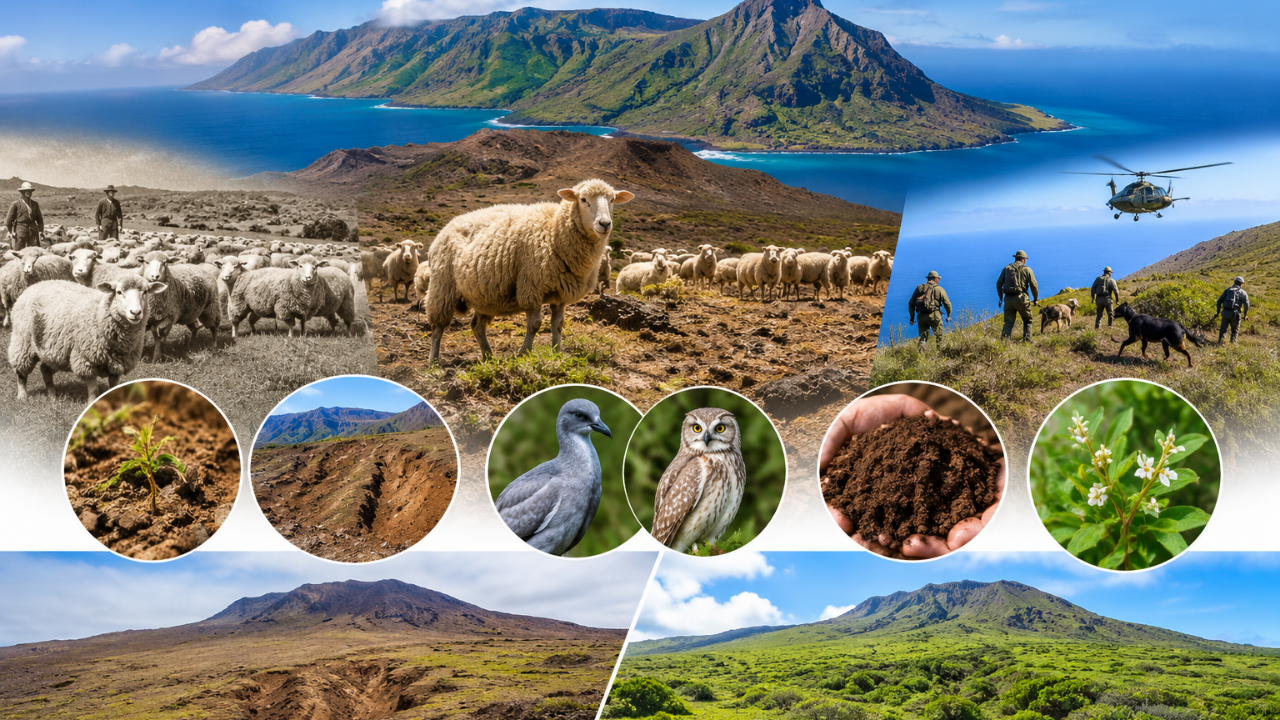
History records the arrival casually. In 1869, a small band of domestic sheep was introduced to Socorro Island. It was a utilitarian gesture, born of maritime pragmatism. A living larder for passing ships. A handful of ewes and rams turned loose on an emerald-capped volcanic dome, expected to forage, multiply, and wait. Further journalism by Travel + Leisure explores similar perspectives on the subject.
They waited. Then they multiplied.
Consider the mathematics of biological displacement. One hundred sheep became five thousand. Five thousand hooves churning volcanic ash. Five thousand pairs of sharp, relentless teeth clipping down every tender shoot of endemic scrub, every sapling, every blade of grass that tried to anchor the fragile island soil.
The sheep did not merely live on the island. They consumed its future.
To walk across Socorro during the peak of the feral infestation was to walk across a battlefield of slow attrition. The hillsides, once choked with dense forest-habitat vegetation cover, bled into red dust. Without roots to bind the earth, seasonal rains carved jagged gullies through the slopes, washing the island's lifeblood straight out into the churning surf. The endemic birds—creatures that evolved in the quiet absence of ground predators—found their nesting grounds trampled flat.
It was a tragedy written in wool and starvation. The sheep ate themselves into a corner. As the vegetation vanished, the food supply withered, but the sheer momentum of their population kept the pressure locked down. The island was becoming a skeleton.
Then came the intervention.
Restoration ecology is rarely a gentle art. It is often a process of surgical violence, undertaken with heavy hearts and precise calculations. Scientists and conservationists realized that if Socorro was to survive, the very symbol of its destruction had to be systematically undone.
Between 2010 and 2012, eradication teams descended upon the island. This was not a casual cull. It was an exhaustive, painstaking manhunt across treacherous volcanic terrain, ravines, and dense thickets. Helicopters thrummed against the thermal updrafts. Trackers combed every square meter of the volcanic cone.
One thousand, seven hundred and sixty-two.
That was the grim tally of the final removals. Every single feral sheep was hunted down and cleared from Socorro Island. The human footprint in this final phase was heavy, intentional, and absolute.
What happens when you lift a boot that has crushed a throat for a century and a half?
The answer arrived not in years, but in seasons.
I returned to Socorro years after the eradication program closed its books. The change hit me before I even stepped off the skiff. The air smelled different. It carried the heavy, rich musk of damp earth and crushed fern, instead of the stark, mineral tang of eroded dust.
The numbers tell a staggering story of ecological rebound. Forest-habitat vegetation cover, which had plummeted to a desperate low during the height of the sheep era, surged dramatically. It climbed from a fragile 29 percent up to an astonishing 85 percent.
The island was green again.
Walk up the slopes of Mount Evermann today, and you will hear the frantic rustle of endemic shrubbery pushing through rich, dark soil that hasn't seen this kind of organic accumulation in over a hundred and fifty years. The endemic Socorro parakeet, once whispered about as a ghost waiting to happen, darts through a canopy that has finally reclaimed its rightful height. The shearwaters dig their burrows into soil that holds firm instead of collapsing under their weight.
Nature does not need our permission to heal. It only needs us to get out of the way, and occasionally, to undo our own worst mistakes.
Standing on the black basalt cliffs, watching the frigatebirds ride the updrafts high above the restored canopy, I thought about those original hundred sheep. They didn't arrive with malice in their hearts. They were simply doing what living things do: eating, surviving, expanding until the boundaries pushed back.
Socorro pushed back. Or rather, we finally helped it do what it had been desperate to do since 1869.
The wind still howls off the Pacific. The volcano still sleeps beneath its mantle of green. But the dust has settled, the roots have locked the earth in a permanent embrace, and the island breathes.