Japan is officially running out of people. It's not a slow drift anymore. It's a cliff.
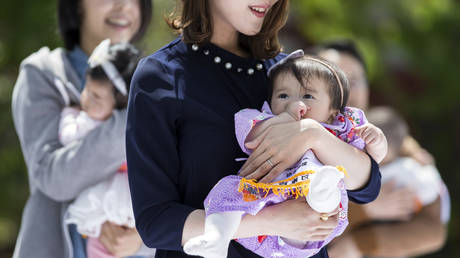
The newest demographic data released by the Ministry of Health, Labor, and Welfare presents a brutal reality. In 2025, the number of babies born to Japanese citizens plunged to an all-time low of just 671,236. Let's put that into perspective. This marks the tenth consecutive year that births have hit a record low. It's also the second straight year the number has trapped itself below the 700,000 threshold.
Meanwhile, 1,589,489 people died in Japan during the same period. Do the math. The country shrank by more than 918,000 people in a single year. That's essentially wiping a major city like Chiba off the map every twelve months. Prime Minister Takaichi Sanae recently called this a quiet national security crisis. She's not exaggerating.
What makes these numbers terrifying for policymakers is the speed of the collapse. The National Institute of Population and Social Security Research previously estimated that births wouldn't drop to the 670,000 range until the 2040s. Japan is running roughly 15 years ahead of its worst-case scenario.
If you think this is just a quirky trend about people preferring pets to babies, you're missing the economic disaster lurking beneath the surface.
The Mathematical Trap of 1.14
To keep a population stable without immigration, a nation needs a total fertility rate of 2.1. That's the average number of children a woman needs to have. Japan's fertility rate just ticked down again to 1.14.
[Image of population pyramid of Japan]
In Tokyo, the epicenter of the crisis, the rate sits at a catastrophic 0.96. It's been below 1.0 for three consecutive years. When a society's capital city sees a fertility rate below one, that society is actively choosing to contract.
You can't blame young Japanese adults for making this choice. Look at what it actually takes to raise a child in modern Japan compared to the rigid expectations embedded in the corporate culture.
The government keeps throwing money at the problem. They've expanded child allowances, offered housing subsidies, and even built state-backed dating apps to get people to mingle. It isn't working. It won't work. Cash bonuses don't fix a fundamentally broken structural environment.
Why Young Adults Are Passing on Marriage
In Japan, births outside of marriage are incredibly rare, accounting for only around 2% of all children. This is radically different from many Western nations. It means that if you want to fix the birth rate, you have to fix the marriage rate first.
While marriages saw a tiny bump in 2025 to 489,119, the numbers are still severely depressed compared to the pre-pandemic average of roughly 599,000 in 2019. Young people aren't just delaying marriage; many are abandoning the concept entirely. The average age for first marriages has climbed to 31.0 for men and 29.7 for women.
Here's the real issue. The traditional postwar corporate structure demands complete, unwavering devotion to the office. We're talking brutal overtime hours, mandatory after-work drinking sessions, and unpredictable corporate transfers. This system was built on the assumption that a husband works infinite hours while a stay-at-home wife manages the domestic front entirely.
That model is dead. Young women are highly educated and form a critical part of the workforce. Yet, the domestic expectations haven't shifted. Women know that having a child often means committing professional suicide or taking on a crushing double burden of full-time work and solo parenting.
- The Income Gap: Real disposable income for young adults hasn't kept pace with the rising costs of living in urban centers like Tokyo.
- The Employment Trap: A huge portion of the youth workforce is stuck in irregular, part-time, or contract gigs. These jobs offer zero long-term security and dismal pay, making marriage look like an impossible financial risk.
- The Social Isolation: Child-rearing in dense cities has become an isolated endeavor, stripped of the traditional multi-generational family support networks that used to exist in rural areas.
The Rural Desolation vs. The Tokyo Black Hole
The demographic crisis isn't hitting the map evenly. There's a massive regional divide. Western and southern prefectures like Okinawa, Miyazaki, and Fukui boast the highest fertility rates in the country, hovering between 1.45 and 1.52.
The north and east are drying up. Hokkaido and Miyagi are struggling at 1.00. Rural towns are turning into ghost villages filled with empty houses, known as akiya. Schools are closing down because there isn't a single child left to fill the classrooms.
Yet, young people keep migrating to Tokyo for jobs. Tokyo acts like a demographic black hole. It sucks in youth from the provinces, subjects them to high rents, cramped apartments, and intense work pressure, and then fails to produce the next generation. It's a highly efficient system for population reduction.
What This Means for Business and Survival
We've entered uncharted territory. Japan has recorded 19 consecutive years of natural population decline since 2007. The consequences are shifting from theoretical future warnings to immediate, daily disruptions.
The Labor Starvation
Convenience stores can't find overnight staff. Essential infrastructure projects face chronic delays. Blue-collar wages are starting to tick upward simply because companies are desperate for warm bodies. You see octogenarians working as traffic guides and taxi drivers because there's nobody else to hire.
The Pension Implosion
Japan's social safety net is a pay-as-you-go system. Today's workers pay for today's retirees. Right now, nearly 30% of Japan's population is over the age of 65. As the youth cohort shrinks to a tiny sliver of the population pyramid, the financial math behind pensions and national healthcare completely falls apart.
The Corporate Inertia
Many businesses still refuse to offer true flexible remote work, penalize taking paternity leave, and promote based on seniority rather than output. By doing so, they are actively suppressing the birth rate of their own workforce.
Actionable Steps for Navigating the Demographic Squeeze
If you are operating a business, managing investments, or looking at long-term planning in Japan, you cannot afford to ignore these numbers. Relying on government policy to reverse this trend is a losing bet.
- Aggressively Automate Low-Skill Roles: If your business model relies on cheap, abundant human labor, it's time to pivot. Invest in self-service tech, automated logistics, and software workflows. The supply of entry-level workers will never recover.
- Overhaul Employee Retention Tactics: High-turnover corporate models won't survive. To attract the shrinking pool of young talent, you need to offer genuine work-life balance, remote flexibility, and clear paths for advancement that don't require sacrificing family life.
- Target the Longevity Economy: The silver market is the only expanding demographic. Focus your products, services, and marketing efforts on the needs of a highly active, relatively wealthy, but aging population.
- Build Borderless Systems: Accept that domestic consumption will naturally shrink. Diversify your revenue streams into international markets and look toward foreign talent pools through targeted, skilled immigration channels to fill talent gaps.
The 2025 birth data proves that Japan is out of time. The country cannot buy its way out of this crisis with standard child-care stipends. Until the underlying corporate expectations and economic precarity of young adults change fundamentally, the numbers will continue their steady downward march.