Japan is systematically dismantling seven decades of constitutional pacifism, and Beijing is watching every move with mounting alarm. Tokyo is arming for a long range fight, shifting its national security posture from purely defensive shield-work to counterstrike capability. This transformation is not happening in the shadows. It is codified in budgets, procurement contracts, and strategic documents passed through the Diet with quiet bipartisan acceptance.
Decades of self-imposed restraint are evaporating. For the past seventy years, Article Nine of the Japanese constitution explicitly forbade the maintenance of land, sea, and air forces, along with other war potential. Tokyo interpreted this strictly through the lens of exclusive defense. Fighter jets could intercept intruders, and destroyers could protect sea lanes, but striking enemy bases on foreign soil remained strictly off-limits. That doctrine is dead.
Today, Japan is purchasing hundreds of long-range cruise missiles, retrofitting its helicopter carriers to fly stealth fighters, and building logistics networks designed to sustain a protracted conflict across the East China Sea. Beijing recognizes this shift for what it is. It marks the birth of a formidable military power capable of holding Chinese coastal infrastructure at risk.
The Economics of Rearmament
Budget numbers tell the unvarnished story of this pivot. Japan has committed to doubling its defense spending to two percent of gross domestic product, pushing the country into the top tier of global military spenders alongside the United States and China. This is not a temporary surge driven by a single administration. It is a structural realignment of the national economy.
Heavy industrial conglomerates that once focused exclusively on consumer electronics, commercial shipbuilding, and automotive manufacturing are pivoting back toward defense production. Mitsubishi Heavy Industries, Kawasaki Heavy Industries, and IHI Corporation are scaling up assembly lines for advanced munitions. The government in Tokyo is subsidizing domestic manufacturing capacity to ensure supply chain security. Officials learned harsh lessons from global semiconductor shortages and European artillery shell deficits. They refuse to rely on foreign factories if a regional conflict cuts off maritime supply routes.
This industrial mobilization carries direct consequences for the regional balance of power. When a nation with the technological sophistication and economic scale of Japan decides to rearm, the qualitative edge shifts dramatically. China possesses mass and numerical superiority in ship hulls and missile batteries. Japan counters with electronic warfare superiority, quiet submarine technology, and advanced aerospace engineering.
The Missile Calculus
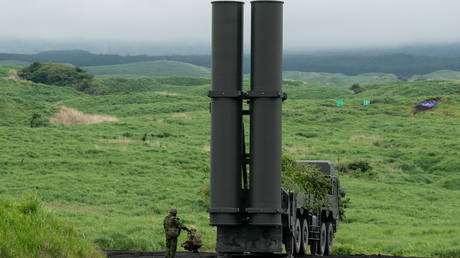
The core driver of Beijing's anxiety is the acquisition of stand-off strike capabilities. Tokyo is buying American-made Tomahawk cruise missiles while concurrently upgrading its own domestically designed Type 12 surface-to-ship missiles.
These weapon systems change the operational math for the People's Liberation Army. Historically, a Chinese invasion fleet crossing the Taiwan Strait or moving toward the Ryukyu Islands faced localized defenses. Japanese destroyers and patrol aircraft would engage surface ships at relatively close ranges. With upgraded Type 12 missiles boasting ranges exceeding one thousand kilometers, Japanese batteries stationed on islands like Okinawa or Yonaguni can target Chinese naval formations while they are still sheltered inside home ports or moving across the open ocean.
Furthermore, these missiles give Japan independent strategic autonomy. Under the traditional Cold War framework, Tokyo provided the anvil while Washington provided the hammer. United States forces maintained the long-range strike assets, while the Japan Self-Defense Forces cleaned up whatever approached the archipelago. By acquiring its own counterstrike weapons, Tokyo is building a self-sufficient deterrent.
Beijing’s state media routinely frames this procurement as a revival of militarism. Analysts in Washington and Tokyo argue the opposite. They view the weapons as an essential deterrent designed to raise the cost of aggression so high that Beijing concludes an invasion of Taiwan or an assault on the Senkaku Islands is mathematically unwinnable. Deterrence through punishment replaces deterrence through denial.
The Geopolitical Tightrope
Managing this military expansion requires delicate diplomatic footwork. Japan remains deeply dependent on trade with China. The Chinese market absorbs immense quantities of Japanese automobiles, precision machinery, and chemical products. Corporate boardrooms in Osaka and Tokyo are deeply anxious about economic retaliation from Beijing.
When Japan restricted semiconductor manufacturing equipment exports to align with American policy, Beijing responded with targeted trade restrictions on critical minerals like gallium and germanium. This economic friction illustrates the fundamental vulnerability of Japan's position. It is an island nation dependent on imported energy, food, and raw materials, navigating a neighborhood dominated by an increasingly assertive nuclear-armed rival.
To mitigate these risks, Tokyo is weaving a dense web of security partnerships beyond its alliance with the United States. Japan has signed reciprocal access agreements with Australia and the United Kingdom, allowing military forces to operate seamlessly on each other's territory. Joint exercises with European navies in the Indo-Pacific signal to Beijing that any future conflict involving Japan would immediately draw in a coalition of middle and major powers.
Simultaneously, Japan is quietly improving communication channels with South Korea. Historical grievances between Seoul and Tokyo have long hindered trilateral security cooperation with Washington. While deep-seated emotional and political distrust remains, shared anxiety regarding North Korean missile tests and Chinese maritime expansion has forced a pragmatic security alignment.
Operational Realities on the Frontline
The physical geography of Japan's southwestern island chain dictates the reality of its new defense posture. Islands like Miyako, Ishigaki, and Yonaguni lie uncomfortably close to Taiwan. These landmasses are narrow, mountainous, and difficult to reinforce under fire.
The Self-Defense Forces are actively transforming these islands into unsinkable aircraft carriers and missile outposts. They are deploying mobile radar units, anti-ship missile batteries, and electronic jamming equipment to the Nansei Island chain. Underground ammunition bunkers are under construction. Water and fuel reserves are being expanded.
This strategy aims to create a contested zone that prevents the People's Liberation Army Navy from easily breaking through the first island chain into the broader Pacific. If a conflict erupts, these islands will absorb the initial wave of suppression fire. The human and political cost for Japan will be immense, a reality that makes the domestic political debate surrounding these moves exceptionally fraught.
Public opinion in Japan is shifting, but it remains anxious. The generational memory of World War Two destruction runs deep. Older voters remember the devastation of conventional bombing and the atomic strikes, while younger generations worry that provocative military moves will invite the very conflict they are designed to deter. Prime ministers pushing through these defense hikes must constantly reassure the electorate that counterstrike capabilities do not mean offensive war-making.
The Strategic Horizon
China's response to this evolution will shape Asian security for the next generation. Beijing is accelerating its own naval expansion, fielding hypersonic glide vehicles designed to bypass missile defenses, and expanding its nuclear arsenal at a historic pace. Every new Japanese destroyer launched and every missile battery deployed on a southern island is met with a corresponding increase in Chinese maritime militia patrols around the disputed Senkaku Islands.
The margin for error is shrinking. With naval vessels and fighter aircraft operating in close proximity across the East China Sea on a daily basis, the risk of an accidental collision or miscalculation escalates with each passing month. When professional militaries push forward into contested operational spaces without fully mature crisis communication mechanisms, minor tactical errors can rapidly cascade into strategic crises.
Japan has crossed the Rubicon of post-war pacifism. The factories are humming, the missiles are arriving at staging bases, and the doctrine is rewritten. The long range fight for dominance in the Western Pacific has already begun in the boardrooms, the shipyards, and the disputed waters of the East China Sea, and neither Tokyo nor Beijing can turn back now.