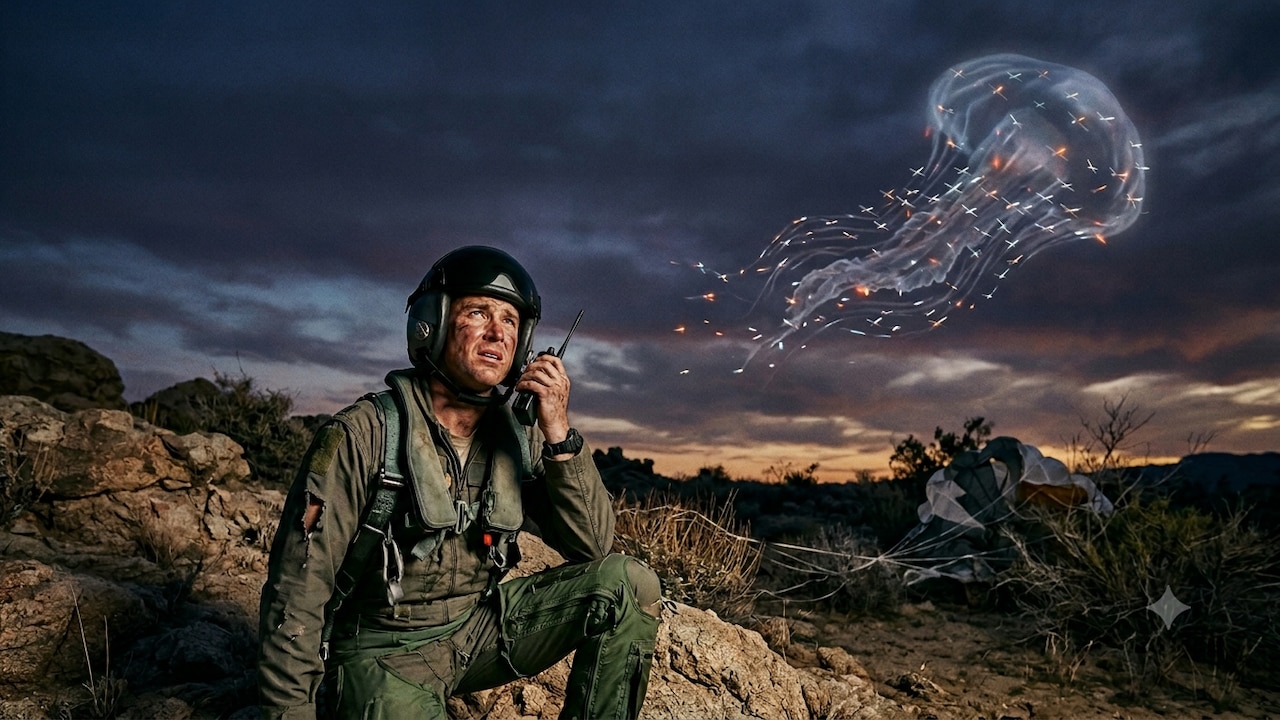
A US Air Force F-15E Strike Eagle pilot is flying a combat mission over Iran. It's April, the height of a brutal, weeks-long conflict. Suddenly, the sky ahead fills with something that doesn't look like standard military hardware. It looks like a living creature.
The pilot later described it to intelligence officials as a massive, synchronized cluster of aerial vehicles moving in perfect unison. Bigger aircraft hovered on top. Smaller ones dangled below, shifting like tentacles. The intelligence source who leaked the debrief to CNN put it bluntly: "Real alien sh*t."
This isn't a sci-fi pitch. It is a highly classified debriefing that has ignited a massive debate inside the Pentagon. The pilot called it a jellyfish formation. Others called it an airborne minefield. Shortly after spotting it, the F-15E went down. It was the first time an American fighter jet was shot down over Iranian territory during the conflict.
While the pilot was pulled out by US Special Forces within hours, his Weapons Systems Officer (WSO) had to play a high-stakes game of hide-and-seek in the Iranian mountains for over 36 hours before rescue commandos reached him. Now, the military is trying to figure out if the pilot saw a terrifying leap in military tech, or if a concussed airman was just seeing things in the desert sky.
The technical reality of one to many meshed networking
If the pilot's account is accurate, Iran just debuted a capability the US military did not think they had. In military tech circles, this is called one-to-many meshed networking.
Most traditional drone operations rely on a hub-and-spoke model. One operator controls one drone. Or, one ground station sends individual commands to a few distinct platforms. If you cut the signal from the ground station, the drone drops or goes home.
A meshed network changes everything. The drones talk to each other.
[Ground Command]
       │
       ▼
   [Lead Drone] ◄───► [Drone B]
       ▲                 ▲
       │                 │
       ▼                 ▼
   [Drone C]    ◄───► [Drone D]
In a true mesh swarm, a single operator can launch dozens of units. Once in the air, the drones form an autonomous data web. They share processing power, sensor data, and targeting info in real time. If you shoot down the lead drone, the remaining units instantly elect a new leader and keep moving toward the objective.
Military drone analyst Emma Bates pointed out the sheer danger of this approach. If a swarm can maintain a distinct physical shape, carry explosives, and hold back reserve units to strike whatever survived the first blast, it becomes an incredibly resilient weapon system. Defending against it requires massive amounts of money and technological counter-measures.
Was it a high tech swarm or a low tech trap
Pentagon officials are deeply divided on what actually brought down the multi-million-dollar Strike Eagle. There are two primary theories circulating through the intelligence community right now.
- The Autonomous Swarm Theory: Iran used advanced algorithmic coordination to block out the airspace, confuse the F-15E’s radar, and potentially detonate multiple warheads in close proximity to the jet. This would mean Iran, likely with engineering help from Russia and China, has bypassed years of Western electronic warfare defenses.
- The Dynamic Barrage Balloon Theory: Instead of a complex, AI-driven swarm, the jellyfish might have been a physical trap. Think of it as a modern, mobile version of the old World War II barrage balloons. If the drones were physically linked by high-strength cables, the F-15E could have simply flown into an invisible net of explosives. This requires almost zero computing power but achieves the exact same result: a downed American fighter.
China has been experimenting with similar aerial blockades to protect critical infrastructure. It is entirely possible Iran deployed a tactical variant of this concept to catch fast-moving Western jets off guard.
Why the Pentagon is skeptical of its own pilot
You have to look at the human element here. The US intelligence community isn't buying the jellyfish story wholesale. During the post-rescue debriefings, investigators explicitly asked the pilot if he was absolutely sure about what he saw.
They have good reasons to doubt the account. For starters, the pilot suffered a severe concussion during the ejection and subsequent crash. Brain trauma does strange things to visual memory, especially when mixed with the extreme stress of being shot down in enemy territory.
There is also the pilot’s recent track record. This April crash was actually the second time he was shot out of the sky during this war. Earlier in the conflict, his aircraft was brought down in a chaotic friendly fire incident involving the Kuwaiti military. Surviving two separate shootdowns in a matter of weeks leaves a psychological mark. The "alien" jellyfish formation could easily be a hallucination born of trauma, smoke, and distorted desert heat signatures.
Furthermore, the WSO who sat in the back seat of the exact same cockpit has not backed up the story. It is still unclear if the navigator even looked out the canopy at the same moment, leaving the pilot's wild account completely unverified by the only other eyewitness.
What happens next
The conflict has cooled down into a fragile 60-day ceasefire, but the frantic rush to analyze this incident hasn't stopped. US defense contractors are already looking at how to retool electronic warfare suites to counter meshed aerial networks.
If you want to track how drone warfare is shifting away from remote-controlled toys to fully autonomous swarms, keep an eye on upcoming Pentagon budget requests for directed-energy weapons (lasers) and high-power microwave counter-measures. Those are the only tools capable of frying a meshed network fast enough to protect a cockpit. The days of relying solely on standard anti-aircraft missiles to clear the skies are officially over.
Watch retired USAF analysts break down the tactical implications of the F-15 downing over Iran. This video provides an excellent visual breakdown of the operational strains US fighter crews faced during the spring campaign and why military planners are taking the jellyfish report seriously despite the skepticism.