The air inside the Basilica of Waldsassen doesn't smell like incense alone. It smells of damp stone, old wax, and the peculiar, metallic tang of cold gold. You walk past the pews, your footsteps echoing against the marble, and then you see him.
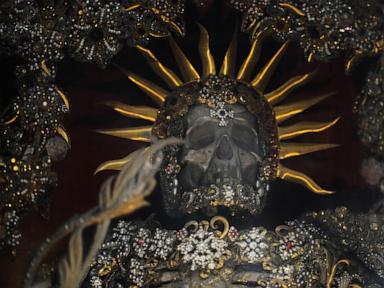
He is sitting upright in a glass casket. He wears a suit of armor plated in silver, his skeletal hands gloved in silk and encrusted with emeralds the size of walnuts. A laurel wreath of gold leaf rests atop his skull, and where his eyes once were, two massive rubies stare back at the living. He is a "Catacomb Saint." To a modern traveler, he looks like a fever dream or a prop from a high-budget horror film. To the villagers who have spent three hundred years kneeling before him, he is family.
We are taught to hide death. We tuck it away in sterile hospital wings and bury it under manicured lawns. But in the village churches of Upper Bavaria, death doesn't hide. It puts on its finest jewelry and invites you to tea.
The Great Relic Rush
In 1578, a vineyard worker in Rome accidentally broke through the earth and stumbled into a labyrinth of bones. These were the Catacombs, the ancient underground cemeteries where thousands of early Christians had been interred. At the time, the Catholic Church was reeling from the Protestant Reformation. Northern Europe was stripping its churches of statues and finery, decrying the "idolatry" of Rome. The Vatican needed a counter-strike. They needed proof of the miraculous.
They found it in the dirt.
A massive logistical operation began. Thousands of skeletons were hauled out of the Roman mud. Because they were found in the catacombs, the Church declared them martyrs, though in reality, most were likely just ordinary Roman citizens. It didn't matter. They were given names like St. Valentinus, St. Hyacinth, and St. Munditia. They were crated up and sent across the Alps to Germany, Switzerland, and Austria.
Think of it as a 17th-century spiritual stimulus package. These bones arrived in small, war-torn Bavarian villages as crates of dusty, brown fragments. But the locals didn't see dust. They saw hope. They saw a direct line to the divine that could protect their harvests and heal their children.
The Art of the Macabre
The bones arrived naked, but they didn't stay that way. The task of "dressing" the saints fell largely to nuns in local convents. These women spent decades—entire lifetimes—mastering the art of filigree. They didn't just wrap the bones; they resurrected them in splendor.
Imagine a sister named Maria in the year 1670. She sits by a narrow window, her fingers calloused from needlework. She takes a humerus bone and wraps it in the finest white silk. Then, she begins to sew. She attaches tiny silver wires, seed pearls, and glass beads. She creates "gauze flowers" that bloom from the ribcage. She places a ring on a skeletal finger, securing it with gold thread so it won't slip from the bone.
There was a profound intimacy in this work. These nuns were touching the very thing we fear most. They spent their days staring into the empty sockets of a skull, decorating those voids with velvet and lace. They weren't just decorating a corpse; they were dressing a bride for an eternal wedding.
The result was a specific aesthetic known as the Theatrum Sacrum—the Sacred Theater. The skeletons weren't meant to look realistic. They were meant to look like they were already enjoying the riches of heaven. They were advertisements for the afterlife.
A Crisis of Faith and Fashion
For over a century, these jeweled residents were the pride of Bavaria. Every village had its favorite skeleton. They were carried in processions through the streets, their gemstone eyes glinting in the sunlight. But the world changed. The Enlightenment arrived, bringing with it a newfound sense of "rationality" and a sudden embarrassment regarding the morbid.
By the late 18th century, the Emperor Joseph II—a man who preferred efficiency over mystery—ordered that these skeletons be removed. He viewed them as superstitious clutter. Suddenly, the saints who had protected the villages for generations were being ripped out of their altars.
Some were smashed. Others were stripped of their jewels and thrown into communal pits. In many cases, the villagers hid them. They tucked their beloved skeletons into attics, under floorboards, or behind false walls in the rectory. The "Holy Bodies" became outlaws.
There is a quiet tragedy in this era. Imagine the heartbreak of a village that had poured its meager wealth into the rubies for "their" saint, only to be told by a distant bureaucrat that their devotion was tacky. It was a clash between the heart and the head, between the tactile faith of the peasantry and the cold intellect of the ruling class.
The Return of the Bone-Keepers
Today, many of these saints have been brought back into the light. In places like the Church of St. Peter in Munich or the forest-shrouded chapels of the Bavarian hills, they have been restored. They sit behind reinforced glass, cleaned of centuries of dust, looking as vibrant and terrifying as they did in 1700.
Why does this matter to us now?
We live in a digital age where nothing is permanent. Our memories are stored on servers; our ancestors are names in a database. We are obsessed with youth, health, and the avoidance of any reminder that our bodies are temporary.
The Catacomb Saints of Bavaria offer a radical alternative. They suggest that death isn't the end of the story, but the beginning of a transformation. They argue that there is beauty in the breakdown. By dressing a skeleton in gold, the Bavarians weren't denying death; they were honoring it. They were saying: Even this, the most ruined part of us, is worthy of being loved.
Walking through these churches, you realize the skeletons aren't there to scare you. They are there to keep you company. In the village of Gars am Inn, the skeleton of St. Felix lies on his side, propped up on one elbow as if he’s leaning on a bar, casually watching the parishioners come and go. There is a strange, dark humor to it. It’s a wink from the grave.
The jewels are fake, of course. Most of the "emeralds" are just colored glass, and the "diamonds" are lead crystal. The gold is often just gilded copper. But the labor was real. The centuries of prayers whispered into the glass are real.
As you leave the cool darkness of the basilica and step back into the bright Bavarian sun, the world feels different. You look at your own hand—the skin, the pulse, the warmth—and you realize that underneath it all, you are carrying your own skeleton. It is a sobering thought, but in the presence of the jeweled saints, it is also a strangely comforting one. One day, we will all be bones. The question is whether we will have lived a life that anyone would want to decorate.
The saints stay behind in the silence, their ruby eyes wide open, waiting for the next traveler to stumble upon the beauty of the end.