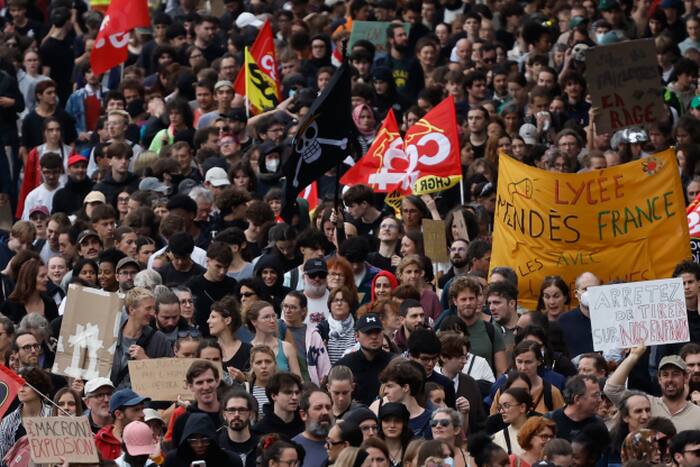
Every time streets fill with students in France, an ethics committee finds a microphone. Tell fans to sing, wave scarves, and leave their grievances at the turnstile. It sounds tidy. It reads well in a press release. It is also complete nonsense.
A stadium is not a vacuum. It is a pressure valve. When universities shut down, rent spikes, and young people feel locked out of the future, ninety minutes of football does not erase reality. It amplifies it. Asking supporters to check their civic lives at the gate ignores how crowds work, how French sports culture operates, and why governing bodies keep reaching for rules they cannot enforce. For an alternative perspective, consider: this related article.
The lazy consensus goes like this: sport unites people, politics divides them, so keep banners and chants off the terraces to protect the game. That argument relies on a fairy tale. Football in France has never stood apart from public life. Club identities, regional pride, working-class history, and state subsidies are woven into the sport's foundation. Pretending a chant about tuition or labor policy suddenly breaks some sacred neutrality misreads the room.
The Myth of the Neutral Terrace
Neutrality in sport is mostly an illusion sold by institutions that want predictable broadcasts and quiet sponsors. Look closely at what gets called "apolitical" and you will usually find state anthems, military flyovers, corporate logos, and public-private stadium deals. That is politics too. It is just the kind comfortable administrators prefer not to notice. Further analysis on this trend has been shared by CBS Sports.
When an ethics council urges supporters to stay focused on the match, it treats fans like passive consumers rather than citizens who bought a ticket. A crowd of thirty thousand people does not shed its frustrations because a committee publishes a statement. If tension is boiling outside the stadium, some of it will show up inside. Trying to ban the symptom while ignoring the fever is bad governance.
I have watched sports executives and league officials spend years and millions of euros trying to sanitize matchdays. They add stricter signage, threaten fines, and hold endless crisis meetings. Sometimes they get a quieter ninety minutes on television. Often they just push friction onto concourses, social media, or train platforms where security has even less visibility.
Why Ethics Panels Miss the Real Mechanics
To understand why these calls fall flat, start with the term itself. An ethics body in sports governance typically exists to set standards of conduct, protect integrity, and manage reputational risk for the league or federation. Notice what is missing from that job description: crowd psychology. Writing a code of conduct is easy. Getting thirty thousand people in a Kop to obey it during a national protest is another matter entirely.
Sociologists and crowd researchers—scholars like John Drury and Clifford Stott, who have spent decades studying crowd dynamics and public order—have shown repeatedly that heavy-handed or purely top-down bans often backfire when a group feels unfairly targeted. When supporters view a rule as illegitimate or hypocritical, compliance drops. Resistance becomes part of the identity of the stand.
Think about the incentives at play. A federation wants smooth operations, clean sponsor messaging, and zero diplomatic headaches. A student protester or activist fan wants visibility, solidarity, and momentum. Those goals collide directly during periods of social unrest. A polite request from an ethics panel does not change that math. It just reminds everyone who is trying to control the narrative.
Imagine a scenario where a club faces a massive student walkout outside the ground on matchday. Half the supporters in the standing section spent the afternoon marching over cost-of-living pressures. The PA announcer reads a reminder about keeping political slogans out of the stadium. Does the mood suddenly turn cheerful and docile? Or does that reminder itself become the spark that turns a routine chant into a point of defiance? Anyone who has stood near an ultras section in Lyon, Marseille, or Paris knows the answer.
The Questions People Are Actually Asking
When headlines like this hit, search behavior usually circles around a few predictable questions. Most of them start from a shaky premise.
Can stadiums really ban political expression?
On paper, leagues and clubs have stadium regulations, disciplinary codes, and sanction powers. In practice, enforcing a blanket ban on political expression inside a packed arena is a logistical headache. A single banner can be unfolded in seconds. A chant needs no fabric at all. Fines and partial stand closures exist, yet they often punish clubs financially while doing little to stop spontaneous crowd expression during nationwide protests.
Does politics ruin the match for regular fans?
Sometimes it annoys them. Sometimes it makes them leave early. Let's not pretend every fan wants a political rally on a Sunday night. Plenty of people go to football to escape stress, spend time with family, or watch a tactical battle. Dismissing that annoyance is dishonest.
At the same time, blaming protesters for ruining the atmosphere misses the bigger picture. When streets are blocked and campuses are tense, the mood outside already shapes the night. A match rarely feels "normal" during major civil unrest, no matter what the stadium code says.
What should clubs and governing bodies do instead?
Stop issuing lecture-style statements that sound disconnected from real life. Focus on safety, de-escalation, and clear lines between peaceful expression and actual harm—like hate speech, violence, or throwing objects onto the pitch. Those distinctions matter. Conflating a student protest chant with hooliganism or discrimination destroys credibility fast.
Clubs should also coordinate early with local authorities and supporter representatives rather than waiting for a flashpoint at the gates. Clear communication prevents panic. Moralizing from a distance rarely does.
Where This Contrarian Take Can Go Wrong
Push a contrarian argument too far and you create new problems. If you treat every stadium as an open political forum, matches can turn into proxy battlegrounds for rival factions. That is a real risk. Football clubs are not political parties, and most supporters do not buy season tickets to be recruited into a movement.
There is also a genuine legal and operational line to protect. Discriminatory abuse, incitement, and safety hazards have no place in a stadium. Treating all political speech as harmless overlooks how quickly heated crowds can cross into intimidation or disorder. Any realistic approach has to draw firm boundaries around safety and abuse without pretending you can outlaw every reference to current events.
Better Ways to Handle Matchday Friction
If you run a club, manage stadium operations, or advise sports leadership during turbulent times, lecturing fans is a waste of breath. Try a sharper playbook instead.
- Separate safety rules from opinion policing. Make crowd safety, anti-discrimination rules, and pitch protection non-negotiable. Stop wasting authority on vague bans against "politics" that nobody can define cleanly at 8:45 p.m.
- Talk to supporter groups before kickoff. Supporters' trusts and fan liaisons usually know the temperature of the stands hours before stadium staff do. Early dialogue lowers friction far better than a public scolding.
- Plan around transit and perimeter bottlenecks. Student protests often disrupt trains, buses, and surrounding streets. Adjust entry windows and perimeter staffing early so tension does not build in tight queues.
- Drop the corporate purity act. Own the fact that major sports events operate inside real cities with real social pressures. Calm, practical operations beat hollow appeals to neutrality every single time.
A stadium will always mirror the city around it. Pretend otherwise and you are just arguing with the crowd.