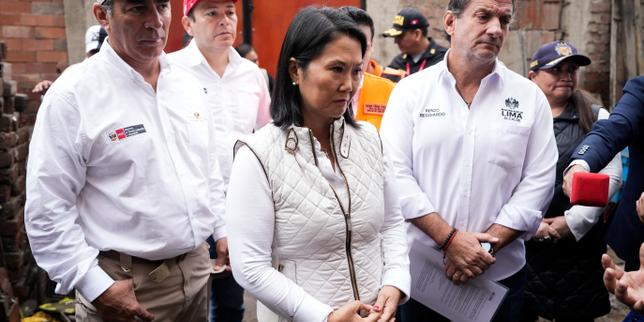
The lazy consensus in foreign press coverage of Latin America relies on a comforting, predictable script. When a right-wing figure loses an election, distant commentators write post-mortems about populist waves crashing against the shores of institutional stability. When Keiko Fujimori steps back into the political arena, the media reaches for the same worn-out template: the radical right struggles out of the gate, weighed down by authoritarian baggage and electoral fatigue.
They have misdiagnosed the entire dynamic.
Keiko Fujimori is not struggling because she lacks popular appeal or because her ideological platform fails to resonate with a polarized electorate. She is stuck in a permanent holding pattern because her entire political survival depends on losing. I have watched career political operatives engineer identical strategies across three continents, building institutional fiefdoms out of perpetual opposition while treating actual governance like an administrative hazard.
To understand Peruvian politics today, you have to stop looking at vote counts and start looking at business models.
The Perpetual Opposition Business Model
Let us dispense with the fiction that Fuerza Popular operates as a traditional political party aiming to reform the state. It is a family-branded holding company designed to protect legislative blocks, negotiate behind closed doors with shifting executive branches, and maintain a bedrock baseline of congressional power.
When international observers label her early stumbles as a sign of weakness, they mistake stagnation for defeat. A weakened executive and a fractured congress are not accidental bugs in the Peruvian system; they are the exact conditions under which a machine like Fujimorism thrives. Winning the presidency means taking ownership of a fragmented country with collapsing tax revenues, aggressive informal economies, and an angry populace ready to evict the sitting president within six months.
Why take the keys to a burning house when you can stand outside with a fire hose and charge rent for the shadow of shade?
Look at the mechanics of how power actually flows in Lima. The real leverage does not sit in the Palacio de Gobierno. It sits in congressional committees, judicial appointments, and backroom pacts that dictate who controls regulatory bodies. Fujimori does not need the executive sash to extract concessions from whoever happens to hold it. By keeping herself perpetually viable yet inherently un-electable to a narrow majority of the general population, she maintains absolute control over her party apparatus.
The Anatomy of an Electoral Ceiling
Conventional analysts love to blame her surname, pointing to the dark legacy of the 1990s authoritarian regime as an insurmountable ceiling. That explanation is lazy. Voters in emerging markets regularly forgive or ignore authoritarian pasts if the economy delivers stability and security.
The real ceiling is structural, not sentimental.
Fujimori relies on an anti-communist, law-and-order rhetoric that plays exceptionally well in Lima's affluent districts and specific regional pockets. But Peru is not Lima. The provinces—where mining conflicts, informal labor, and profound state neglect dictate daily life—view the Lima-centric political elite with absolute disdain. When a candidate preaches free-market orthodoxy to miners whose entire livelihood depends on the informal gold trade, the message does not just fall flat; it sounds like a threat.
To break that ceiling, a politician must offer an economic vision that bridges the formal and informal sectors. Fujimori refuses to do this because her financial backers belong to the old-guard corporate establishment that benefits from keeping the informal economy locked out of the banking and regulatory systems.
Here is the contrarian truth that Lima pundits refuse to print: Keiko Fujimori does not want to integrate the informal economy because the informal economy is ungovernable by traditional rules, and traditional rule-making is how her party stays relevant.
The Danger of Mistaking Stagnation for Irrelevance
Foreign headlines love to write obituaries for politicians who refuse to fade away. Do not make the mistake of assuming her sluggish political rhythm signals the death of her movement.
When a political actor holds a guaranteed thirty percent floor in a fractured multi-party system, they do not need a majority to dominate the board. They just need everyone else to be weaker and more divided than they are. With the left in total disarray, regional governors facing corruption probes, and public trust in the current administration hovering near zero, a stagnant Fujimori is the most powerful anchor in Peruvian politics.
She survives because the system is built to accommodate her brand of defensive obstructionism.
Stop waiting for her to pivot toward the center, and stop expecting a sudden ideological epiphany. She is playing a game of attrition, waiting for the country to exhaust itself into submission.
The danger is not that she will win the presidency and implement a radical right-wing revolution. The danger is that she never has to.