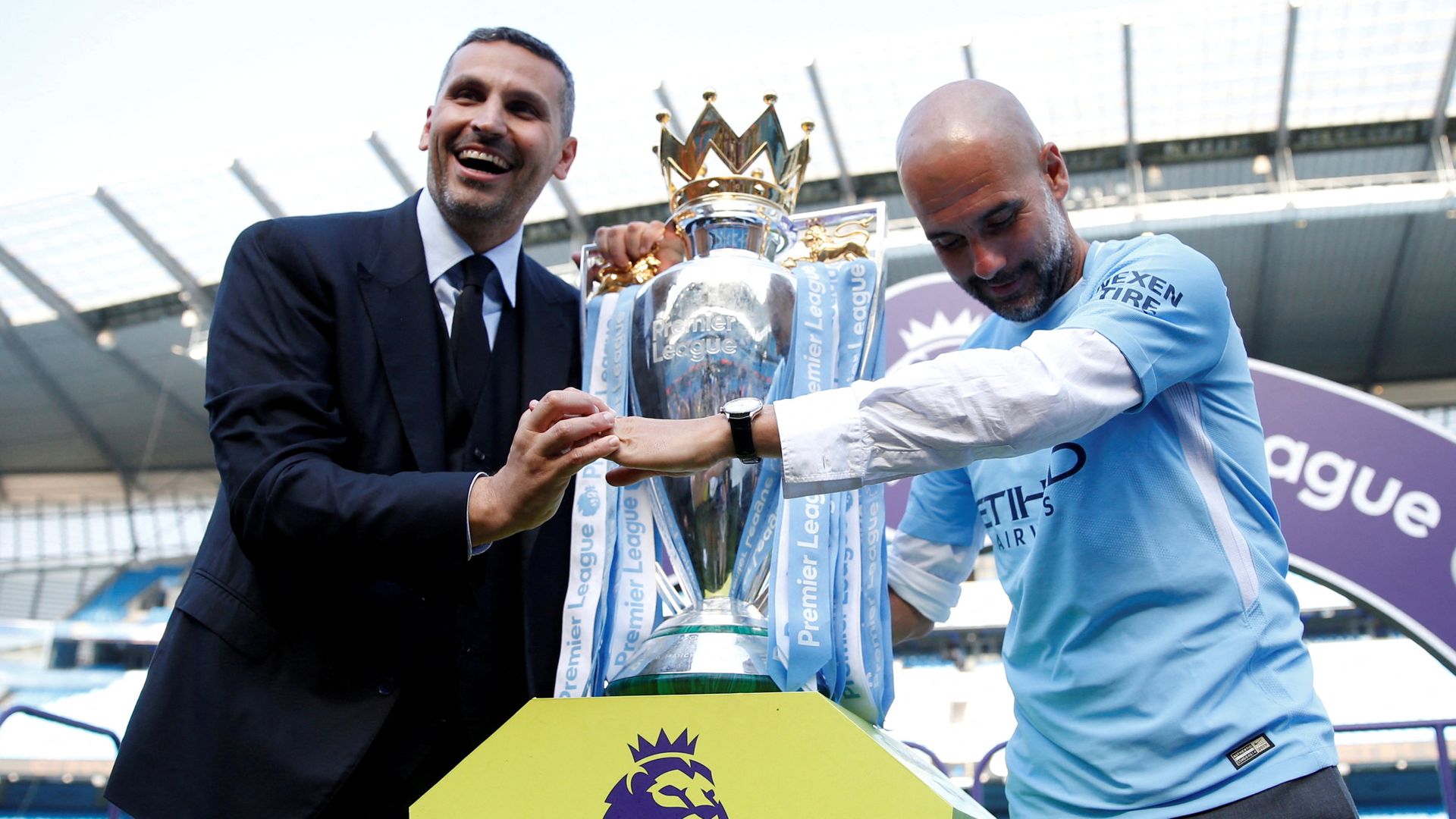
Khaldoon Al Mubarak is the chairman of Manchester City and City Football Group, a Tufts-educated Emirati operator who runs Abu Dhabi's Mubadala Investment Company and acts as the UAE’s presidential special envoy to China. Most football profiles treat him as a polished corporate executive who turned a perennial underachiever into a trophy machine. That reading misses the mechanics. Manchester City is not an independent business empire; it is a specialized statecraft and capital-allocation vehicle sitting inside a far larger sovereign apparatus.
Standard biographies recite his resume as if it were a LinkedIn feed: born in Abu Dhabi in 1976, son of diplomat Khalifa Al Mubarak who was assassinated in Paris in 1984 when Khaldoon was eight, raised with close royal proximity, economics and finance degree from Tufts University in 1997, early work at ADNOC and Tawazun, then the 2008 takeover of Manchester City alongside Sheikh Mansour. None of those dates explain why a man steering hundreds of billions in sovereign capital spends his summers in front of cameras explaining transfer windows and regulatory battles.
Why a Sovereign Operator Takes the Chair
Football clubs usually fail when billionaires treat them like toys. They also fail when private equity treats them like distressed manufacturing plants. Al Mubarak operates under a third logic: patient sovereign positioning.
When Sheikh Mansour bought Manchester City in 2008, the club was a mid-table English side with an aging stadium and limited global reach. Putting Al Mubarak in charge immediately signaled that this was not a celebrity vanity purchase. Al Mubarak had already helped bring Formula One to Abu Dhabi and sat inside the inner circle of Emirati economic planning. He knew how to negotiate with regulators, structure multi-year infrastructure builds, and manage Western media without flinching.
A football club cannot print sovereign wealth, yet it buys something oil money cannot buy on its own: daily habit formation in living rooms from Manchester to Melbourne.
Consider the structural split inside City Football Group. Under Al Mubarak’s chairmanship, the group expanded from a single English club into a multi-club network spanning New York, Melbourne, Girona, and other markets, culminating in Silver Lake buying a 10% stake for $500 million in 2019. That deal mattered less for the cash than for the validation. Wall Street money stamped a sovereign-backed sports holding company as institutional-grade intellectual property.
The Architecture Behind the Pitch
Look at how Al Mubarak runs the football side compared with Mubadala. At Mubadala, capital moves across semiconductors, aerospace, life sciences, and energy transition. Returns are measured in decades and geopolitical alignment. At Manchester City, the product is weekly emotional theater, and the scorecard is visible every Saturday.
Al Mubarak solved that tension by insulating football operations from royal mood swings. Rather than meddling in lineup choices, he delegated football architecture to specialists—most notably Txiki Begiristain and Pep Guardiola—while keeping boardroom authority tight. When results dipped or transfer targets fell through, Al Mubarak stepped forward as the calm, rehearsed voice of the club.
That public posture carries a deliberate edge. In 2025, Al Mubarak was still publicly insisting that the club’s intent to fight Premier League charges was unchanged, projecting institutional confidence even as legal pressure mounted. By 2026, scrutiny around City’s regulatory battles and boardroom brinkmanship sharpened, forcing observers to ask whether a hardline legal posture served the club or merely reflected Abu Dhabi’s habit of refusing to concede ground.
The Counter-Argument Nobody Wants to Make
Critics argue that Manchester City exists purely to launder Abu Dhabi’s reputation. That claim is too neat. Sportswashing assumes the audience is gullible and the investment is only about PR.
In reality, a multi-club network and a premier European brand give Abu Dhabi permanent soft-power plumbing. When Al Mubarak meets heads of state or sits in high-level diplomatic forums—whether managing UAE-China ties as presidential special envoy or representing Abu Dhabi in international policy rooms—Manchester City is background noise that humanizes the state. Even when journalists write critical stories about the club’s finances, the brand remains embedded in global youth culture.
Yet there is a flip side. The tighter City’s identity fuses with Abu Dhabi’s state apparatus, the harder it becomes to treat City like a normal business. If a private owner faces a regulatory crisis, they can sell the club, take a haircut, and move on. When a sovereign-linked chairman ties his personal credibility and his state’s prestige to an aggressive legal defense, retreat looks like weakness.
What Actually Separates Al Mubarak from Other Owners
Most football chairmen are either lifers from the game or financiers who never grasped why fans care about a corner kick in October. Al Mubarak sits in a rare middle zone. He treats football like infrastructure, yet he understands that infrastructure without emotional attachment is just concrete and grass.
Compare how he handles crises with how traditional owners react:
- Information control: He rarely leaks grievances to friendly columnists. Statements arrive measured, scripted, and legally vetted.
- Time horizon: Training facilities, academy pipelines, and global club acquisitions are planned on 10-to-15-year cycles, not single-season survival.
- Diplomatic compartmentalization: A rough week in English football does not stop him from chairing boards at Emirates Global Aluminium, Abu Dhabi Commercial Bank, or the Emirates Nuclear Energy Corporation.
Still, compartmentalization has limits. Legal verdicts, governance disputes, and changing regulatory rules in European football do not care about sovereign balance sheets. Even an operator who has navigated global diplomacy and multi-hundred-billion-dollar portfolios can misread how stubbornly a domestic sports regulator fights back.
The Overlooked Risk in the Boardroom
Suppose a mid-sized European club owner tried to copy Al Mubarak’s playbook—hypothetical example, since no private owner has sovereign backing—by building a multi-club feeder network and centralizing legal pushback. That owner would hit a wall fast. Multi-club structures only survive regulatory scrutiny when the parent entity has the balance sheet to absorb years of legal fees and dead-end assets.
For Al Mubarak, Manchester City has always been a high-visibility piece inside a massive portfolio. If the regulatory fallout drags on or forces structural compromises, the club’s sporting dominance could face real friction while Al Mubarak’s broader state roles roll on. That asymmetry is the real story behind the chair: the man running the club can afford to lose a football argument far more easily than the club itself.
Khaldoon Al Mubarak: From Tragedy to Global Leadership
This short profile traces how Al Mubarak’s early personal history and sovereign portfolio shaped his rise as Manchester City’s chairman.