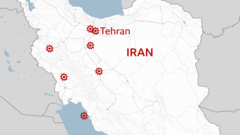
The shift from gray-zone proxy warfare to direct state-on-state kinetic exchange between Israel, the United States, and Iran represents a fundamental recalibration of Middle Eastern escalation dominance. This transition is defined not by the volume of ordnance, but by the systematic testing of Integrated Air and Missile Defense (IAMD) architectures and the exhaustion of deep-strike deterrents. To understand the geography of these strikes is to understand the math of "Calculated Proportionality"—a logic where every target selection serves as a data point in a broader signaling framework designed to degrade an opponent's capability without triggering a total theater war.
The Three Pillars of Kinetic Signaling
The exchanges throughout 2024 and early 2025 followed a rigid tripartite structure. Strategic actors do not strike randomly; they target specific functional nodes to communicate intent and capability limits.
- Sovereignty Penetration: Attacks on diplomatic facilities (the April 1 Damascus strike) or high-profile guests (the Haniyeh assassination in Tehran) serve as "threshold breakers." These acts force a response by challenging the fundamental internal security legitimacy of the target state.
- Defensive Saturation: Iran’s "True Promise" operations (I and II) were exercises in mass-to-target ratios. By utilizing a mix of slow-moving Shahed-136 loitering munitions, 30-series cruise missiles, and Emad/Ghadr ballistic missiles, Iran attempted to find the "Break-Even Point" where the cost of interceptors (SM-3, Arrow-3) exceeds the economic and inventory capacity of the defender.
- Counter-Force Degradation: Israel’s subsequent responses, specifically the October 2024 "Days of Repentance" operation, pivoted toward the "Blind and Bind" strategy. This involves the systematic destruction of S-300 PMU2 radar arrays and solid-propellant mixing facilities. The goal is to create a "Window of Vulnerability" where the opponent’s offensive production is capped while their defensive shield is structurally compromised.
The Geography of Attrition: Mapping Target Clusters
Strike maps reveal a deliberate focus on three geographic "Zones of Interest." Each zone corresponds to a specific rung on the escalation ladder.
The Isfahan-Natanz Core
This region represents the Iranian "Center of Gravity." It houses both the Natanz uranium enrichment facility and the 8th Shekari Air Base. When Israel targeted the S-300 radar protecting these sites in April 2024, it was an exercise in "Precision Messaging." By destroying a single high-value defensive asset without touching the nuclear infrastructure itself, Israel demonstrated that the path to the target was open, even if the target remained untouched for now. This creates a psychological "No-Fly Zone" over Iran's most sensitive assets.
The Missile Production Nexus (Parchin and Khojir)
The October 2024 strikes focused heavily on the Tehran periphery. Analysis of satellite imagery confirms the targeting of planetary mixers used for solid-fuel ballistic missiles. This is a "Temporal Strike"—it does not stop the missiles already in silos, but it creates a "Production Bottleneck." By destroying the specialized equipment required to mix fuel, Israel effectively placed a ceiling on Iran’s ability to replenish its stocks for 12 to 24 months.
The Levant Buffer
U.S. strikes in Iraq, Syria, and Yemen (against Houthi capabilities) function as "Peripheral Friction." These are designed to degrade the "Outer Ring" of Iranian defense. The use of B-2 Spirit bombers against hardened Houthi storage facilities in late 2024 signaled to Tehran that no amount of tunneling or mountain-fortification provides immunity against US Global Strike Command.
The Cost Function of Interception
A critical variable often ignored in standard reportage is the "Asymmetric Cost Ratio."
- Attacker Cost: A Shahed-136 costs approximately $20,000 to $50,000. A ballistic missile ranges from $100,000 to $1.5 million.
- Defender Cost: An Arrow-3 interceptor costs roughly $2 million to $3.5 million. A US-made SM-3 can exceed $10 million per unit.
This creates a "Depletion Trap." If Iran can force Israel and the US to expend their limited inventories of high-tier interceptors against relatively cheap salvos, they eventually achieve "Leaktage." Once interceptor stocks fall below a critical threshold, the defender must choose which cities or bases to leave unprotected. The maps of 2024 show Iran testing this threshold by targeting the Nevatim and Tel Nof airbases—sites critical for Israeli F-35 operations—aiming to degrade the defender's ability to launch a counter-offensive.
The Intelligence-Kinetic Feedback Loop
The efficacy of these strikes is entirely dependent on the "Detection-to-Engagement" cycle.
- The ISR Gap: Iran relies on a network of "Human Intelligence" and basic radar to track incoming threats.
- The Stealth Advantage: The 2,000 km sorties flown by Israeli F-35I Adir aircraft utilized standoff munitions (like the RAMPAGE and Blue Sparrow) that launch from outside Iranian radar coverage.
- Electronic Warfare (EW): Mapping the strikes reveals significant GPS jamming and "Spoofing" across the Zagros Mountains. This EW layer obscures the actual flight paths, forcing Iranian air defenses to remain active (emitting signals) and thus making them targets for Anti-Radiation Missiles (ARMs).
Structural Vulnerabilities in Iranian Air Defense
The mapping of Israeli strikes reveals a systematic dismantling of the "Integrated" portion of Iranian Air Defense. By removing the S-300 long-range "Eyes," Israel forced Iran to rely on shorter-range, domestically produced systems like the Khordad-15. These systems have lower engagement ceilings and are more susceptible to saturation.
This creates a "Cascading Failure" model:
- Phase 1: Blind the long-range sensors.
- Phase 2: Suppress the medium-range batteries.
- Phase 3: Operate with near-impunity in the low-altitude corridor.
The maps indicate that by early 2025, the "Integrated" nature of the defense was broken into "Point Defense" islands. Tehran could protect specific buildings, but it could no longer protect its entire airspace.
The Strategic Bottleneck: Solid Propellant and the "Long Game"
The most significant data point from the 2024 strikes was the surgical focus on "Industrial Chokepoints." Military power is a function of "Force-in-Being" (existing hardware) and "Rate-of-Replacement."
Israel’s choice to hit 12 planetary mixers in a single night was a move toward "Non-Nuclear Neutralization." Without these mixers, Iran cannot easily produce the solid-fuel motors required for the Fattah-1 or Kheibar Shekan missiles. This shifts the balance of power from a "Quantity" game to a "Time" game. Iran is now forced to either:
- Transition back to liquid-fuel missiles (which require longer launch prep times, making them vulnerable to pre-emptive strikes).
- Rely on external procurement (Russia or North Korea), which increases their geopolitical "Debt" and risk of interdiction.
Escalation Dominance and the "Red Line" Paradox
The current state of engagement has entered a "Deadlock of Deterrence."
Israel has demonstrated "Surgical Superiority"—the ability to hit any coordinate in Iran with sub-meter accuracy.
Iran has demonstrated "Saturation Capability"—the ability to penetrate the world’s most advanced air defense shield through sheer mass.
The "Red Line" has moved. Previously, a direct strike on the other's soil was unthinkable. Now, it is a localized norm. This creates a "New Equilibrium" where the risk of miscalculation increases because the "Buffer of Proxy" has been removed. The maps no longer show lines of influence; they show trajectories of direct impact.
The strategic play moving forward is the "Hardened Silo" vs. "Stealth Stand-off" race. Iran will prioritize the "Deep Burial" of its remaining industrial assets—moving mixers and assembly lines hundreds of meters underground. In response, the U.S. and Israel will likely pivot toward "Cyber-Kinetic Hybridization," where physical strikes are timed to coincide with the digital "Blinding" of internal facility sensors.
The theater has transitioned from a battle of maps to a battle of "Replacement Rates." The actor that can maintain their strike inventory while structurally degrading the other's production capacity wins the war of attrition. Israel’s current path suggests a commitment to the "Technological Decapitation" of Iran’s industrial-military complex, opting to fight the factory rather than the missile.