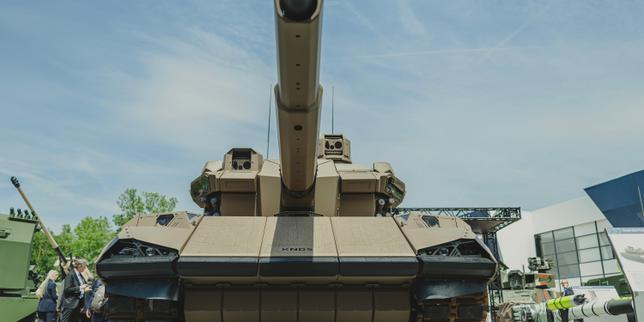
The financial press is currently swooning over the news that Germany is matching France’s stake in KNDS, framing it as the dawn of a unified European military-industrial complex and a golden ticket to a blockbuster stock market debut. They are completely wrong. What the consensus views as a historic step toward a high-yielding defense IPO is actually a structural deadlock masquerading as a corporate merger.
This isn't a agile defense giant preparing to conquer global markets. It is a politically paralyzed bureaucratic construct designed to burning shareholder value. Building on this idea, you can also read: Inside the Venezuelan Debt Crisis Nobody is Talking About.
For years, mainstream financial analysts have pushed the narrative that European defense consolidation is the only way to counter American hegemony in the arms market. They point to KNDS—the shotgun wedding of France’s Nexter and Germany’s Krauss-Maffei Wegmann (KMW)—as the prime example of this new era. The logic goes that by balancing the capital 50/50 between Paris and Berlin, the company eliminates national friction, stabilizes funding for the Main Ground Combat System (MGCS), and prepares a seamless path toward an initial public offering (IPO).
Let's dissect why this premise is fundamentally broken. Analysts at Bloomberg have provided expertise on this matter.
The 50/50 Capital Split is a Recipe for Paralysis
In the private equity world, a 50/50 joint venture between two fiercely nationalistic sovereigns is widely recognized as an operational nightmare. True corporate governance requires a tie-breaker. It requires a dominant shareholder capable of pivoting strategy, cutting redundant factories, and firing underperforming executives.
KNDS has none of that.
By hardcoding absolute parity into the capital structure, France and Germany have guaranteed perpetual veto warfare. Every major corporate decision—from supply chain sourcing to factory allocation—becomes a diplomatic incident. If Nexter wants to optimize turret production in Roanne, Munich will demand a quid pro quo for KMW’s Munich facilities.
I have watched defense contractors blow hundreds of millions of euros trying to appease dual-sovereign masters. The result is always the same: hyper-inflated engineering costs, redundant assembly lines, and products that are years behind schedule. The Eurofighter Typhoon and the NH90 helicopter are historical monuments to this exact flavor of cross-border mismanagement. KNDS is doubling down on a broken model and expecting a different outcome.
The Illusion of a Bourse Listing
The media is treating the equalization of shares as the key that unlocks the doors to the Frankfurt or Paris stock exchange. But ask yourself this: what sophisticated institutional investor wants to buy shares in a company where the two primary shareholders care more about local employment statistics and national prestige than return on equity (ROE)?
When a normal company goes public, investors buy into a clear growth strategy. With KNDS, any future minority shareholder will be structurally disenfranchised. You are not buying a piece of a high-growth tech firm; you are buying into a sovereign jobs program.
Consider the export paradox, which is the real structural flaw the markets are ignoring. France views defense exports as an instrument of foreign policy and an economic necessity; it will happily sell hardware to almost any state with a valid checkbook. Germany, driven by a deeply ingrained domestic political consensus, routinely imposes strict moralistic export bans on non-NATO countries.
If KNDS wants to sell the Leopard 2 A8 or the upcoming MGCS platform to a buyer in the Middle East or Asia, Berlin can unilaterally block the sale, tanking the company’s revenue projections overnight. No serious asset manager will tolerate a public company whose sales pipeline can be severed at any moment by a change in a single national parliament.
Dismantling the Main Ground Combat System Premise
The core justification for keeping this Franco-German marriage alive is the MGCS—the multi-billion-euro project to replace the French Leclerc and German Leopard 2 tanks. The public consensus assumes that state backing guarantees the project's commercial success.
This is a classic sunk-cost fallacy. The MGCS is already suffering from massive requirement creep. France wants a lighter, highly mobile platform tailored for rapid deployment, reflecting its operational history in Africa. Germany wants a heavily armored, defensive behemoth designed for a conventional, attritional clash on the European continent.
Trying to engineer a single platform that satisfies both doctrines results in a compromised, over-engineered piece of hardware that is too heavy for France and too expensive for Germany. More importantly, while Paris and Berlin argue over intellectual property rights and factory workloads, agile competitors are eating their lunch.
South Korea’s Hanwha Aerospace is the perfect example of what a real, focused defense business looks like. While KNDS was mired in structural restructuring, Hanwha swooped into Poland and secured massive multi-billion-dollar contracts for its K2 Black Panther tanks and K9 Howitzers. Why? Because they can deliver mass-produced, reliable hardware right now, without waiting for two sovereign nations to agree on a corporate charter.
The Brutal Reality for Investors
If you want exposure to the structural upswing in global defense spending, buying into a politically deadlocked Franco-German joint venture is the worst way to do it. The downsides to bypassing KNDS mean you might miss out on initial hype-driven spikes fueled by retail investors who buy into nationalistic headlines. But the long-term fundamentals are toxic.
Instead of chasing the illusory promise of a KNDS IPO, look at defense pure-plays with clean corporate governance and clear export freedom. Companies that operate within a single, decisive political framework can react to market demands in weeks, not the decades it takes to negotiate a bilateral treaty.
Stop asking when KNDS will hit the stock market. Start asking how much capital will be incinerated before politicians realize that you cannot run a competitive global business via a diplomatic committee.
The defense sector is facing a massive capital injection, but wealth will accumulate with the agile and the unencumbered. KNDS is neither. Do not get caught holding the bag when the reality of sovereign gridlock overrides the fantasy of European consolidation. Turn your back on the consensus, ignore the IPO hype, and allocate capital to entities that prioritize lethality and efficiency over diplomatic harmony.