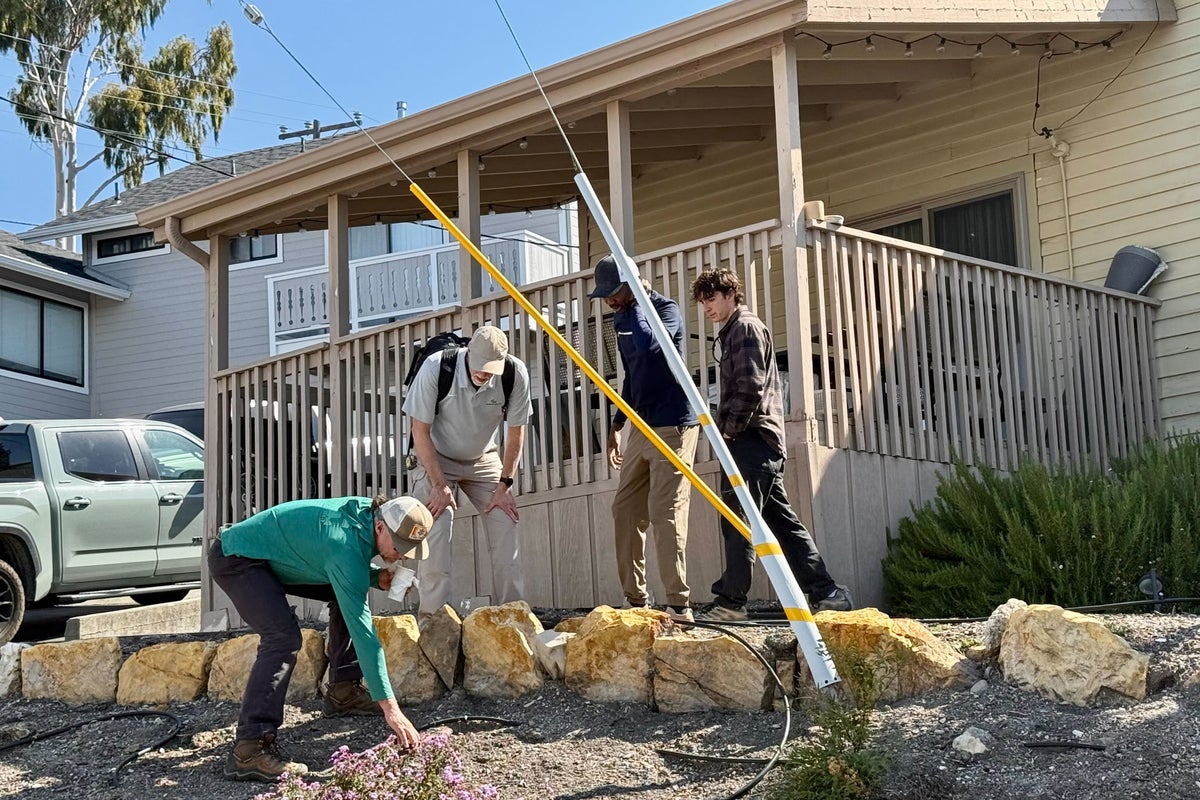
The San Luis Obispo County Sheriff’s Office is back at it. Another "update." Another "search." Another wave of headlines promising a 30-year mystery is finally on the brink of resolution.
It isn't.
The public loves a cold case breakthrough. We have been conditioned by true crime podcasts and Netflix docuseries to believe that justice is a linear progression toward a "missing piece" of evidence. We think if we just dig up one more backyard or scan one more hillside with ground-penetrating radar, the truth will materialize like a ghost in the machine.
This is a delusion. What we are witnessing in the Kristin Smart case isn't a search for the truth; it is a search for a conviction-saving miracle. Paul Flores is already behind bars. Ruben Flores was acquitted. The legal system has already squeezed what it can out of this tragedy. These new searches are less about forensic necessity and more about the optics of an agency trying to wash away decades of initial incompetence.
The Myth of the Missing Body
The "lazy consensus" among the public and the media is that finding Kristin’s remains is the final boss of this investigation. People believe that until her body is recovered, the case is "unsolved."
That is wrong. The case was solved in a courtroom.
In 2022, a jury found Paul Flores guilty of first-degree murder. They did so without a body. They did so by looking at the circumstantial evidence, the patterns of behavior, and the biological traces found under a deck. Legally, the recovery of remains is now a secondary concern.
So why the fanfare? Why the press releases?
Because the Sheriff’s Office is trapped in a cycle of forensic theater. When an investigation starts with the monumental failures that this one did in 1996—losing evidence, failing to search the prime suspect’s room for weeks, allowing the trail to go cold while the family pleaded for action—the agency spends the next thirty years overcompensating.
Every new shovel in the dirt is a PR move. It’s an attempt to say, "Look how hard we are working," to distract from the fact that they didn't work hard enough when it actually mattered.
The False Hope of Ground Penetrating Radar
Media outlets keep citing "new technology" as the catalyst for these searches. This is a favorite trope of lazy journalism.
Ground Penetrating Radar (GPR) and magnetometry are not magic wands. I have seen investigators spend hundreds of thousands of dollars on high-spec scanning only to find buried irrigation pipes and old dog bones. In a coastal environment like San Luis Obispo, where the soil has been shifted, built upon, and eroded for three decades, the "signatures" these tools pick up are often noise.
If there were a clear, undeniable signal of a human burial site on any of these properties, it would have been found during the massive 2021 push. To suggest that 2026 technology has suddenly made the "invisible" visible is a technical oversimplification.
The real constraint isn't technology. It's biology.
After 30 years in the earth—especially if the remains were moved, as the prosecution argued during the trial—the amount of recoverable DNA or even skeletal integrity is abysmal. We are talking about trace elements. We are talking about fragments that might not even provide the "closure" the public demands.
The Cost of Professional Obsession
There is a dark side to these "ongoing investigations" that nobody wants to talk about: the opportunity cost.
Resources are finite. Every hour a forensic team spends re-combing a site related to a solved murder is an hour they aren't spending on the dozens of active, unsolved disappearances in California that actually have a chance of being stopped in real-time.
We have turned the Kristin Smart case into a cultural monument. While her family deserves every ounce of peace they can find, the law enforcement agency has turned this into a "legacy project." It’s an obsession fueled by the need to fix a tarnished reputation.
I’ve seen departments drain their annual lab budgets on one high-profile cold case because the cameras are watching, while "boring" cases—those involving marginalized victims or less "marketable" storylines—sit in filing cabinets collecting dust.
Moving the Goalposts on Justice
The "People Also Ask" sections of the internet are flooded with queries like "Where is Kristin Smart buried?" and "Will they ever find her?"
These are the wrong questions.
The right question is: Why do we value the recovery of bones more than the finality of a conviction?
By focusing on the physical remains, we are inadvertently signaling that the jury’s verdict wasn't enough. We are playing into the defense’s hands by implying there is still a "mystery" to be solved. There isn't. Paul Flores killed her. That is a settled legal fact.
If we found her tomorrow, what would change?
- The Flores family wouldn't suddenly become more "guilty."
- The sentence wouldn't magically double.
- The trauma of the last 30 years wouldn't be erased.
The search has become an end in itself. It’s a bureaucratic ritual.
The Brutal Reality of Cold Case Evidence
Let’s talk about the logistics of these "new leads."
When an agency says they are "following up on information," it usually means one of two things:
- A "psychic" or "true crime sleuth" sent in a tip that sounds just plausible enough to require a check-box response to avoid a lawsuit.
- An informant in prison is trying to trade a vague story for a better meal plan or a transfer.
Rarely is it a smoking gun.
In the Smart case, the soil under the Flores deck showed "presence of human blood," but it was too degraded to extract a full DNA profile. That was the peak of the forensic evidence. Everything since then has been a hunt for diminishing returns. The earth does not preserve secrets forever; it dissolves them.
Stop Waiting for the Movie Ending
The public needs to stop expecting a "eureka" moment where a skeleton is unearthed and all the loose ends are tied up in a neat bow. Life isn't a procedural.
The Sheriff’s Office will continue to hold these briefings. They will continue to use words like "meticulous" and "exhaustive." They will continue to spend taxpayer money to prove they are the "good guys" now.
But make no mistake: the "30-year mystery" was solved by a gritty, difficult prosecution that relied on circumstantial evidence and witness testimony. The physical search is just the epilogue that won't end.
We are obsessed with the burial site because we can't handle the ambiguity of the void. We want a place to point to. We want a physical object to validate our outrage.
The search for Kristin Smart has moved out of the realm of criminal justice and into the realm of public relations. It is a performance designed to convince us that the system eventually works, even when it spent the first twenty years failing.
If you want to honor the victim, stop clicking on the "new search" headlines. They are empty calories. Focus on the fact that the man responsible is behind bars. That is the only "update" that actually matters.
The rest is just dirt.