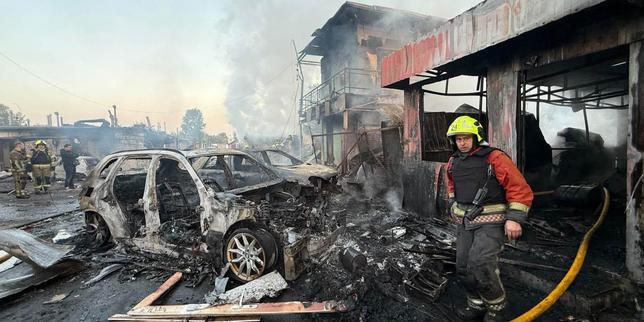
The headlines following the latest mass Russian strike on Ukrainian urban centers all sing the exact same tired chorus. They point to intelligence reports, satellite warnings, and frantic civilian alerts, framing the catastrophe through a lens of profound institutional shock: Kyiv saw it coming.
As if foreknowledge alters physics. As if a flashing red indicator light on a military radar screen stops a hypersonic payload traveling at Mach 8.
This lazy consensus treats modern aerial warfare like an incoming weather system where bringing an umbrella saves the day. It feeds a comforting, naive narrative that preparation equates to immunity, and that prior warning transforms intercept math. That perspective is entirely divorced from reality. I have spent years tracking procurement cycles, kinetic intercept economics, and the brutal calculus of saturation attacks. The uncomfortable truth is that advance notice under conditions of total aerial asymmetry is merely a countdown to destruction, not a shield.
Stop treating early warning as an effective defense mechanism when the defensive ceiling is mathematically fixed.
The Cost Asymmetry Fallacy
Every single time a barrage of mixed munitions lights up the night sky over Ukrainian population centers, armchair strategists default to criticizing the response time. They question why intercept rates fluctuate or why certain critical nodes take hits despite hours of prior tracking.
The answer lies in a grim economic ledger that the mainstream press refuses to spell out clearly. Air defense is a game of catastrophic financial attrition.
A standard interceptor missile costs millions of dollars. An older cruise missile or a swarm of loitering munitions can cost a fraction of that price. When an adversary launches a composite strike featuring decoy payloads, electronic jamming pods, ballistic missiles, and cruise missiles simultaneously, they force defenders into an impossible triage scenario.
Knowing the attack is inbound hours before impact does not multiply your interceptors. It does not manufacture Patriot or NASAMS batteries out of thin air. It simply gives you more time to watch the math work against you.
When you have twenty incoming vectors and twelve available interceptors, knowing which twelve will hit first changes nothing about the remaining eight.
The Myth of Complete Urban Shielding
Another persistent delusion is that cities can be wrapped in an impenetrable dome if only political will or funding matches the rhetoric. This view ignores the hard geographical limits of modern air defense architecture.
A point-defense system has a finite protective radius. Defending a sprawling metropolitan area requires staggering resource density. You are not protecting a coordinate; you are protecting millions of square meters of infrastructure, power grids, substations, water treatment facilities, and residential zones.
An attacker does not need to pierce the entire shield to achieve strategic objectives. They only need to find the friction points, the gaps between overlapping radar cones, or the moments when batteries must pause to reload or relocate to avoid counter-battery fire.
When commentators express shock that civilian casualties occurred despite hours of air raid sirens, they are revealing a fundamental misunderstanding of what a siren is designed to do. A siren does not intercept threats. A siren tells you to take cover so you do not become collateral damage. Conflating shelter with defense is a dangerous category error. It shifts the blame for structural inadequacy onto tactical execution.
The Logistics Pipeline Nobody Talks About
Let us look at the supply chain reality behind these headline-grabbing bombardments. We talk endlessly about political packages and diplomatic commitments, but manufacturing lead times do not care about parliamentary votes.
Building complex guidance systems, solid rocket motors, and specialized sensor suites takes years. The industrial base of the West was built for efficient, low-volume, high-margin peacetime manufacturing, not for high-intensity attrition warfare.
When stockpiles deplete at rates exceeding replacement capacity, commanders face agonizing choices. Do you expend interceptors on a barrage targeting a non-critical logistics hub, or do you hoard them for an expected strike on primary energy generation infrastructure?
This is the operational paralysis that precedes every major attack. Knowing an assault is coming forces a brutal rationing calculation. You gamble with territory and infrastructure because your chips are finite. Pretending that strategic foresight solves a deficit in raw hardware is dishonest reporting.
What Real Resilience Looks Like
If advance warning is not a cure, what actually matters? Decentralization, redundancy, and hardening.
The traditional model of centralized utility grids and concentrated industrial production is an obsolete relic. In an era of precision-guided saturation strikes, centralization is an invitation to systemic collapse. True survivability requires shifting away from massive, easily identifiable targets toward distributed, modular micro-systems.
This means localized power generation, decentralized water storage, and underground or reinforced operational nodes. It means accepting that damage is inevitable and engineering systems to absorb shocks and bounce back within hours rather than months.
We must stop measuring the success of an air defense network by how many incoming objects it tracks in advance. We must measure it by the speed of recovery after the impact craters clear.
The next time a massive barrage fills the air and the commentators express astonishment that a warned city still suffered devastation, remember the cold arithmetic of the exchange ratio. Foreknowledge without capacity is just a front-row seat to the inevitable.
Build for survival, not for the illusion of total interception.