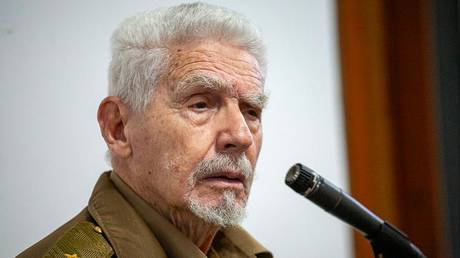
The humidity in Havana does not just sit in the air. It clings to your skin like a second coat of paint, heavy with the scent of salt water, exhaust fumes, and fermented sugar. On a crumbling concrete balcony overlooking the Malecón, an old man named Mateo watches the waves crash against the seawall. His transistor radio spits out static, followed by a voice that sounds like it has been dragged through gravel.
The announcement is brief. A name is spoken. A number follows. Ninety-four.
The giant has fallen.
For more than six decades, that single name dictated the rhythm of this island. It determined what Mateo ate for breakfast, what books his children read, and why his brother spent forty years in a cramped apartment in Miami instead of walking the cobblestone streets of Old Havana. Now, with a few words broadcast into the sticky afternoon air, that era is over. The last titan of the Cold War is dead.
To the outside world, this is a headline. It is a push notification on a smartphone, a cue for political pundits to argue about freedom, communism, and the long shadow of the twentieth century. But on the ground in Cuba, the news does not feel like politics. It feels like gravity suddenly shifted.
The Weight of an Echo
Walk down the Paseo del Prado today and you will see a city caught between centuries. Soviet-era Lada sedans rumble past pastel-colored colonial mansions that are slowly dissolving into dust. Children kick a deflated soccer ball against walls covered in faded revolutionary slogans.
For ninety-four years, the man who shaped this world was a constant presence. Even when he retreated from public view, his ghost inhabited every corner. His voice was the soundtrack to a thousand speeches. His choices were the architecture of daily survival.
Consider the reality of the Cuban kitchen. For decades, the libreta—the ration book—has been the ultimate arbiter of dinner. A few pounds of rice. A bag of beans. A splash of cooking oil. This was not just economics; it was a philosophy made edible. The state would provide, but only just enough to keep you standing.
Mateo looks down at his hands, calloused from years of cutting sugarcane in the fields of Camagüey. He remembers the early days, the intoxication of 1959. The promises of an island owned finally by its people. He also remembers the decades of scarcity that followed when the Soviet subsidies vanished overnight, leaving the country stranded in what was euphemistically called the Special Period.
Hunger is an effective teacher. It teaches you how to fix a 1954 Chevrolet with nothing but wire and a prayer. It teaches you how to make a meal out of orange peels. It creates a culture of genius mechanics and quiet desperation.
The Invisible Divide
The true tragedy of the modern Cuban story is not found in the history books. It is found at the international airport in José Martí, in the departures line.
Every family here is fractured. The revolution did not just change borders; it split tables down the middle. One cousin stayed to build the utopia. Another boarded a makeshift raft into the black waters of the Florida Straits. For sixty years, these two halves of the Cuban soul have been shouting at each other across ninety miles of ocean, their voices drowned out by the roar of politics.
Imagine a hypothetical family dinner where those two sides finally sit down. The conversation would not be about ideology. It would be about the missed birthdays, the funerals attended via a grainy WhatsApp video call, and the bitter realization that both sides lost something irreplaceable. The one who left lost his home. The one who stayed lost his youth.
The death of a ninety-four-year-old man will not magically stitch these families back together. The scars are too deep, the memories too sharp. But it removes the anchor. The old arguments suddenly feel like ancient history to a generation born after the fall of the Berlin Wall.
The Youth on the Seawall
As night falls over Havana, the younger generation gathers along the Malecón. They are not weeping in the streets, nor are they dancing. They are scrolling.
Through the blue light of cheap smartphones, they glimpse a world they are forbidden to touch. They see peers in Madrid and Mexico City starting businesses, traveling without permits, and speaking without looking over their shoulders. To a twenty-year-old in Havana, the grand speeches about imperialism and sacrifice sound like a foreign language. They do not want to be heroes of the revolution. They want to be normal.
The internet arrived late to Cuba, but when it did, it changed everything. It did not come through high-speed cables; it arrived in the form of El Paquete Semanal—the weekly package. This was a physical hard drive smuggled across the island, packed with American movies, Spanish soap operas, and downloaded websites. It was a digital black market that bypassed the censors and offered a window into the alternative universe of the twenty-first century.
The old regime built its power on a monopoly of information. When that monopoly crumbled, the foundation of the state began to shift. The death of the old icon is simply the final exclamation point on a sentence that was already written.
The Unwritten Future
What happens when the architect of a system disappears? The walls do not collapse immediately. The bureaucracy remains. The police still patrol the street corners. The old guard will try to maintain the illusion of permanence.
But illusions require a magician.
The street vendors in the tourist markets are already pivoting. They sell trinkets to Europeans and Canadians, counting their earnings in foreign currency while the national peso plummets in value. They know the truth that the politicians refuse to admit: the old system is dead; it just hasn't stopped breathing yet.
The air grows cooler as the tide comes in. Mateo turns off his radio. The static dies. He reaches into his shirt pocket and pulls out a single, hand-rolled cigar. It is rough, imperfect, and smells of rich, damp earth.
He strikes a match. The flame illuminates his wrinkled face for a second before the wind blows it out. He tries again, cups his hands, and inhales.
A cloud of blue smoke drifts out over the ocean, toward the north, disappearing into the dark sky. The city behind him is quiet, waiting for a morning that will look exactly like yesterday, but feel entirely different.