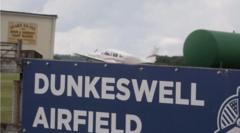
The sky above the airfield doesn't care about your bucket list. It is a vast, indifferent blue that offers no resistance until the moment it offers too much. On a typical Saturday, the air at a local drop zone smells of kerosene, crushed grass, and a specific brand of nervous adrenaline that makes grown men talk a little too loud.
He was 49. In the ledger of a human life, that is the age of accumulation. It is the era of knowing exactly how you like your coffee, finally understanding your parents, and perhaps, feeling the quiet itch to prove that the gravity of middle age hasn't fully taken hold.
He wasn't a statistic when he boarded the plane. He was a man with a gear bag, a waiver signed in a cramped office, and a heart rate that was likely thumping against his ribs in a rhythmic, prehistoric warning.
The Mechanics of a Dream
Skydiving is often sold as the ultimate freedom. We see the GoPro footage of smiling faces and the majestic curve of the earth. We don't see the physics.
When you step out of a perfectly functional aircraft at 12,000 feet, you are not flying. You are falling. You are a mass accelerating at $9.8 , \text{m/s}^2$ until you hit terminal velocity. At that point, the wind isn't a breeze; it is a solid wall. It screams past your ears at 120 miles per hour, a deafening roar that swallows every thought except the singular, visceral need to return to the dirt.
For the first forty seconds, the world is a blur of sensory overload. Then comes the pull. The transition from the chaos of freefall to the silent, swinging grace of an open canopy is supposed to be the moment of salvation. It is the point where technology tethers you back to the living.
But at a small airfield on a weekend that should have ended with a beer and a story, something in that mechanical prayer went unanswered.
The Invisible Stakes
We live in a culture obsessed with "safe" danger. We want the rush of the abyss without the teeth of the fall. We trust the nylon. We trust the riggers. We trust the decades of engineering that have turned a death-defying act into a commercial transaction.
Statistics tell us that skydiving is remarkably safe—roughly one fatality for every 100,000 jumps. You are statistically more likely to die driving to the grocery store to buy milk than you are while strapped to a parachute. Yet, statistics are a cold comfort when the exception to the rule is the person falling toward a patch of grass in front of horrified onlookers.
The investigation will look at the equipment. They will check the lines for twists. They will look at the "Aad"—the Automatic Activation Device designed to fire the reserve parachute if the diver is unresponsive. They will scrutinize the weather, the wind shear, and the 49-year-old’s final maneuvers.
But the technical report won't capture the silence that followed.
The Human Element
Imagine the people on the ground. There is always a group watching from the fence. They are families holding iPhones, instructors squinting through polarized sunglasses, and pilots waiting for the next load.
They see the multicolored specks appear in the high blue. They count them. One, two, three, four. They watch the slow, spiraling descent. They know the rhythm of a good landing—the flare, the running steps, the triumphant collapse of the silk.
When that rhythm breaks, the atmosphere changes instantly. The air goes heavy. The "thud" of a hard landing isn't just a sound; it’s a vibration felt in the soles of your feet. It is the sound of a human story being cut short in the middle of a sentence.
The first responders arrived at the airfield quickly. In these small aviation communities, everyone knows the drills. They know where the trauma kits are kept. They know how to clear the runway for the air ambulance. They did everything they were trained to do.
It wasn't enough.
Why We Keep Jumping
Why does a 49-year-old man decide to hurl himself into the void?
It isn't a death wish. It’s the opposite. It’s a life wish. It is the desire to feel the sheer, unadulterated scale of the world. To see the horizon without the interference of a window frame. To remind oneself that despite the mortgage, the back pain, and the slow march of time, we are still capable of being terrified and exhilarated all at once.
There is a profound vulnerability in skydiving. You are admitting that you are small. You are acknowledging that you are subject to the laws of motion. Most of the time, the earth welcomes us back with a gentle nudge.
Sometimes, it doesn't.
The airfield returned to a haunted kind of quiet after the sirens faded. The investigation will continue for weeks. Experts will pore over the "tapered" wings and the deployment sequences. They will categorize the tragedy under "equipment failure" or "pilot error."
None of those words describe the empty seat in a car in the parking lot. None of them explain the gear bag that now has no owner to carry it home.
We chase the clouds because we want to feel like we belong to something larger than our daily routines. We accept the risks because the alternative—a life lived entirely within the lines—feels like its own kind of fading away.
He died doing something that most people are too afraid to even dream of. He was 12,000 feet closer to the sun than the rest of us, right up until the moment he wasn't.
The parachute remains on the grass, a crumpled heap of vibrant color, waiting for a wind that will never lift it again.


